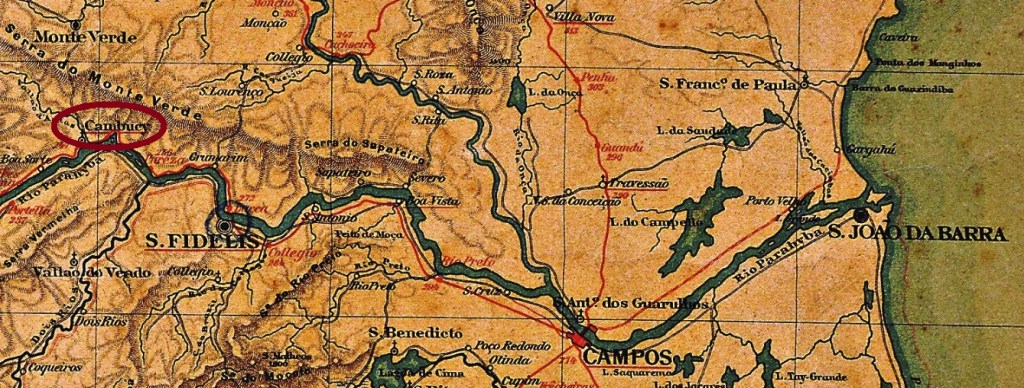
This station was inaugurated in July 1880 by the E.F. Santo Antonio de Padua Railway Company and was located on the north bank of the Paraíba do Sul River in the Município of São Fidélis, 300 km northeast of the capital Rio de Janeiro. The line changed hands in 1884 to E.F. Macahe e Campos, in 1887 to E.F. Leopoldina, and from 1975 until its closure in 1996 it belonged to Rede Ferroviária Federal S.A. (estacoesferroviarias.com.br). The name Vallão das Antas means Creek of the Tapirs, but from about 1886 the station was renamed Cambucy. The local jurisdiction changed to the Município of Monte Verde in May 1891, and since October 1918 Cambuci (as it is written today) has been an independent municipality.
As listed in the Directory of Imperial Post Offices (Tabella das Agencias do Correio do Imperio, Rio de Janeiro, 1885), there was a station post office from 1880. The imperial postmark from this is VRJ-0980a, as shown in the Paulo Ayres (Catálogo de Carimbos Brasil-Império, S. Paulo, 1937, 1942):

For postmarks with Cambucy (from 1886) see R. Koester: Carimbologia VIII.
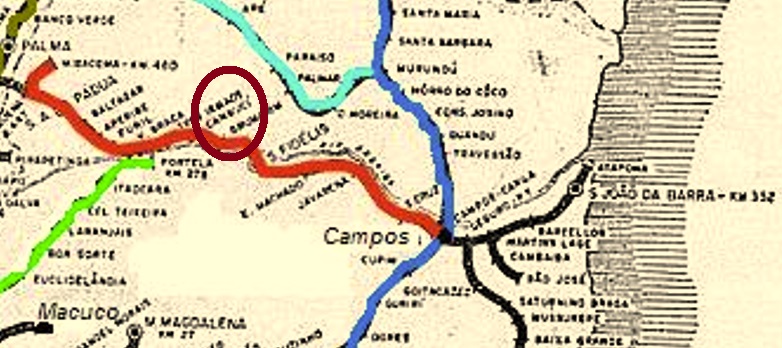
Dieser Bahnhof wurde im Juli 1880 durch die E.F. Santo Antonio de Padua Bahngesellschaft eingeweiht und lag im Município von São Fidélis, 300 km nordöstlich der Hauptstadt Rio de Janeiro entfernt. Die Linie wechselte 1884 zur E.F. Macahe e Campos, 1887 zur E.F. Leopoldina, und von 1975 bis zur Stilllegung 1996 gehörte sie der Rede Ferroviária Federal S.A. (estacoesferroviarias.com.br). Der Name Vallão das Antas bedeutet Graben der Tapire, aber ab ca. 1886 hieß der Bahnhof Cambucy. Die Ortszuständigkeit wechselte im Mai 1891 zum Município von Monte Verde, und seit Oktober 1918 ist Cambuci (wie man es heute schreibt) ein eigenständiger Município.
Wie im Verzeichnis der kaiserlichen Postämter (Tabella das Agencias do Correio do Imperio, Rio de Janeiro, 1885) aufgelistet, gab es ein Bahnhofspostamt ab 1880. Das kaiserliche Poststempel davon ist VRJ-0980a, wie im Paulo Ayres (Catálogo de Carimbos Brasil-Império, S. Paulo, 1937, 1942) abgebildet:

Für Poststempel mit Cambucy (ab 1886) siehe R. Koester: Carimbologia VIII.

 Carimbologia