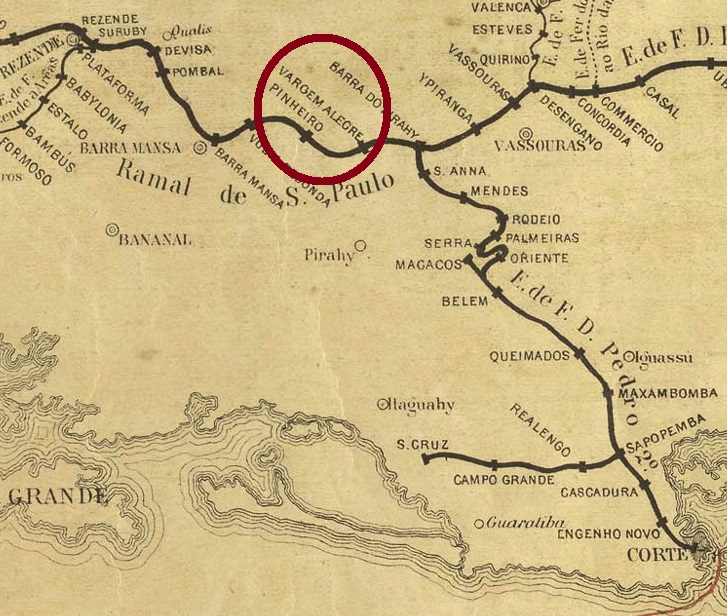
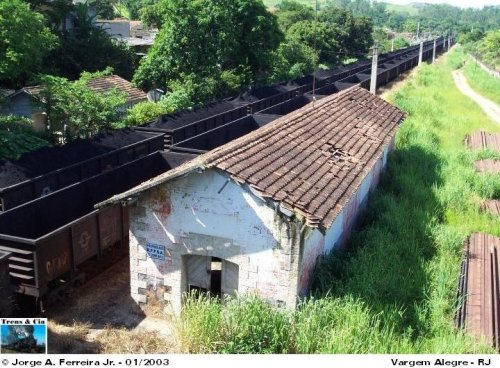
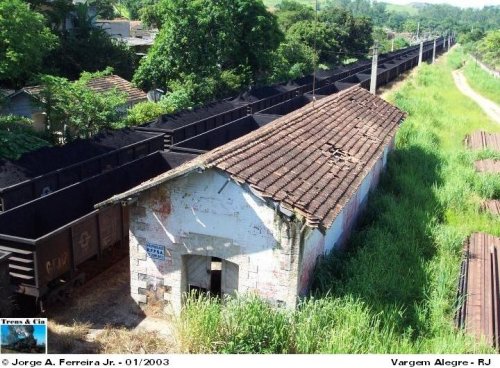
Vargem Alegre (Happy Meadow) station was inaugurated in January 1871 by the E.F. Dom Pedro II Railway Company (São Paulo Branch) and was located near on the Paraiba do Sul River in the Município of Barra do Pirahy, 120 km northwest of the capital Rio de Janeiro. The railway line changed hands with the Republic in 1889 to E.F. Central do Brasil and from 1975 until the line was closed in 1996 it belonged to Rede Ferroviária Federal S.A. (estacoesferroviarias.com.br). Today, the station building is in ruins:
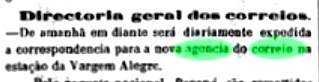
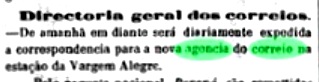
The station post office began operations in February 1871, according to the Rio press:
The first station postmark is VRJ-1720a (Col. José A. Junges): a double circle with the inscription VARGEM ALEGRE and a diamond ornament below. The only specimen found has an illegible date on the stamp, but it was used on a D. Pedro issue of 1883. Paulo Novaes shows the following ones in agenciaspostais.com.br. VRJ-1720b (Coll. José A. Junges) is a double circle with the inscription VARGEM=ALEGRE above and an ornament in lozenge below, the four sides of which are open. In the double circle VRJ-1720c (agenciaspostais.com.br) the strokes between VARGEM and ALEGRE above are missing and the ornament in lozenge below seems to be formed by four small lozenges. In inner dates go from 1885 to 1897, which raises doubts about the attribution of this cancel.
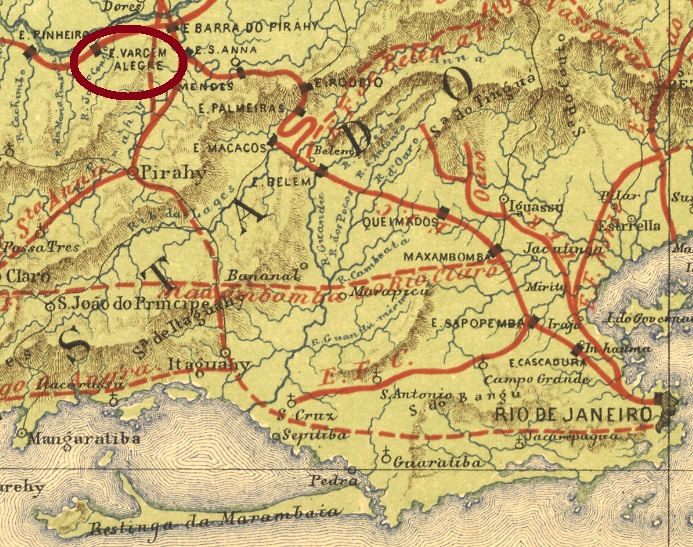
Der Bahnhof Vargem Alegre (Fröhliche Aue) wurde im Januar 1871 durch die E.F. Dom Pedro II Bahngesellschaft (São Paulo Abzweigung) eingeweiht und lag direkt am Fluss Paraiba do Sul im Município von Barra do Pirahy, 120 km nordwestlich der Hauptstadt Rio de Janeiro entfernt. Die Bahnlinie wechselte 1889 mit der Republik zu E.F. Central do Brasil und von 1975 bis zur Streckenstilllegung 1996 gehörte sie der Rede Ferroviária Federal S.A. (estacoesferroviarias.com.br). Heute ist das Bahnhofsgebäude eine Ruine:
Das Bahnhofspostamt nahm im Februar 1871 den Betrieb auf, wie die Presse aus Rio mitteilte:
Der erste Bahnhofsstempel ist VRJ-1720a (Samml. José A. Junges): ein Doppelkreis mit der Inschrift VARGEM ALEGRE und einem Rauten- Ornament darunter. Das einzige gefundene Exemplar hat ein unleserliches Datum auf dem Stempel, aber es wurde auf einer D. Pedro-Ausgabe von 1883 verwendet. Paulo Novaes zeigt in agenciaspostais.com.br die darauf folgenden. VRJ-1720b (Samml. José A. Junges) ist ein Doppelkreis mit der Inschrift VARGEM=ALEGRE oben und einem Ornament in Raute unten, deren vier Seiten offen sind. Daten in der Mitte von 1885 bis 1888. Beim Doppelkreis VRJ-1720c (agenciaspostais.com.br) fehlen die Striche zwischen VARGEM und ALEGRE oben und das Ornament in Raute unten scheint durch vier kleine Rauten gebildet zu sein. In inneren Daten gehen von 1885 bis 1897, was Zweifel an der Zuordnung dieses Stempels weckt.

 Carimbologia