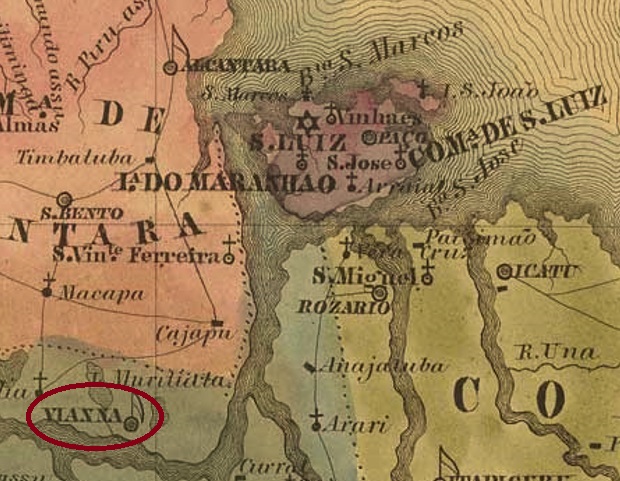
Another name: Aldeia de Maracu
The former settlement called Aldeia de Maracu was beautifully situated on the west bank of the river Mearim, 220 km south of the future provincial capital São Luis, between the lakes of Vianna and Aquari. It became the Freguesia de N. Sra. da Conceição de Vianna in June 1757 and a Vila the very next month. Since June 1855, Viana – as it is written today – has been a town.
Two dates of foundation were found for the local post office. First in March 1830, as Nova Monteiro writes in Administrações e Agencias Postaes do Brasil Imperio (in Brasil Filatelico/RJ, 1934-5; Reprint SPP 1994-1999). Then again in October 1833, as can be read in both the Directory of Imperial Post Offices (Tabella das Agencias do Correio do Imperio, Rio de Janeiro, 1885) and the Postal Report (Relatorio Postal) for 1887.
The imperial postmark is VMA-0285a (Coll. Fuad Ferreira Fo.): a double oval typical of the province of Maranhão with the inscriptions CORREIO (above), DO (in the middle) and VIANNA. (below), plus ornaments on the right and left. So far, examples have been found on stamp issues from 1850 to 1876.
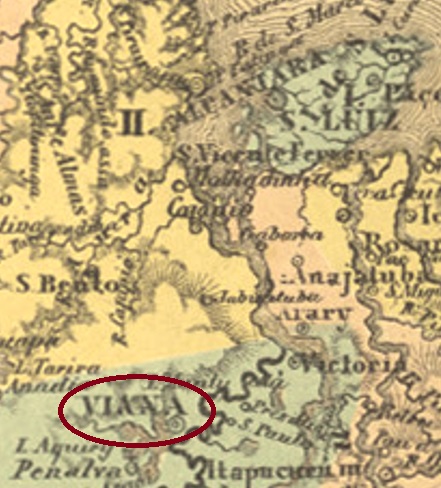
Anderer Name: Aldeia de Maracu
Die frühere Siedlung namens Aldeia de Maracu lag schön am Westufer des Flusses Mearim, 220 km südlich der künftigen Provinzhauptstadt São Luis, zwischen den Seen von Vianna und Aquari. Sie wurde zur Freguesia de N. Sra. da Conceição de Vianna im Juni 1757 und zur Vila gleich im folgenden Monat. Seit Juni 1855 ist Viana – wie man heute schreibt – eine Stadt.
Zwei Gründungsdaten wurden fürs örtliche Postamt gefunden. Erstmals im März 1830, wie Nova Monteiro in Administrações e Agencias Postaes do Brasil Imperio (in Brasil Filatelico/RJ, 1934-5; Reprint SPP 1994-1999) schreibt. Dann wieder im Oktober 1833, wie sowohl im Verzeichnis der kaiserlichen Postämter (Tabella das Agencias do Correio do Imperio, Rio de Janeiro, 1885) als auch im Postbericht (Relatorio Postal) für 1887 zu lesen ist.
Der kaiserliche Poststempel ist VMA-0285a (Samml. Fuad Ferreira Fo.): eine für die Provinz Maranhão typische Doppelovale mit den Inschriften CORREIO (oben), DO (in der Mitte) und VIANNA. (unten), dazu Ornamente rechts und links. Bisher wurden Exemplare auf Markenausgaben von 1850 bis 1876 gefunden.

 Carimbologia