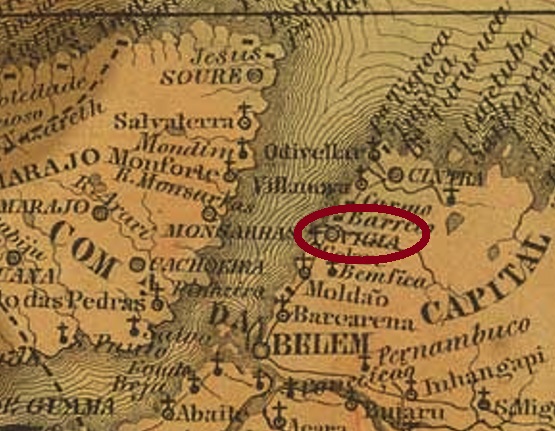
Another name: Uruitá
The Portuguese word Vigia means guard. So, the strategically located Indian settlement of Uruitá became a guard post of the colonial power to put a stop to robbers and smugglers. As early as 1693, the freguesia of N. Sra. de Nazareth da Vigia was established on the east bank of the Furo da Laura (Laura’s Waterway), 100 km north of the future provincial capital Belém do Pará. Five years later, the place was already a vila, which was elevated to a town in October 1854.
Two dates of origin for the local post office were found. The first one was around 1855, as can be read in the provincial president’s report for May of that year:
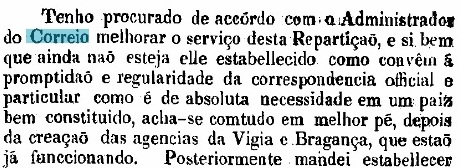
Then again in July 1858, as Nova Monteiro writes in Administrações e Agencias Postaes do Brasil Imperio (Brasil Filatelico/RJ, 1934-5; Reprint SPP 1994-1999). Only one imperial postmark has been found so far, unfortunately not the oldest. The French type VPA-0245b (Coll. Karlheinz Wittig) shows the inscription VIGIA in a double circle at the top and the typical star between brackets at the bottom. Dates in the middle were found for 1886-1888.
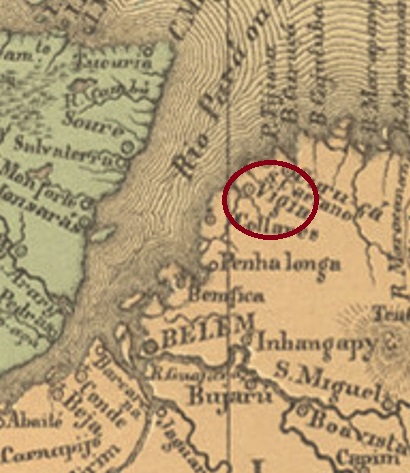
Anderer Name: Uruitá
Das portugiesische Wort Vigia bedeutet Wache. Also wurde aus der strategisch gelegenen Indianersiedlung Uruitá ein Wachposten der Kolonialmacht, um Wegelagerern und Schmugglern das Handwerk zu legen. Bereits 1693 entstand die Freguesia von N. Sra. de Nazareth da Vigia am Ostufer des Furo da Laura (Lauras Wasserweg), 100 km nördlich der künftigen Provinzhauptstadt Belém do Pará entfernt. Fünf Jahre später war der Ort bereits eine Vila, die im Oktober 1854 zur Stadt erhoben wurde.
Zwei Entstehungsdaten fürs örtliche Postamt wurden gefunden. Erstmals ca. 1855, wie aus dem Bericht des Provinzpräsidenten für Mai d. Js. zu entnehmen ist:
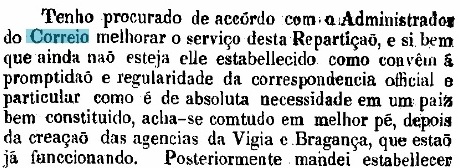
Dann wieder im Juli 1858, wie Nova Monteiro in Administrações e Agencias Postaes do Brasil Imperio (Brasil Filatelico/RJ, 1934-5; Reprint SPP 1994-1999) schreibt. Nur ein kaiserlicher Poststempel wurde bisher gefunden, leider nicht der älteste. Der französische Typus VPA-0245b (Samml. Karlheinz Wittig) zeigt oben im Doppelkreis die Inschrift VIGIA, unten ist der typische Stern zwischen Klammern zu sehen. Bisherige Daten in der Mitte: 1886-1888.

 Carimbologia