See also Guaratinguetá (R. Koester: Carimbologia XXI)
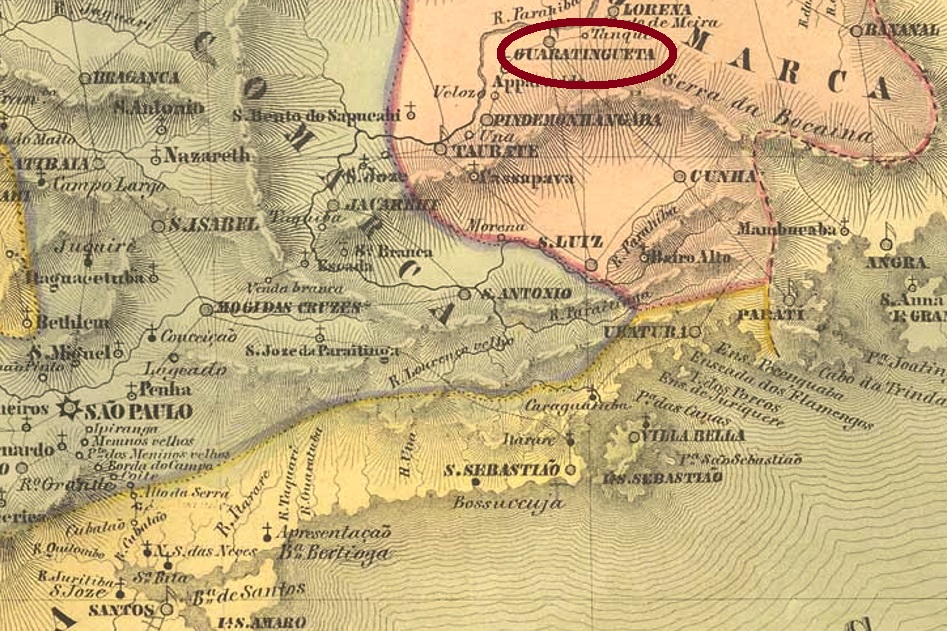
The freguesia of Santo Antonio de Guaratinguitá was mentioned in documents as early as 1630, belonged to the Vila of Taubaté and was situated on the south bank of the river Paraíba do Sul, 180 km northeast of the later provincial capital São Paulo. As early as 1657, the place was elevated to the status of a vila, but it was not until January 1844 that Guaratinguetá (as it is written today) was granted the status of a city. The name from the Tupi-guarani language means many white herons.
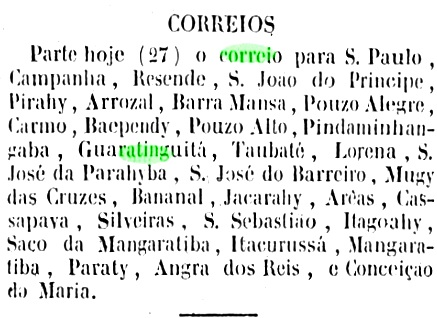
In the Directory of Imperial Post Offices (Tabella das Agencias do Correio do Imperio, Rio de Janeiro, 1885) we read that there had been a post office there since 1847. This cannot be the beginning of the first period of operation, because there are many cancelled letters from earlier years. As was the case in larger municipalities along the Paraíba-do-Sul valley, there was probably a postal system here before the establishment of the imperial post office, which was probably organised by the provincial government. Whatever, regular postal connections between Rio de Janeiro and Guaratinguetá already existed in January 1842:
The first postmarks were already presented by Paulo Ayres in Catálogo de Carimbos Brasil-Império (S. Paulo, 1937, 1942). However, they have the same spelling mistake, which is why they are shown here with the corrected version. VSP-1775a also occurs in red-brown, was in use from 1837 to at least 1844 and corresponds to Paulo Ayres’ No. 1527:

The following VSP-1775b also exists in red, it was in use from about 1843 to at least 1852 and corresponds to P. Ayres’ No. 1528:

For later postmarks with the inscription GUARATINGUETÁ see R. Koester, Carimbologia XXI.
Siehe auch Guaratinguetá (R. Koester: Carimbologia XXI)
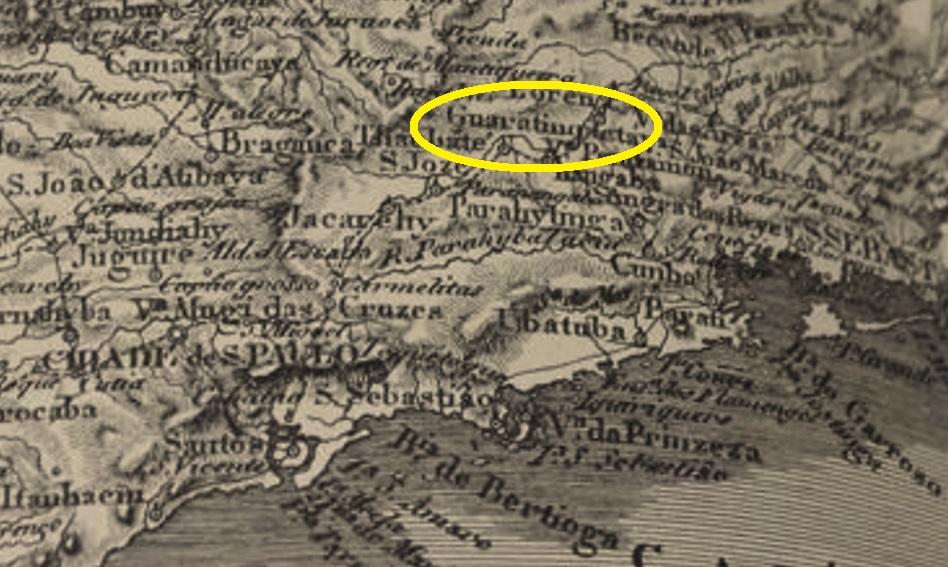
Die Freguesia von Santo Antonio de Guaratinguitá wurde bereits 1630 urkundlich erwähnt, gehörte der Vila von Taubaté und lag am Südufer des Flusses Paraíba do Sul, 180 km nordöstlich der späteren Provinzhauptstadt São Paulo entfernt. Bereits 1657 wurde der Ort zur Vila erhoben, aber erst im Januar 1844 erhielt Guaratinguetá (wie es heute geschrieben wird) den Status einer Stadt. Der Name aus der Tupi-guarani-Sprache bedeutet viele weiße Reiher.
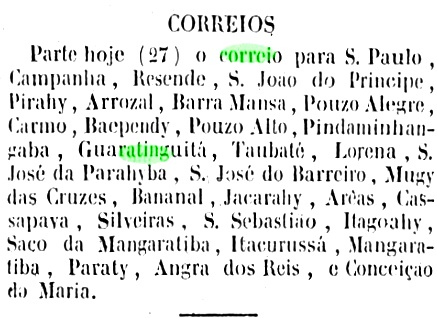
Im Verzeichnis der kaiserlichen Postämter (Tabella das Agencias do Correio do Imperio, Rio de Janeiro, 1885) liest man, dass es dort seit 1847 ein Postamt gab. Das kann nicht der Anfang der ersten Betriebsperiode sein, denn es gibt viele gestempelten Postsendungen aus früheren Jahren. Wie es in größeren Gemeinden entlang des Paraíba-do-Sul-Tals der Fall war, gab es wohl auch hier ein Postwesen vor der Einrichtung des kaiserlichen Postamts, das vermutlich von der Provinzregierung organisiert wurde. Wie es dem auch sei, reguläre Postverbindungen zwischen Rio de Janeiro und Guaratinguetá gab es bereits im Januar 1842:
Die ersten Poststempel wurden bereits durch Paulo Ayres in Catálogo de Carimbos Brasil-Império (S. Paulo, 1937, 1942) vorgestellt. Allerdings haben sie den gleichen Schreibfehler, weswegen sie hier mit der jeweils korrigierten Version gezeigt werden. VSP-1775a kommt auch in Rotbraun vor, war von 1837 bis mindestens 1844 in Gebrauch und entspricht Paulo Ayres’ Nr. 1527:

Den Nachfolgestempel VSP-1775b gibt es auch in Rot, er wurde von ca. 1843 bis mindestens 1852 verwendet und entspricht P. Ayres’ Nr. 1528:

Für spätere Poststempel mit Inschrift GUARATINGUETÁ siehe R. Koester, Carimbologia XXI.

 Carimbologia