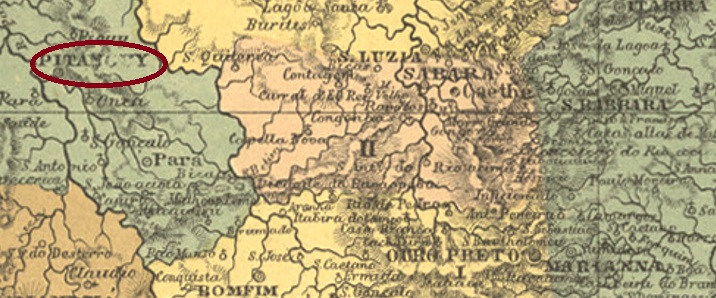
See also Pitangui (R. Koester: Carimbologia XXXI)
This settlement arose in the 17th century after gold miners found the precious metal at Descoberto Mountain, over 200 km northwest of the later provincial capital Ouro Preto. The village grew so rapidly that villa status was achieved in February 1715 as Villa Nova do Infante das Minas do Pitangui, nine years earlier than the designation as Freguesia of N. Sra. do Pilar de Pitangui. Pitangui has been a town since May 1855.
Two years of origin for the local post office could be found. First in March 1798, as Paula Sobrinho writes in História Postal de Minas Gerais (Belo Horizonte, 1997). Then again in March 1829, as R. Koester reports in Carimbologia XXXI. VMG-3785a is so far the oldest cancel; it also occurs in sepia, brown and green between 1836 and 1848 and was already presented by Paulo Ayres in Catálogo de Carimbos Brasil-Império (S. Paulo, 1937, 1942) under no. 1164 and also in the RHM catalogue under P-MG-46. Since the spelling erroneously shows a Y (instead of I), here are both images:

Later postmarks bear the place name Pitangui or Pitanguy, without mentioning Villa.
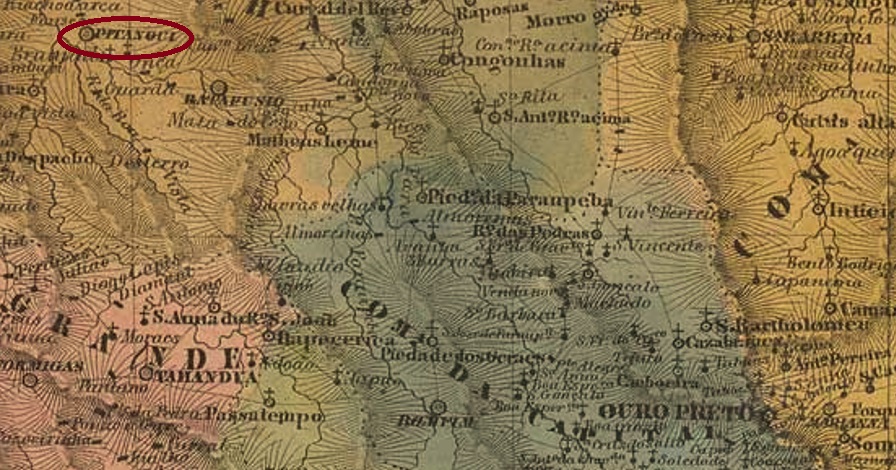
Siehe auch Pitangui (R. Koester: Carimbologia XXXI)
Diese Siedlung entstand im 17. Jahrhundert, nachdem Goldgräber das Edelmetall am Descoberto-Berg gefunden haben, über 200 km nordwestlich der späteren Provinzhauptstadt Ouro Preto entfernt. Die Ortschaft wuchs so rasch, dass der Villa-Status im Februar 1715 als Villa Nova do Infante das Minas das Minas do Pitangui erreicht wurde, neun Jahre früher als die Ernennung zur Freguesia von N. Sra. do Pilar de Pitangui. Seit Mai 1855 ist Pitangui eine Stadt.
Zwei Entstehungsjahre fürs örtliche Postamt waren zu finden. Erstmals im März 1798, wie Paula Sobrinho in História Postal de Minas Gerais (Belo Horizonte, 1997) schreibt. Dann im März 1829, wie R. Koester in Carimbologia XXXI berichtet. VMG-3785a ist bisher der älteste Stempel; er kommt auch in sepia, braun und grün zwischen 1836 und 1848 vor und wurde bereits von Paulo Ayres in Catálogo de Carimbos Brasil-Império (S. Paulo, 1937, 1942) unter Nr. 1164 und auch im RHM-Katalog unter P-MG-46 vorgestellt. Da die Schreibweise irrtümlich ein Y (statt I) zeigt, hier beide Abbildungen:

Spätere Poststempel tragen die Ortsbezeichnung Pitangui oder Pitanguy, ohne Villa zu erwähnen.

 Carimbologia