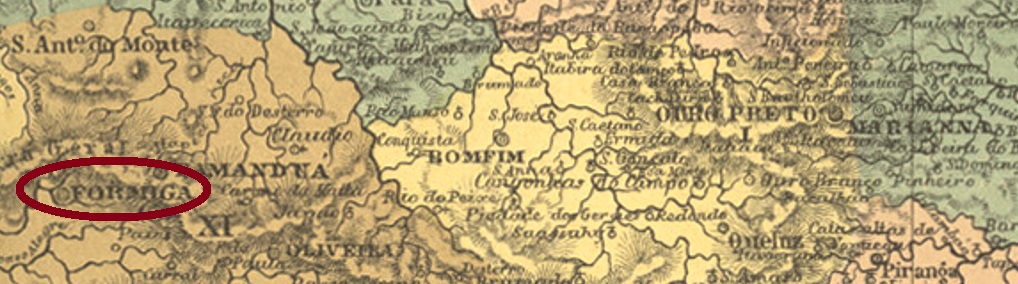
See also Formiga (R. Koester: Carimbologia XIX)
The parish of S. Vicente Ferrer da Formiga was established in July 1832 in the município of Tamanduá, 290 km west of the provincial capital Ouro Preto. There was no danger to the ant (Formiga) from the anteater (Tamanduá) because the Serra Geral lies between both. In March 1839, the village rose to become Villa Nova da Formiga, and has been a town since June 1858.
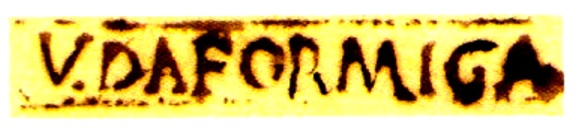
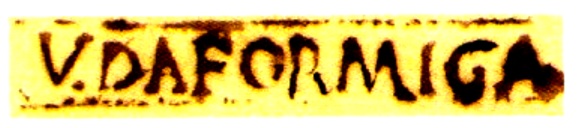
Both Paula Sobrinho (História Postal de Minas Gerais, Belo Horizonte, 1997) and Reinhold Koester (Carimbologia XIX) agree that the local post office was created in March 1840. Two early postmarks have already been recorded. VMG-3644a also exists in sepia, was used from 1840 to at least 1843 and is known through the RHM catalogue:
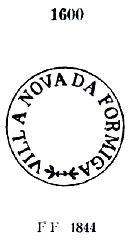
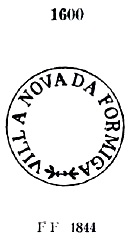
Its successor VMG-3645a was in use from about 1843 and was already known by Paulo Ayres (Catálogo de Carimbos Brasil-Império, S. Paulo, 1937, 1942) with no. 1600:
Later postmarks bear only the place name FORMIGA and have already been presented by Koester (op. cit.).
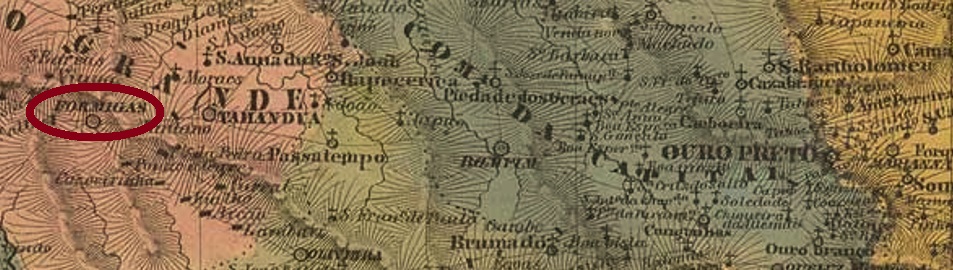
Siehe auch Formiga (R. Koester: Carimbologia XIX)
Die Pfarrei von S. Vicente Ferrer da Formiga wurde im Juli 1832 im Município von Tamanduá errichtet und lag 290 km westlich der Provinzhauptstadt Ouro Preto entfernt. Da bestand für die Ameise (Formiga) keine Gefahr durch den Ameisenbär (Tamanduá), denn zwischen beiden liegt die Serra Geral. Im März 1839 stieg der Ort zur Villa Nova da Formiga auf, und ist seit Juni 1858 eine Stadt.
Sowohl Paula Sobrinho (História Postal de Minas Gerais, Belo Horizonte, 1997) als auch Reinhold Koester (Carimbologia XIX) sind sich darüber einig, dass das örtliche Postamt im März 1840 entstanden ist. Zwei frühe Poststempel sind bereits erfasst. VMG-3644a gibt es auch in sepia, wurde von 1840 bis zumindest 1843 verwendet und ist durch den RHM-Katalog bekannt:
Sein Nachfolger VMG-3645a war ab ca. 1843 in Gebrauch und wurde bereits durch Paulo Ayres (Catálogo de Carimbos Brasil-Império, S. Paulo, 1937, 1942) mit Nr. 1600 bekannt:
Spätere Poststempel tragen lediglich die Ortsbezeichnung FORMIGA und sind durch Koester (op. cit.) bereits vorgestellt.

 Carimbologia