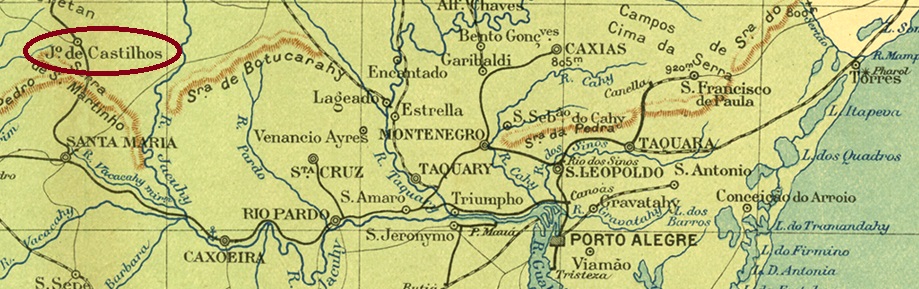
Other names: Povo Novo, Júlio de Castilhos (1904)
The young history of this locality began in 1870, with the settlement of Povo Novo in the freguesia of São Martinho near Cruz Alta, 340 km west of the provincial capital Porto Alegre. In May 1880, it became the freguesia of N. Sra. da Piedade do Povo Novo, when São Martinho was elevated to município. In December 1885, the place name changed to Villa Rica, which was promoted to município in July 1891. Since December 1904, this municipality has borne the name Júlio de Castilhos, in honour of the politician of the same name (1860-1903) who was born there.
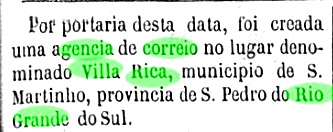
The local post office was created in January 1888, according to the Rio press:
The oldest postmark is VRS-0485a (Coll. Dieter Kerkhoff): a double circle with the inscription VILLA RICA above; below is an ornament in X formed by four converging arrowheads. Previous dates in the centre: 1888 to 1893. Its successor VRS-0485b (Coll. Dieter Kerkhoff) may already be republican: here the double circle has the same inscription above, below one now reads (S. PEDRO DO SUL), and the inner dates so far go from 1896 to 1908.
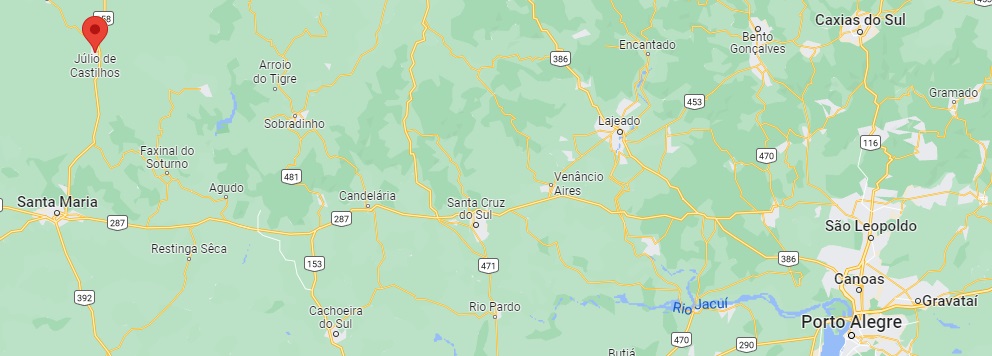
Andere Namen: Povo Novo, Júlio de Castilhos (1904)
Die junge Geschichte dieser Ortschaft fing 1870 an, mit der Siedlung von Povo Novo in der Freguesia von São Martinho bei Cruz Alta, 340 km westlich der Provinzhauptstadt Porto Alegre entfernt. Im Mai 1880 wurde daraus die Freguesia von N. Sra. da Piedade do Povo Novo, als São Martinho zum Município erhoben wurde. Im Dezember 1885 änderte sich der Ortsname zu Villa Rica, die im Juli 1891 zum Município aufstieg. Seit Dezember 1904 trägt diese Gemeinde den Namen Júlio de Castilhos, zu Ehren des gleichnamigen Politikers (1860-1903), der dort geboren wurde.
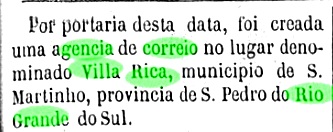
Das örtliche Postamt entstand im Januar 1888, wie die Presse aus Rio mitteilte:
Der älteste Poststempel ist VRS-0485a (Samml. Dieter Kerkhoff): ein Doppelkreis mit der obigen Inschrift VILLA RICA; unten ist ein Ornament in X, das aus vier konvergierenden Pfeilspitzen gebildet wird. Bisherige Daten in der Mitte: 1888 bis 1893. Sein Nachfolger VRS-0485b (Samml. Dieter Kerkhoff) dürfte bereits republikanisch sein: hier hat der Doppelkreis die gleiche Inschrift oben, unten liest man nun (S. PEDRO DO SUL), und die inneren Daten gehen bisher von 1896 bis 1908.

 Carimbologia