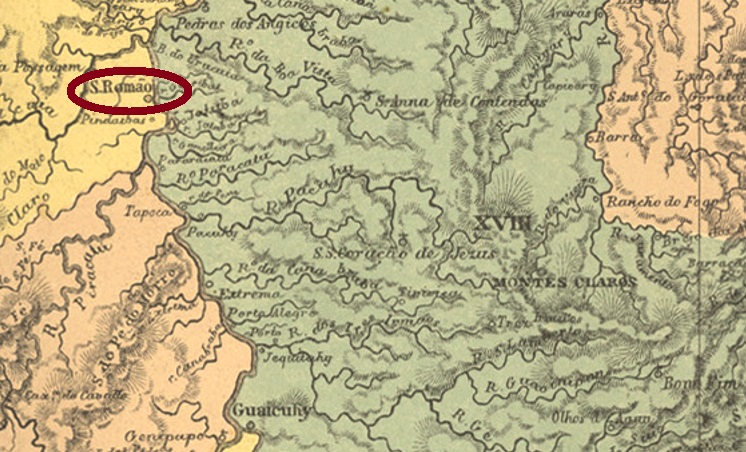
Other names: Risonha, São Romão, Villa da Manga
See also São Romão (SMG-2565)
This locality has a turbulent history that began around 1700, when gold miners forcibly expelled the Indians living there. The battle took place on St. Roman’s Day, and an island of São Francisco was named after him. Later, the place became a freguesia of Paracatu, located on the west bank of the São Francisco River, almost 590 km northwest of the provincial capital Ouro Preto. It rose to villa status as early as October 1831, under the record-breaking name of Villa Risonha de Santo Antonio da Manga de São Romão. In the 1960s, a fever epidemic led to the villa’s social and economic decline. In March 1871, the place became a district under Pedra dos Angicos, a newly created município located on the other bank of the river. It became a villa again in 1887, now under the place name Villa Rizonha de São Romão. Since September 1923 it has been the town of São Romão.
Paula Sobrinho writes in História Postal de Minas Gerais (Belo Horizonte, 1997) that there was a post office there from October 1833. The oldest postmark is probably VMG-3825a, registered with dates between 1841 and 1848 and already seen in the RHM catalogue under P-MG-56:

Later postmarks bear the place name São Romão and were presented under SMG-2565.
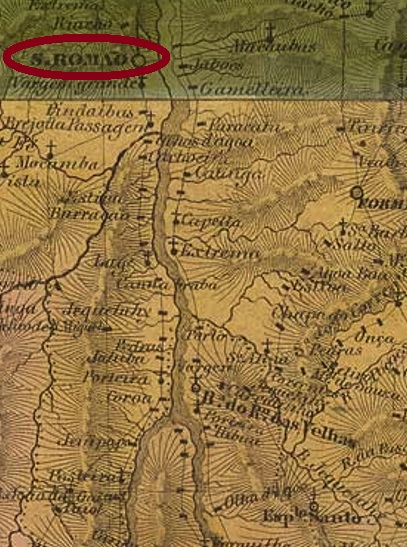
Andere Namen: Risonha, São Romão, Villa da Manga
Siehe auch São Romão (SMG-2565)
Diese Ortschaft hat eine bewegte Geschichte, die ca. 1700 begann, als Goldgräber die dort lebenden Indianer gewaltsam vertrieben. Die Schlacht fand am Tag des Hl. Roman, und nach diesem wurde die Insel des São Francisco genannt. Später wurde der Ort zur Freguesia von Paracatu, die am Westufer des Flusses São Francisco lag, fast 590 km nordwestlich der Provinzhauptstadt Ouro Preto entfernt. Bereits im Oktober 1831 stieg sie zur Villa auf, unter dem rekordverdächtigten Namen Villa Risonha de Santo Antonio da Manga de São Romão. In den 60er Jahren des 19. Jahrhunderts leitete eine Fieberepidemie den sozialen und wirtschaftlichen Verfall der Villa. Im März 1871 wurde der Ort ein Distrikt von Pedra dos Angicos, einem neu entstandenen Município, der am anderen Ufer des Flusses lag. Der Wiederaufstieg zur Villa erfolgte 1887, nun unter den Ortsnamen Villa Rizonha de São Romão. Seit September 1923 ist es die Stadt São Romão.
Paula Sobrinho schreibt in História Postal de Minas Gerais (Belo Horizonte, 1997), dass es dort ab Oktober 1833 ein Postamt gab. Der älteste Poststempel dürfte VMG-3825a sein, der mit Daten zwischen 1841 und 1848 registriert wurde und bereits im RHM-Katalog unter P-MG-56 zu sehen ist:

Spätere Poststempel tragen die Ortsbezeichnung São Romão und wurden unter SMG-2565 vorgestellt.

 Carimbologia