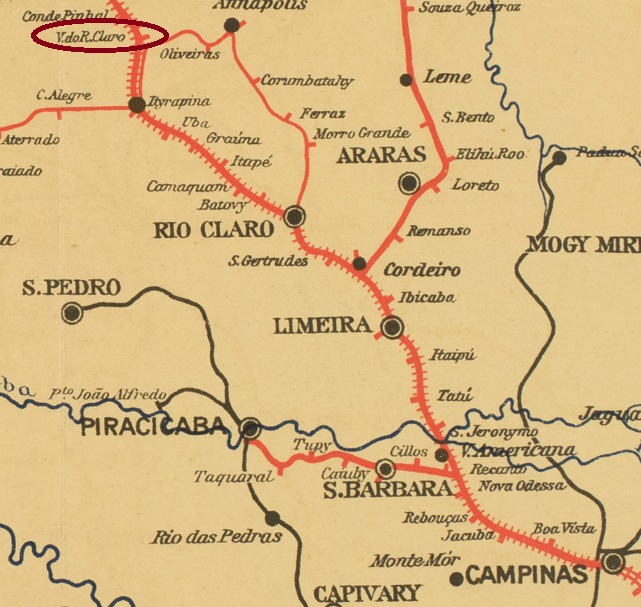
Another name: Estação Feijão
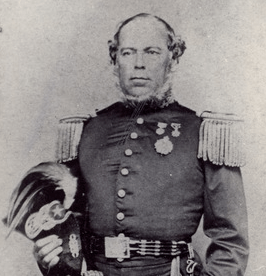
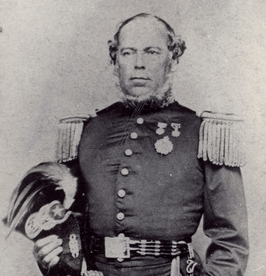
The third viscount among the stations of the imperial province of São Paulo is Visconde do Rio Claro, alias José Estanislau de Oliveira (1803-1884), local politician, owner of a large coffee plantation and colonel of the Brazilian army in the war against Paraguay (1864-1870).
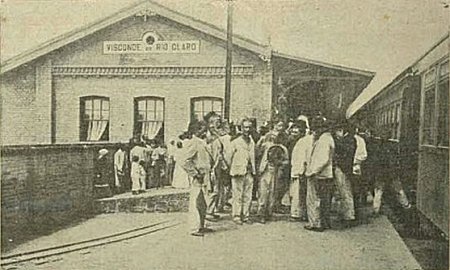
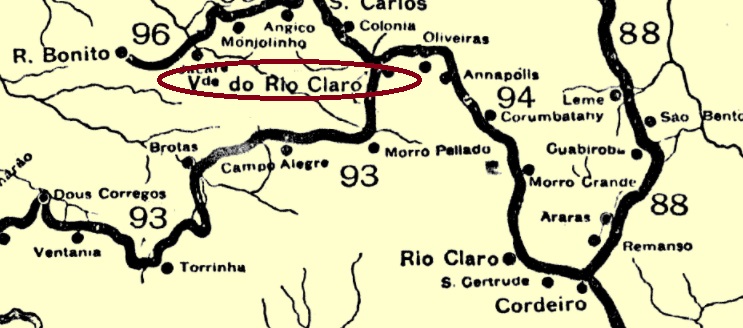
The former railway station called Feijão (Bean) was renamed after him. It was inaugurated in December 1884 by the Companhia Rio-Clarense, Cuscuzeiro Branch, in the município of São João do Rio Claro (today in the município of Itirapina), more than 200 km northwest of the provincial capital São Paulo. The railway line went to the Rio Claro Railway in 1888 and belonged to the Cia. Paulista from 1892 until operation end in 1940. The old station building has long since been demolished (estacoesferroviarias.com.br).
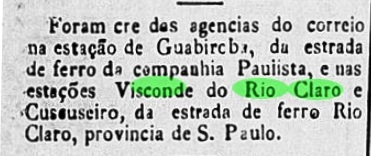
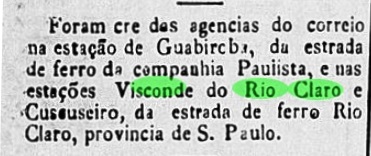
In July 1885, a station post office was created there, as the Rio press informs us:
The imperial postmark is VSP-1510a (Coll. José A. Junges): a double circle with the inscription EST. DO V. DO RIO CLARO above and a five-pointed star below. The inner dates have so far been found for the period 1886-1889.
Anderer Name: Estação Feijão
Der dritte Vicomte unter den Bahnhöfen der kaiserlichen Provinz São Paulo ist der Visconde do Rio Claro, alias José Estanislau de Oliveira (1803-1884), Lokalpolitiker, Besitzer einer großen Kaffeeplantage und Oberst der brasilianischen Armee im Krieg gegen Paraguay (1864-1870).
Nach ihm wurde die ehemalige Bahnstation namens Feijão (Bohne) umbenannt, die im Dezember 1884 durch die Companhia Rio-Clarense, Cuscuzeiro-Abzweigung, im Município von São João do Rio Claro (heute: im Município von Itirapina) eingeweiht wurde, über 200 km nordwestlich der Provinzhauptstadt São Paulo entfernt. Die Bahnlinie ging 1888 zum Rio Claro Railway und gehörte von 1892 bis zur Stilllegung 1940 der Cia. Paulista. Das alte Bahnhofsgebäude wurde längst abgerissen (estacoesferroviarias.com.br).

Über die Einrichtung eines Bahnhofspostamts wurde im Juli 1885 beschlossen, wie die Presse aus Rio informiert:
Der kaiserliche Poststempel ist VSP-1510a (Samml. José A. Junges): ein Doppelkreis mit der Inschrift EST. DO V. DO RIO CLARO oben und einem fünfzackigen Stern unten. Die Daten im Inneren wurden bisher für den Zeitraum 1886-1889 gefunden.

 Carimbologia