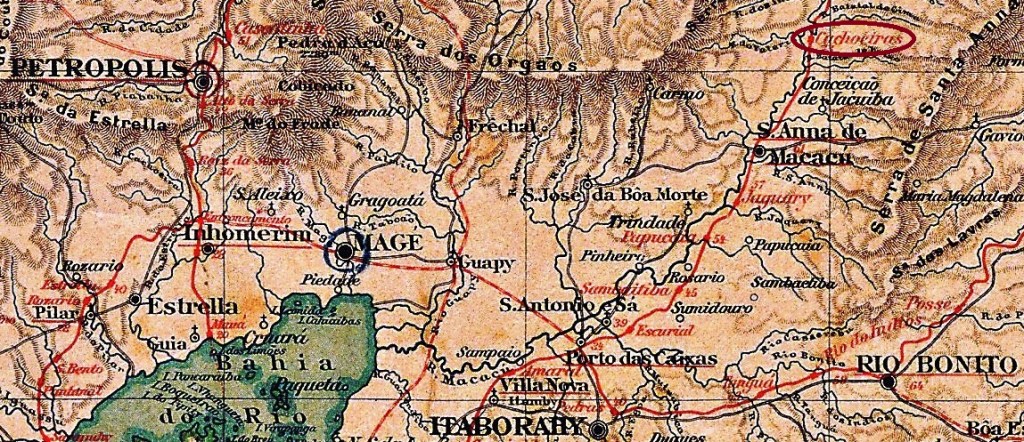
Other names: Cachoeiras, Cachoeiras de Macacu (1943)
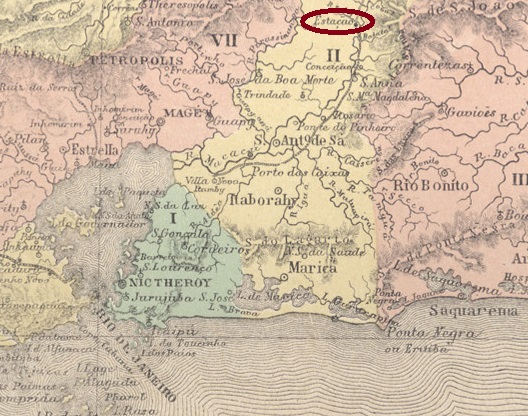
The settlement originated in the valley of the Macacu, belonged to the Vila de Sto. Antonio de Sá and was located 100 km northeast of the capital Rio de Janeiro. In September 1877, the arraial passed into the Vila Sant’Anna de Macacu and only became a Distrito in November 1894. The responsible município was renamed Sant’Anna de Japuíba in December 1898. Finally, in March 1938, it was emancipated into a município called Cachoeiras, which has been called Cachoeiras de Macacu since December 1943.
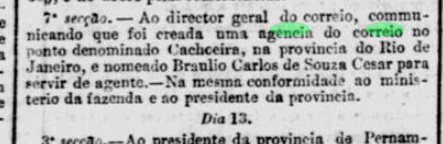
According to the Rio press, the local post office was created in June 1860:
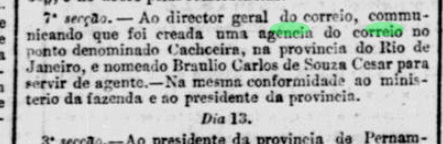
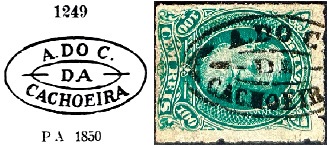
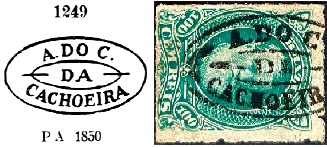
This postal connection must have been caused by the inauguration of the E.F. do Cantagallo station in April of the same year. However, confirmation that it is a station post office is still missing today. The first cancel CRJ-0229a also occurs in blue and was already presented by Paulo Ayres in the Catálogo de Carimbos Brasil-Império (S. Paulo, 1937, 1942) under No. 1249. However, his published illustration has some differences with the actual postmark, as Claudio Coelho’s image shows:
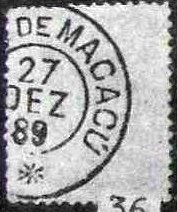
This was followed by CRJ-0230a, previously seen with dates between 1887 and 1894 and depicted by P. Ayres:

The following cancel CRJ-0230b was shown in R. Koster’s Carimbologia VII:
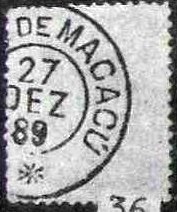
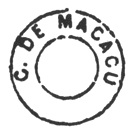
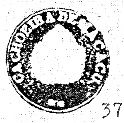
Koester also showed a seal postmark of Cachoeira de Macacu:

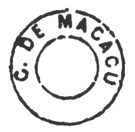
And in Carimbos Postais – século XIX (Rio de Janeiro, 1989), Cicero A. Almeida shows the postmark CRJ-0230d under MPT 771, without further information:
Andere Namen: Cachoeiras, Cachoeiras de Macacu (1943)
Die Siedlung entstand im Tal des Macacu, gehörte zur Vila de Sto. Antonio de Sá und lag 100 km nordöstlich der Hauptstadt Rio de Janeiro. Im September 1877 ging der Arraial in die Vila Sant’Anna de Macacu über und wurde erst im November 1894 zum Distrito. Das zuständige Município wurde im Dezember 1898 in Sant’Anna de Japuíba umbenannt. Im März 1938 erfolgte schließlich die Emanzipation zum Município namens Cachoeiras, das seit Dezember 1943 Cachoeiras de Macacu heißt.
Wie aus der Presse von Rio hervorgeht, entstand das örtliche Postamt im Juni 1860:
Diese postalische Verbindung muss durch die Einweihung des Bahnhofs der E.F. do Cantagallo im April desselben Jahres verursacht sein. Allerdings fehlt bis heute die Bestätigung, dass es sich um ein Bahnhofspostamt handelt. Der erste Stempel CRJ-0229a kommt auch in blau vor und wurde bereits von Paulo Ayres im Catálogo de Carimbos Brasil-Império (S. Paulo, 1937, 1942) unter der Nr. 1249 vorgestellt. Seine veröffentlichte Abbildung weist jedoch einige Unterschiede zum tatsächlichen Poststempel auf, wie die Abbildung von Claudio Coelho zeigt:
Es folgte CRJ-0230a, der bisher mit Daten zwischen 1887 und 1894 gesehen wurde und auch bei P. Ayres zu sehen war:

Der folgende Stempel CRJ-0230b war in R. Kosters Carimbologia VII abgebildet:
Koester zeigte auch einen Siegel-Stempel von Cachoeira de Macacu:
Und in Carimbos Postais – século XIX (Rio de Janeiro, 1989) zeigt Cicero A. Almeida zeigt den Poststempel CRJ-0230d unter MPT 771, ohne weitere Informationen:

 Carimbologia