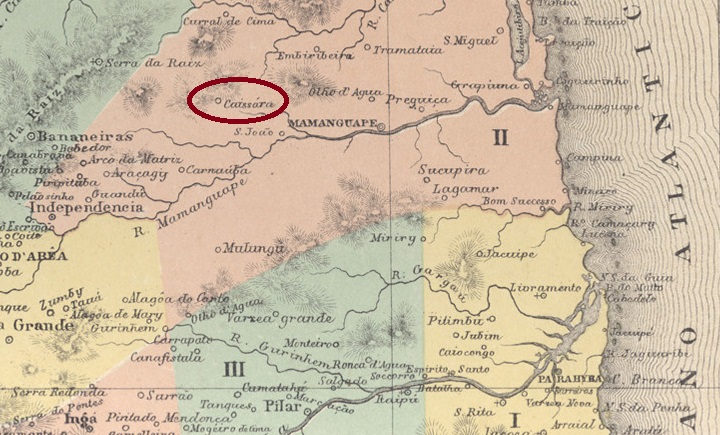
The beautiful Indian word Caiçara (formerly also spelled Caissara) means fisherman’s hut and can still be heard all over Brazil by the sea or rivers. The Arraial of N. Sra. do Rosário de Caiçara was founded around 1841, belonged to the Vila of Serra da Raiz and was located on the banks of the Curimataú, 130 km northwest of the provincial capital Parahyba do Norte (today: João Pessoa). The village was elevated to the status of a vila in December 1883, but passed to the Município Guarabira as a freguesia as early as October of the following year and was not elevated to the status of an independent município again until November 1908.
As was learned from the Rio press, there had been a post office there since May 1884:
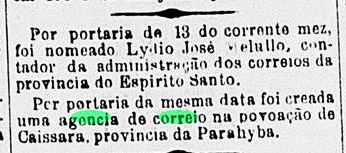
However, this was moved to the neighbouring Serra da Raiz in October 1885, as R. Koester writes in Carimbologia VII, and was not reopened until July 1893. Imperial postmarks from Caiçara have not been seen so far.
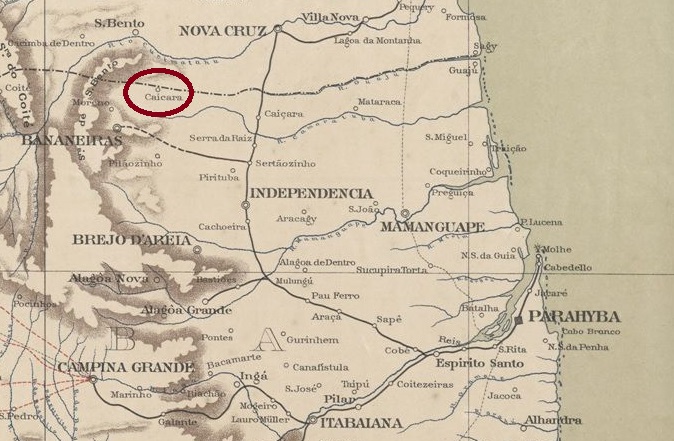
Das schöne indianische Wort Caiçara (früher auch Caissara geschrieben) bedeutet Fischerhütte und ist noch heute in ganz Brasilien am Meer oder an Flüssen zu hören. Der Arraial von N. Sra. do Rosário de Caiçara entstand um 1841, gehörte zur Vila von Serra da Raiz und lag am Ufer des Curimataú, 130 km nordwestlich der Provinzhauptstadt Parahyba do Norte (heute: João Pessoa). Der Ort wurde im Dezember 1883 zur Vila erhoben, ging aber bereits im Oktober des folgenden Jahres als Freguesia zum Município Guarabira und wurde erst im November 1908 wieder zum eigenständigen Município erhoben.
Wie aus der Presse von Rio zu erfahren war, gab es dort seit Mai 1884 ein Postamt:
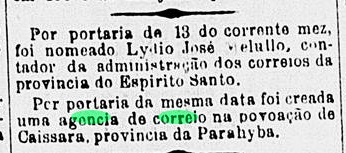
Dieses wurde jedoch im Oktober 1885 in die benachbarte Serra da Raiz verlegt, wie R. Koester in Carimbologia VII schreibt, und erst im Juli 1893 wiedereröffnet. Kaiserliche Poststempel aus Caiçara wurden bisher nicht gesichtet.

 Carimbologia