
The Chapel S. Bento do Cajuru was built in March 1835 in the Município Batatais, 300 km north of the provincial capital São Paulo. In February 1846, it became a freguesia of the municipality of Casa Branca, but returned to Batatais in June 1850. Since March 1865, Cajuru has been a vila in its own município, which became a town in December 1906.
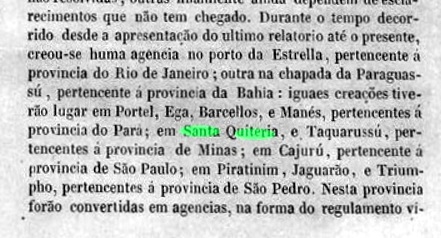
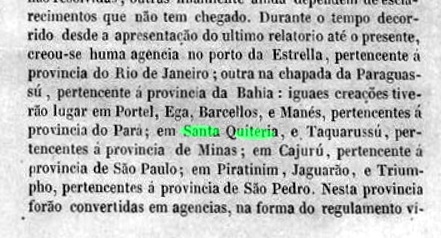
The local post office existed from about 1845, as shown in the yearbook of the following year:
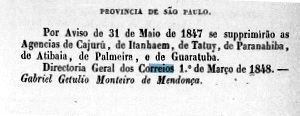
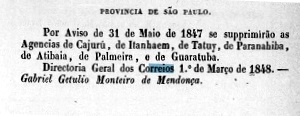
However, the office was closed in May 1847, as shown in the report of the Imperial Ministry:
A reopening of the post office was ordered in February 1849, as Nova Monteiro writes in Administrações e Agencias Postaes do Brasil Imperio (Brasil Filatelico/RJ, 1934-5; reprinted by SPP 1994-1999).
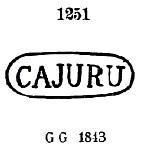
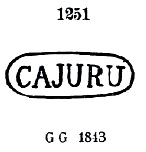
Three place cancels and one mute one were found for the imperial period. CSP-0230a is certainly the oldest, as it was used on Bull’s-Eye issues and until 1876. It also exists in red, it was already presented by Paulo Ayres in the Catálogo de Carimbos Brasil-Império (S. Paulo, 1937, 1942) with No. 1251:
Two double circle cancels followed: CSP-0230b (ill. Jorge L. Pedreira) is quite plain and bears the dates 1881-1882 in the centre. The French type CSP-0230c (ill. from the Internet) bears the broad inscription CAJURU above and the star between brackets below, dated 1886-1894.
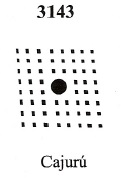
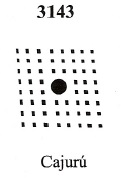
There is also a mute cancel from Cajuru which was given No. 3143 in Mute Cancellations of the Brazil Empire / Carimbos Mudos do Brasil Império (Brazil Philatelic Association, Rio de Janeiro, 2000) by James Dingler and Klerman W. Lopes:
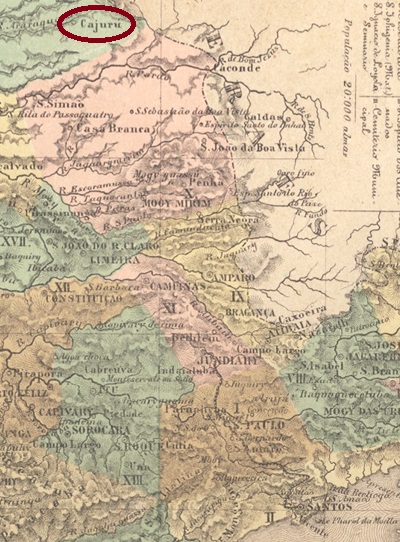
Die Capela de S. Bento do Cajuru wurde im März 1835 errichtet und befand sich im Município Batatais, 300 km nördlich der Provinzhauptstadt São Paulo. Im Februar 1846 wurde es zur Freguesia der Gemeinde Casa Branca, die jedoch im Juni 1850 wieder zu Batatais zurückkehrte. Seit März 1865 ist Cajuru eine Vila in einem eigenen Município, das im Dezember 1906 zur Stadt erklärt wurde.
Das örtliche Postamt bestand seit etwa 1845, wie aus dem Jahrbuch des folgenden Jahres hervorgeht:
Das Amt wurde jedoch im Mai 1847 geschlossen, wie man im Bericht des kaiserlichen Ministeriums lesen kann:
Über eine Wiedereröffnung des Postamts wurde im Februar 1849 verfügt, wie Nova Monteiro in Administrações e Agencias Postaes do Brasil Imperio (Brasil Filatelico/RJ, 1934-5; Nachdruck SPP 1994-1999) schreibt.
Für die Kaiserzeit wurden drei Ortsstempel und ein stummer Stempel gefunden. CSP-0230a ist sicherlich der älteste, da er auf Ochsenaugen-Ausgaben und bis 1876 verwendet wurde. Es gibt ihn auch in rot, er wurde bereits von Paulo Ayres im Catálogo de Carimbos Brasil-Império (S. Paulo, 1937, 1942) mit der Nr. 1251 vorgestellt:
Zwei Doppelkreis-Stempel folgten: CSP-0230b (Abb. Jorge L. Pedreira) ist recht schlicht und trägt in der Mitte die Jahreszahlen 1881-1882. Der französische Typ CSP-0230c (Abb. aus dem Internet) trägt oben die breite Inschrift CAJURU und unten den Stern zwischen Klammern, datiert 1886-1894.
Aus Cajuru stammt auch ein stummer Stempel, der in den Mute Cancellations of the Brazil Empire / Carimbos Mudos do Brasil Império (Brazil Philatelic Association, Rio de Janeiro, 2000) von James Dingler und Klerrman W. Lopes die Nr. 3143 erhielt:

 Carimbologia