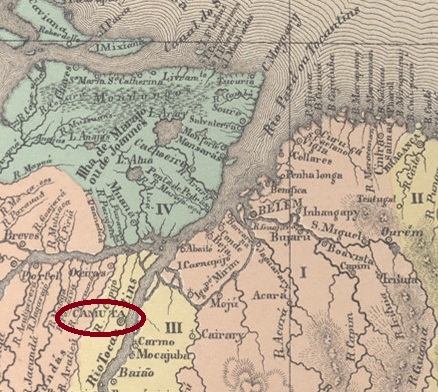
Another name: Camutá
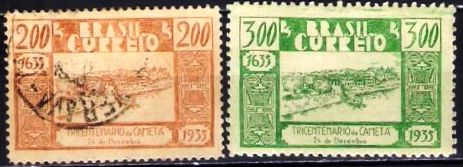
Vila Viçosa de Santa Cruz de Camutá was founded in December 1635 on the west bank of the Tocantins River, 230 km southwest of the provincial capital Belém do Pará. 301 years later, this event was even worth two special stamps to the Brazilian Post, a commemoration that was otherwise seldom used at the time:
Before and after that, things became quieter around the place, which was still elevated to the the town of Cametá in October 1848. The word comes from the Tupi language and is supposed to mean forest elevation.
As Nova Monteiro writes in Administrações e Agencias Postaes do Brasil Imperio (Brasil Filatelico/RJ, 1934-5; Reprint SPP 1994-1999), there was a post office there since March 1829. Three postmarks have been found for the 19th century, unfortunately not the very first one. CPA-0070b, according to R. Koester (Carimbologia VII), would be a double circle with the inscription CAMETÁ above and no ornaments below. He mentioned a copy of it, dated 1881. Its successor CPA-0070c also exists in blue and is already illustrated in Paulo Ayres’ Catálogo de Carimbos Brasil-Império, (S. Paulo, 1937, 1942) on p. 120:

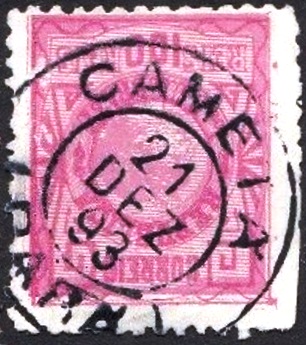
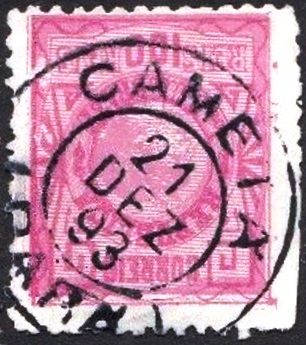
It was followed by CPA-0070d (fig. from the Internet), which could already be Republican, as it shows internal dates from 1890-1893:
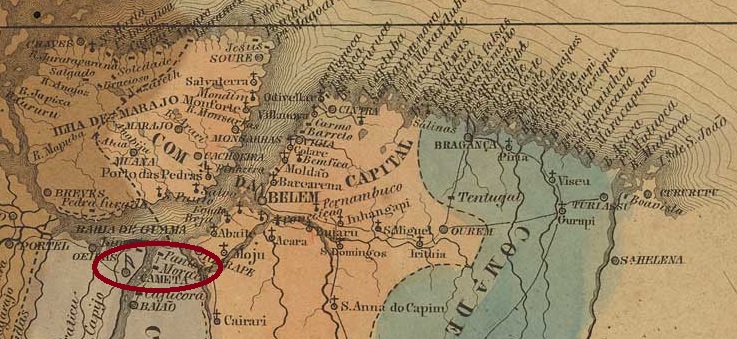
Anderer Name: Camutá
Die Vila Viçosa de Santa Cruz de Camutá wurde im Dezember 1635 am Westufer des Tocantins, 230 km südwestlich der Provinzhauptstadt Belém do Pará, gegründet. 301 Jahre später war dieses Ereignis der brasilianischen Post sogar zwei Sondermarken wert, eine seltene Ehre damals:
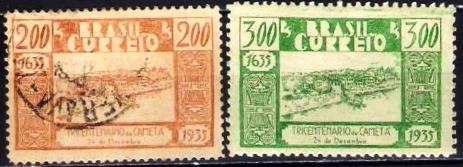
Davor und danach wurde es ruhiger um den Ort, der noch im Oktober 1848 zur Stadt Cametá erhoben wurde. Das Wort stammt aus der Tupi-Sprache und soll Walderhebung bedeuten.
Wie Nova Monteiro in Administrações e Agencias Postaes do Brasil Imperio (Brasil Filatelico/RJ, 1934-5; Reprint SPP 1994-1999) schreibt, gab es dort ein Postamt seit März 1829. Für das 19. Jahrhundert wurden drei Poststempel gefunden, leider nicht der allererste. CPA-0070b soll nach R. Koester (Carimbologia VII) einen Doppelkreis sein, der die Inschrift CAMETÁ oben und ohne Ornament unten trägt. Er kannte ein Exemplar davon, datiert 1881. Der Nachfolgestempel CPA-0070c existiert ebenfalls in blau und ist bereits in Paulo Ayres‘ Catálogo de Carimbos Brasil-Império, (S. Paulo, 1937, 1942) auf S. 120 abgebildet:

Es folgt CPA-0070d (Abb. aus dem Internet), das bereits republikanisch sein könnte, da er interne Daten von 1890-1893 aufweist:

 Carimbologia