
Other names: Luiz Gomes, Hermogênio Silva (1915)
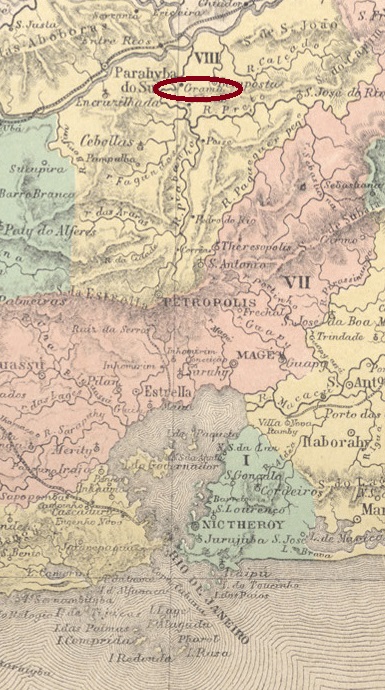
Campo da Gramma (Turf Field) was a small settlement of the Freguesia de Bemposta, then part of the Vila de Parahyba do Sul, located on the east bank of the Piabanha, 120 km north of the capital Rio de Janeiro. In 1861, an estação (road stop, not a railway station) was built there by the company União e Industria. This was Brazil’s first paved trunk road, a prestigious project that was to connect the town of Petropolis in Rio with Juiz der Fora in the province of Minas Gerais by stagecoach.
The local stop was to be called Luiz Gomes, after a local fazendeiro, but this name was largely ignored. Instead, the Estação continued to be called Campo da Gramma. The E.F. Leopoldina railway line did not arrive until 1900, and the station was called Hermogênio Silva from 1915, after a mayor of Petrópolis who had died shortly before. Since December 1938, the village has belonged to the Município Três Rios.
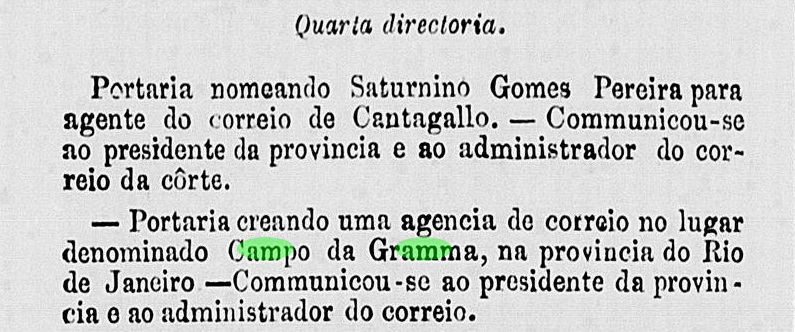
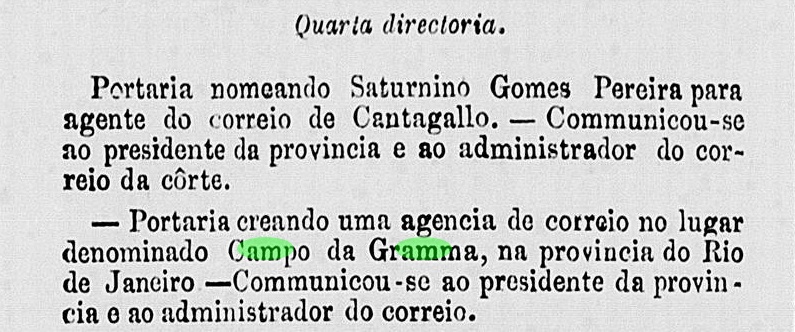
The local post office was created in July 1861, according to the administrative report of the time:
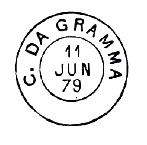
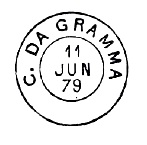
The first postmark is CRJ-0270a, which also existed in green, blue and dark purple until at least 1876. Here the illustration from Catálogo de Carimbos Brasil-Império (S. Paulo, 1937, 1942), by Paulo Ayres:

The following two postmarks CRJ-0120b and CRJ-0120c were also recorded by P. Ayres:

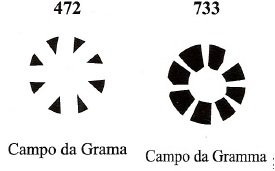
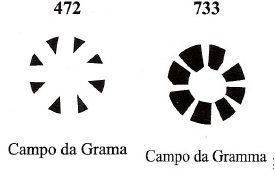
James Dingler and Klerman W. Lopes have listed two mute cancellations from Campo da Gramma in Mute Cancellations of the Brazil Empire / Carimbos Mudos do Brasil Império (Brazil Philatelic Association, Rio de Janeiro, 2000):
Andere Namen: Luiz Gomes, Hermogênio Silva (1915)
Campo da Gramma (Rasenfeld) war eine kleine Siedlung der Freguesia de Bemposta, die damals zur Vila de Parahyba do Sul gehörte und am Ostufer des Piabanha, 120 km nördlich der Hauptstadt Rio de Janeiro, lag. Im Jahre 1861 wurde dort eine Estação (Haltestelle, kein Bahnhof) der Gesellschaft União e Industria gebaut. Es handelte sich um die erste befestigte Fernstraße Brasiliens, ein Prestigeprojekt, das die Stadt Petropolis in Rio mit Juiz der Fora in der Provinz Minas Gerais durch einen Postkutschendienst verbinden sollte.
Die örtliche Haltestelle sollte Luiz Gomes heißen, nach einem Fazendeiro der Region, aber dieser Name wurde weitgehend ignoriert. Stattdessen hieß die Estação weiterhin Campo da Gramma. Die Eisenbahnlinie der E.F. Leopoldina kam erst 1900, und der Bahnhof hieß ab 1915 Hermogênio Silva, nach einem kurz zuvor verstorbenen Bürgermeister von Petrópolis. Seit Dezember 1938 gehört der Ort zum Município Três Rios.
Das örtliche Postamt wurde im Juli 1861 gegründet, wie aus einem damaligen Verwaltungsbericht hervorgeht:
Der erste Poststempel ist CRJ-0270a, den es bis mindestens 1876 auch in den Farben grün, blau und dunkelviolett gab. Hier die Abbildung aus Catálogo de Carimbos Brasil-Império (S. Paulo, 1937, 1942), von Paulo Ayres:

Die beiden folgenden Stempel CRJ-0120b und CRJ-0120c wurden ebenfalls durch P. Ayres erfasst:

James Dingler und Klerman W. Lopes haben in Mute Cancellations of the Brazil Empire / Carimbos Mudos do Brasil Império (Brazil Philatelic Association, Rio de Janeiro, 2000) zwei stumme Entwertungen aus Campo da Gramma aufgelistet:

 Carimbologia