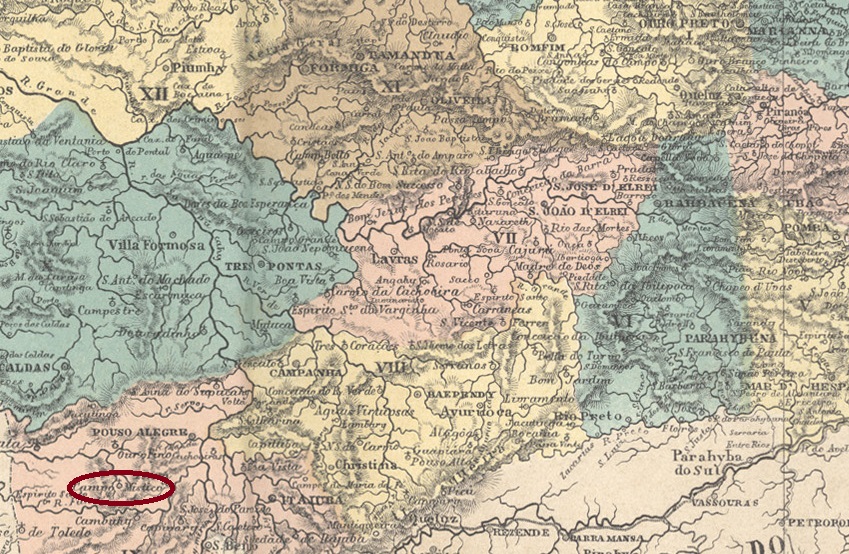
Other names: Senhor Bom Jesus do Ribeirão das Antas, Bueno Brandão (1938).
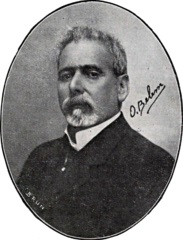
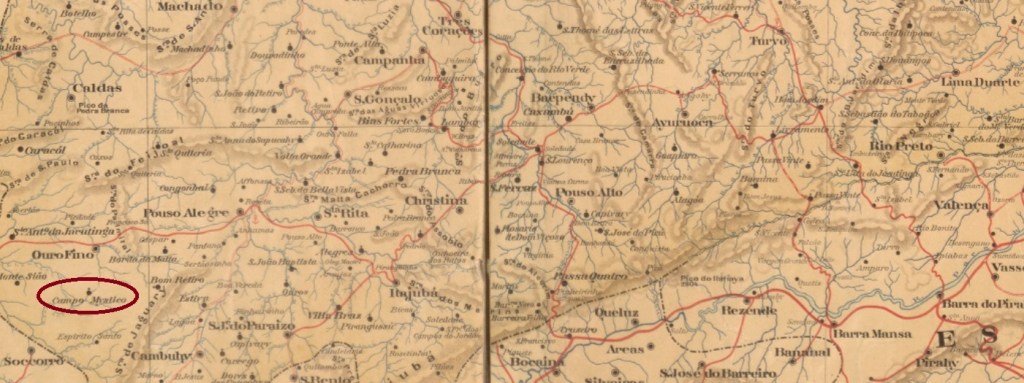
The former chapel of Senhor Bom Jesus do Ribeirão das Antas belonged to the Vila of Ouro Fino and was located on the north bank of the Antas River, 500 km southwest of the provincial capital of Ouro Preto. In June 1850, the village was elevated to a freguesia, with the strange name Campo Mystico (Mystic Field). It remained so until December 1938, when autonomy came as a município, now under the name Bueno Brandão. The latter commemorates the Ouro Fino-born politician Júlio Bueno Brandão (1858-1931), who was twice president of the state of Minas Gerais at the beginning of the Republic.
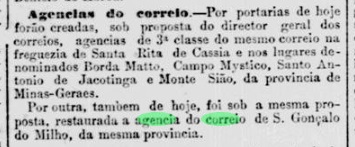
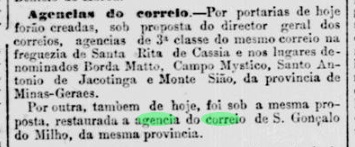
As the Rio press reported, there had been a post office there since the beginning of July 1881:
The first postmark CMG-0520a is known so far with dates between 1885 and 1896, exists also in blue and dark violet and was already presented by R. Koester in Carimbologia VIII:

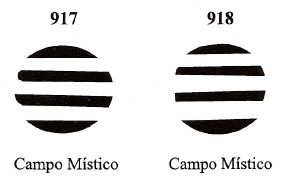
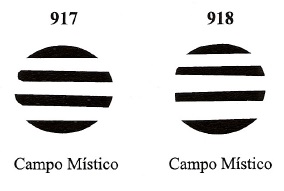
James Dingler and Klerman W. Lopes also found two mute cancellations from there and registered them as Nos. 917 and 918 in Mute Cancellations of the Brazil Empire / Carimbos Mudos do Brasil Império (Brazil Philatelic Association, Rio de Janeiro, 2000):
Andere Namen: Senhor Bom Jesus do Ribeirão das Antas, Bueno Brandão (1938)
Die ehemalige Kapelle von Senhor Bom Jesus do Ribeirão das Antas gehörte zur Vila von Ouro Fino und lag am Nordufer des Antas-Flusses, 500 km südwestlich der Provinzhauptstadt Ouro Preto. Im Juni 1850 wurde das Dorf zur Freguesia erhoben, mit dem seltsamen Namen Campo Mystico (Mystisches Feld). So blieb es bis Dezember 1938, als die Autonomie als Município, nun unter dem Namen Bueno Brandão, kam. Letzterer erinnert an den in Ouro Fino geborenen Politiker Júlio Bueno Brandão (1858-1931), der zu Beginn der Republik zweimal Präsident des Bundesstaates Minas Gerais war.

Wie die Presse in Rio berichtete, gab es dort seit Anfang Juli 1881 ein Postamt:
Der erste Poststempel CMG-0520a ist bisher mit Daten zwischen 1885 und 1896 bekannt, existiert auch in blau und dunkelviolett und wurde von R. Koester bereits in Carimbologia VIII vorgestellt:

James Dingler und Klerman W. Lopes fanden auch zwei stumme Entwertungen von dort und registrierten sie als Nr. 917 und 918 in Mute Cancellations of the Brazil Empire / Carimbos Mudos do Brasil Império (Brazil Philatelic Association, Rio de Janeiro, 2000):

 Carimbologia