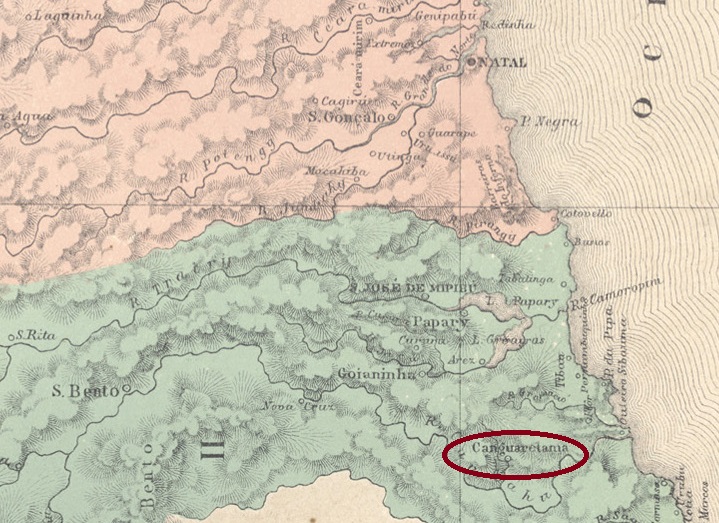
Other names: Uruá, Vila Flor
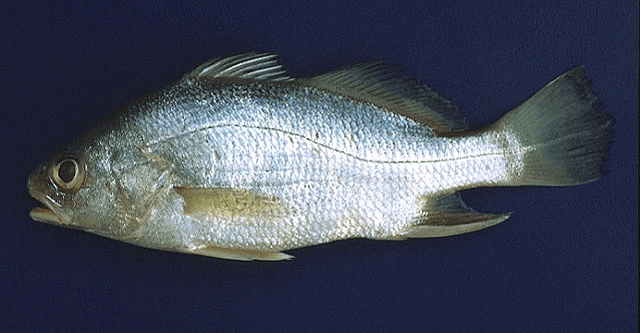
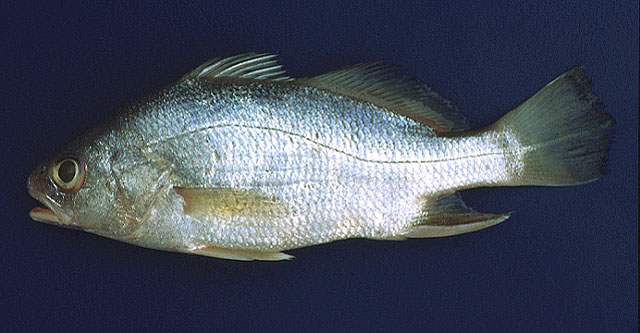
The history of this place – as well as that of the local post office – is very sketchy. The former settlement of Uruá belonged to Vila Flor and was situated on the north bank of the river Cunhaú, now Curimataú, 80 km south of the provincial capital Natal. Vila Flor lost its status as a villa to Uruá, which was now called Canguaretama, in July 1858 due to an epidemic or some other natural event. Canguaretama has been a town since April 1885. The indigenous name means land of many Canguás. Canguá is the name of Bairdiella ronchus, a fish from the Scienidae family.
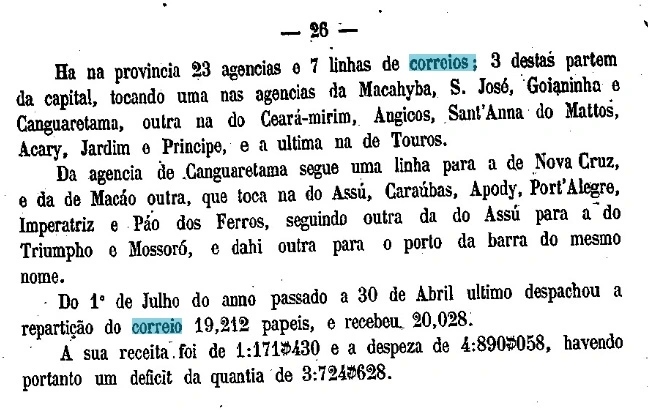
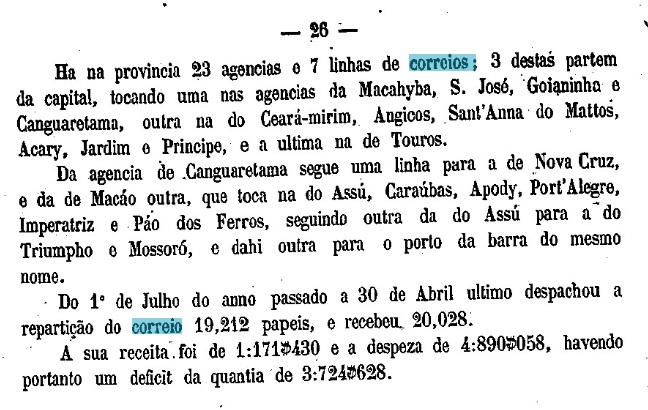
Since when exactly there was an imperial post office here could not be clarified so far. Vila Flor still had a post office around 1856, but it was moved to the neighbouring village of Penha around 1860, where it was still in operation in 1872. However, a post office in Canguaretama is mentioned in the provincial president’s report in 1873:
The post office must have closed by 1879, however, as it is not mentioned in the 1880 postal guide (Guia Postal do Império) or in the list of imperial post offices (Tabella das Agencias do Correio do Imperio, Rio de Janeiro, 1885). However, it can be assumed that it was reopened by the end of the 19th century at the latest. So far, no imperial postmarks from Canguaretama are known.
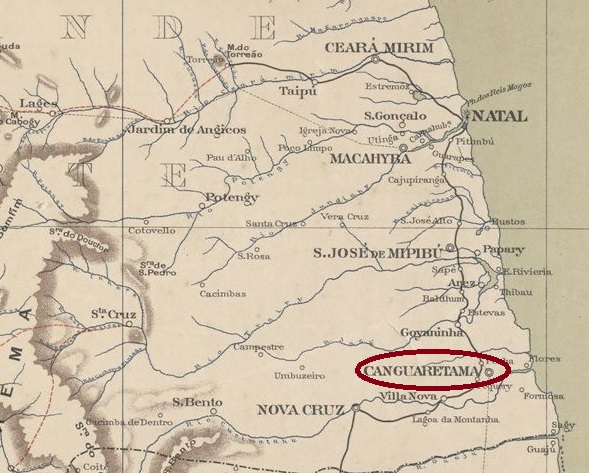
Andere Namen: Uruá, Vila Flor
Die Geschichte dieses Ortes – wie auch die des örtlichen Postamtes – ist sehr lückenhaft. Die ehemalige Siedlung Uruá gehörte zu Vila Flor und lag am Nordufer des Flusses Cunhaú, heute Curimataú, 80 km südlich der Provinzhauptstadt Natal. Vila Flor verlor seinen Status als Villa im Juli 1858 durch eine Epidemie oder ein anderes Naturereignis an Uruá, das nun Canguaretama hieß. Seit April 1885 ist Canguaretama eine Stadt. Der indigene Name bedeutet viele Canguás. Canguá ist der volkstümliche Name von Bairdiella ronchus, einem Fisch aus der Familie Scienidae.
Seit wann genau es hier ein kaiserliches Postamt gab, konnte bisher nicht geklärt werden. Vila Flor hatte noch um 1856 eine Postagentur, die aber um 1860 in den Nachbarort Penha verlegt wurde, wo sie 1872 noch in Betrieb war. Ein Postamt in Canguaretama wird jedoch 1873 im Bericht des Provinzpräsidenten erwähnt:
Das Postamt muss jedoch bereits 1879 geschlossen worden sein, da es weder im Postführer (Guia Postal do Império) von 1880 noch im Verzeichnis der kaiserlichen Postämter (Tabella das Agencias do Correio do Imperio, Rio de Janeiro, 1885) erwähnt wird. Es ist dennoch davon auszugehen, dass es spätestens Ende des 19. Jahrhunderts wieder eröffnet wurde. Bisher sind keine kaiserlichen Poststempel aus Canguaretama bekannt.

 Carimbologia