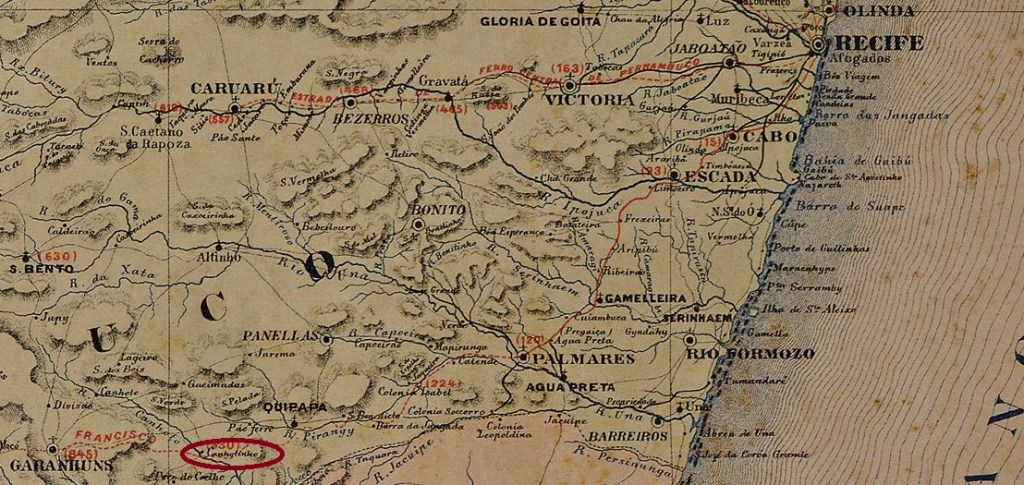
According to a beautiful local legend, two brothers once lived as farmers on the northern bank of a river. The older brother lost his right hand and had to become left-handed (Canhoto). His younger brother was called Canhotinho, and this nickname became the place name as the settlement continued to grow.
Since it is hard to believe that the river was previously nameless, the place name Canhotinho could simply means headwaters (or tributaries) of the Canhoto River. Anyway, the Freguesia de S. Sebastião do Canhotinho was founded in July 1882 on the north bank of the Canhoto near Vila de S. Bento, close to the provincial border with Alagoas, 210 km southwest of the capital Recife. Canhotinho was elevated to vila status in October 1890 and to town status in May 1903. In November 1888, a station of the E.F. Recife ao São Francisco railway company was inaugurated.
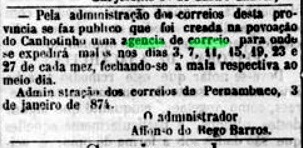
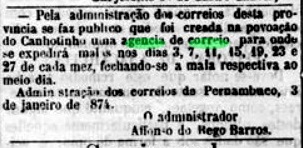
As can be seen from the Directory of Imperial Post Offices (Tabella das Agencias do Correio do Imperio, Rio de Janeiro, 1885), it was decided to establish the local post office in 1873. However, it did not start operating until the following January:
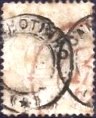
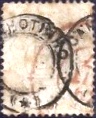
It is quite possible that this post office was moved to the station after the arrival of the railway in 1888. The only postmark from the imperial period so far is the French type CPE-0170a (Fig. Jorge L. Pedreira):
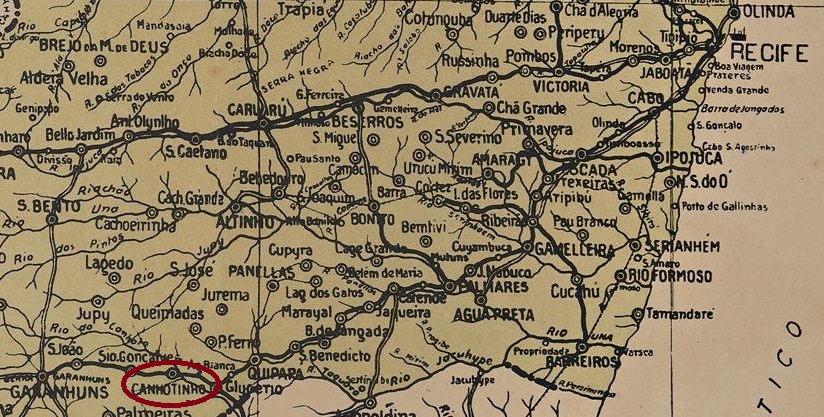
Nach einer schönen lokalen Legende lebten einst zwei Brüder als Bauern am nördlichen Ufer eines Flusses. Der ältere Bruder verlor seine rechte Hand und musste zum Linkshänder (Canhoto) werden. Sein jüngerer Bruder wurde Canhotinho genannt, und dieser Spitzname wurde zum Ortsnamen, als die Siedlung weiter wuchs.
Da es schwer zu glauben ist, dass der Fluss vorher namenlos war, könnte die Ortsbezeichnung Canhotinho einfach Oberlauf (oder Zufluss) des Canhoto. Wie dem auch sei, wurde die Freguesia de S. Sebastião do Canhotinho im Juli 1882 am Nordufer des Canhoto in der Nähe von Vila de S. Bento, nahe der Provinzgrenze zu Alagoas, 210 km südwestlich der Hauptstadt Recife, gegründet. Canhotinho wurde im Oktober 1890 zur Vila und im Mai 1903 zur Stadt erhoben. Im November 1888 wurde ein Bahnhof der Eisenbahngesellschaft E.F. Recife ao São Francisco eingeweiht.
Wie aus dem Verzeichnis der kaiserlichen Postämter (Tabella das Agencias do Correio do Imperio, Rio de Janeiro, 1885) hervorgeht, wurde 1873 die Gründung des örtlichen Postamtes beschlossen. Diese nahm jedoch erst im darauffolgenden Januar ihren Betrieb auf:
Es ist gut möglich, dass dieses Postamt nach der Ankunft der Eisenbahn 1888 an den Bahnhof verlegt wurde. Der bisher einzige Poststempel aus der Kaiserzeit ist der französische Typ CPE-0170a (Abb. Jorge L. Pedreira):

 Carimbologia