
The Freguesia de S. Pedro de Cantagallo was founded in October 1806, belonged to the Vila de Sto. Antonio de Sá and was located 230 km northeast of the capital Rio de Janeiro. It became a vila in March 1814 and a town in October 1857.
As Nova Monteiro writes in Administrações e Agencias Postaes do Brasil Imperio (Brasil Filatelico/RJ, 1934-5; Reprint SPP 1994-1999), there was a post office there from January 1820. Pre-philatelic covers are very rare here, but one suspects that the first postmark is CRJ-0295a. The illustration in the RHM catalogue is not very accurate here, as it is actually a hexagon, as the illustration in the Henrique B. Ferreiras Catálogo ilustrado dos carimbos sobre os olhos-de-boi (4a. ed, Porto Alegre, 2017) shows:

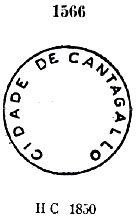
It was followed by the rare CRJ-0295b, presumably in service from 1857 (when Cantagallo became a town) and presented by Paulo Ayres in the Catálogo de Carimbos Brasil-Império, (S. Paulo, 1937, 1942) under no. 1566:

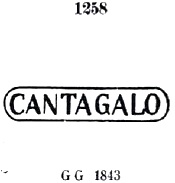
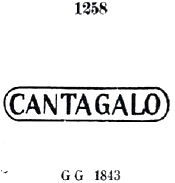
CRJ-0295c is a remake of CRJ-0295a and is often confused with it, but here the corners have been replaced by curves. It is available in red, green and blue and can also be seen at Paulo Ayres (op. cit.), now under no. 1258:
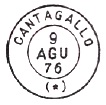
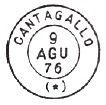
The French type CRJ-0295d was used between 1867 and 1888 and is also shown at Ayres:
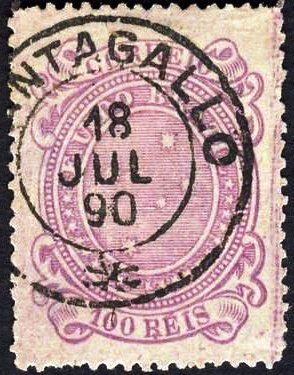
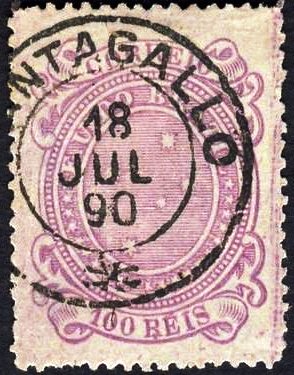
In the late imperial period CRJ-0295e (Fig. Dieter Kerkhoff) was added:
And R. Koester showed us in Carimbologia VIII the seal cancel CRJ-0295f (RK)

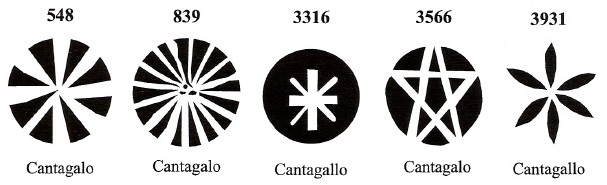
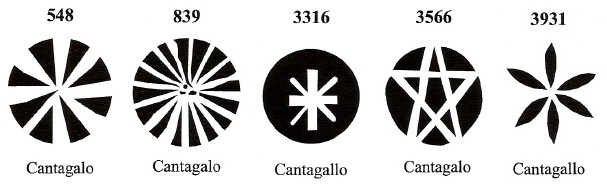
Five mute cancellations from the imperial Cantagallo were registered by James Dingler and Klerman W. Lopes in Mute Cancellations of the Brazil Empire / Carimbos Mudos do Brasil Império (Brazil Philatelic Association, Rio de Janeiro, 2000):

Die Freguesia de S. Pedro de Cantagallo wurde im Oktober 1806 gegründet, gehörte zur Vila de Sto. Antonio de Sá und lag 230 km nordöstlich der Hauptstadt Rio de Janeiro. Im März 1814 wurde es zur Vila und im Oktober 1857 zur Stadt erhoben.
Wie Nova Monteiro in Administrações e Agencias Postaes do Brasil Imperio (Brasil Filatelico/RJ, 1934-5; Reprint SPP 1994-1999) schreibt, gab es dort ein Postamt ab Januar 1820. Vorphilatelistische Belege sind hier sehr selten, aber man vermutet, dass der erste Poststempel CRJ-0295a ist. Die Abbildung im RHM-Katalog ist hier nicht sehr genau, da es sich eigentlich um ein Sechseck handelt, wie die Abbildung im Henrique B. Ferreiras Catálogo ilustrado dos carimbos sobre os olhos-de-boi (4a. ed, Porto Alegre, 2017) zeigt:

Ihm folgte der seltene CRJ-0295b, der vermutlich ab 1857 (als Cantagallo eine Stadt wurde) eingesetzt wurde und durch Paulo Ayres im Catálogo de Carimbos Brasil-Império (S. Paulo, 1937, 1942) mit Nr. 1566 bekannt ist:
CRJ-0295c ist ein Remake von CRJ-0295a und wird oft mit diesem verwechselt, aber hier wurden die Ecken durch Rundungen ersetzt. Es gibt ihn in rot, grün und blau, er ist auch bei Paulo Ayres (op. cit.) zu sehen, diesmal unter Nr. 1258:
Der französische Typ CRJ-0295d wurde zwischen 1867 und 1888 verwendet und ist auch bei Ayres abgebildet:
In der späten Kaiserzeit kam CRJ-0295e (Abb. Dieter Kerkhoff) hinzu:
Und R. Koester zeigte uns in Carimbologia VIII den Siegelstempel CRJ-0295f (RK)

Fünf stumme Entwertungen aus dem kaiserlichen Cantagallo wurden von James Dingler und Klerman W. Lopes in Mute Cancellations of the Brazil Empire / Carimbos Mudos do Brasil Império (Brazil Philatelic Association, Rio de Janeiro, 2000) registriert:

 Carimbologia