
Other names: Capivary do Paraíso, Tapiry, Consolação (1943)
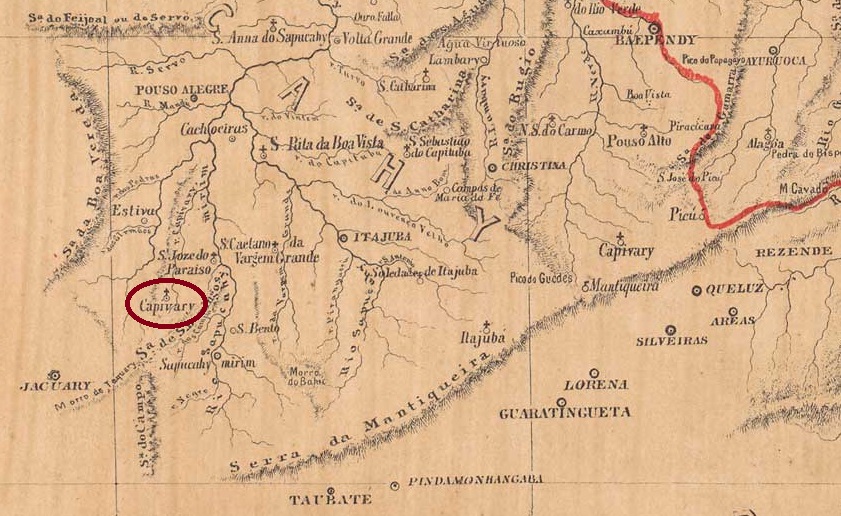
The name Capivary (now spelled Capivari) was and is widely used in Brazil and means river of the Capibaras in the Tupi-Guarani language. The first of three Capivary post offices in Imperial Minas Gerais was the Freguesia de N. Sra. da Consolação do Capivary, founded in July 1857. It belonged to the Vila de S. José do Paraíso (today: Paraisópolis) and was located on the west bank of the Capivari, 490 km southwest of the provincial capital Ouro Preto. The place name changed twice: in September 1923 to Tapiry (= River of the Tapirs) and in December 1943 to Consolação. Since December 1963, Consolação has been a town in its own Município.
Paula Sobrinho in História Postal de Minas Gerais (Belo Horizonte, 1997) and Reinhold Koester in Carimbologia IX agree that there was a post office there since March 1883. So far, a handwritten cancellation from about 1884 has been found, which is illustrated in Koester (loc. cit.):

Obviously, the first postmark was not delivered in time. It was not until the end of the Empire that CMG-3725a (FM collection) was in use:

Andere Namen: Capivary do Paraíso, Tapiry, Consolação (1943)
Der Name Capivary (heute Capivari geschrieben) war und ist in Brasilien weit verbreitet und bedeutet in der Tupi-Guarani-Sprache Fluss der Capibaras. Das erste von drei Capivary-Postämtern in der kaiserlichen Provinz Minas Gerais war die Freguesia de N. Sra. da Consolação do Capivary, die im Juli 1857 gegründet wurde. Sie gehörte zur Vila de S. José do Paraíso (heute: Paraisópolis) und lag am Westufer des Capivari, 490 km südwestlich der Provinzhauptstadt Ouro Preto. Der Ortsname wurde zweimal geändert: im September 1923 in Tapiry (= Fluss der Tapire) und im Dezember 1943 in Consolação. Seit Dezember 1963 ist Consolação eine Stadt im eigenen Município.
Paula Sobrinho in História Postal de Minas Gerais (Belo Horizonte, 1997) und Reinhold Koester in Carimbologia IX sind sich einig, dass es dort seit März 1883 ein Postamt gab. Von dort konnte bisher zunächst eine handschriftliche Entwertung von ca. 1884 gefunden werden, die bei Koester (a.a.O.) abgebildet ist:

Offenbar war der erste Poststempel nicht rechtzeitig eingeliefert. Erst gegen Ende des Kaiserreichs war CMG-3725a (Abb. Sammlung FM) in Gebrauch:


 Carimbologia