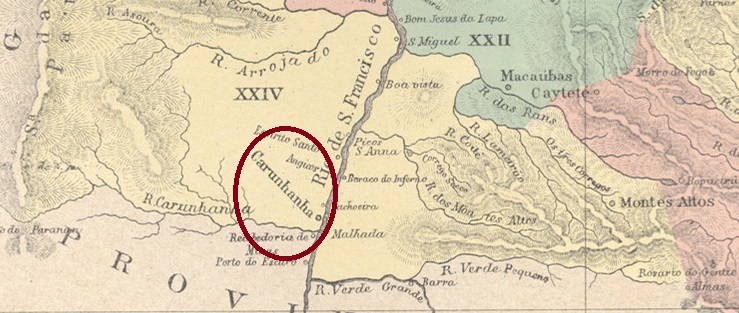
Other names: Carunhanha
The name Carinhanha (or Carunhanha) is of Indian origin and means frog hole.
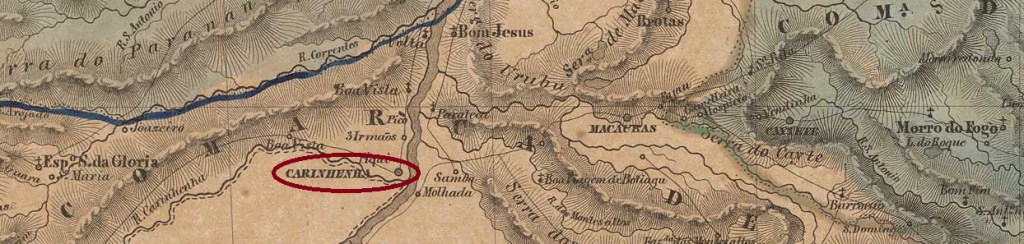
The Freguesia de S. José da Carinhanha was founded in August 1806, belonged to the Vila da Barra do Rio Grande and was located on the mouth of the river with the same name on the west bank of the São Francisco, then in the Capitania of Pernambuco. When it became a vila in April 1832, it was already in the imperial province of Bahia. Since August 1909, Carinhanha has been a town.
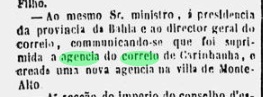
During the imperial period alone, there were three periods of operation for the local post office. The first began in December 1836, as Nova Monteiro writes in Administrações e Agencias Postaes do Brasil Imperio (Brasil Filatelico/RJ, 1934-5; Reprint SPP 1994-1999), and ended in May 1852, as reported by the Rio press:
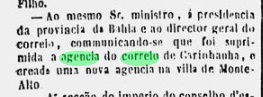
The second establishment of the postal agency must have taken place before 1854, as shown in the 1859 report of the Imperial Ministry. Since the post office is still mentioned in an official bulletin in July 1861, it must have been closed later. The third period of operation probably began in 1866, as shown in the Directory of Imperial Post Offices (Tabella das Agencias do Correio do Imperio, Rio de Janeiro, 1885).
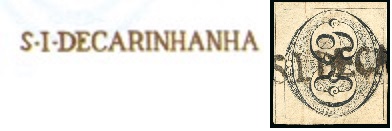
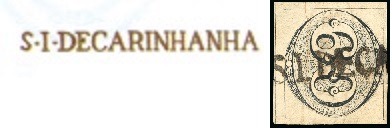
The oldest cancel so far is CBA-0260a and dates from the first period of operation, as it was found on Bull’s-Eye issues from 1843:
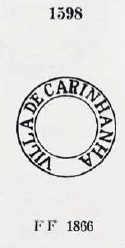
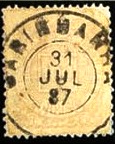
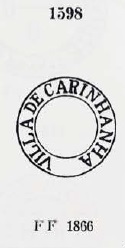
CBA-0260b appeared around 1866, listed in Paulo Ayres’s Catálogo de Carimbos Brasil-Império (S. Paulo, 1937, 1942) as no. 1598
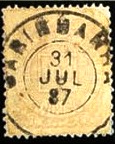
In the 1980s the double circle CBA-0260c (Fig. Felipe Piccinini) appeared:
Andere Namen: Carunhanha
Der Name Carinhanha oder Carunhanha ist indianischen Ursprungs und bedeutet Froschloch.
Die Freguesia de S. José da Carinhanha wurde im August 1806 gegründet, gehörte zur Vila da Barra do Rio Grande und lag an der Mündung des gleichnamigen Flusses am Westufer des São Francisco, damals noch in der Capitania von Pernambuco. Als es im April 1832 zur Vila wurde, lag es bereits in der kaiserlichen Provinz Bahia. Seit August 1909 ist Carinhanha eine Stadt.
Allein in der Kaiserzeit gab es drei Betriebsperioden für das örtliche Postamt. Die erste begann im Dezember 1836, wie Nova Monteiro in Administrações e Agencias Postaes do Brasil Imperio (Brasil Filatelico/RJ, 1934-5; Reprint SPP 1994-1999) schreibt, und endete im Mai 1852, wie die Presse von Rio berichtete:
Die zweite Gründung der Postagentur muss vor 1854 stattgefunden haben, wie aus einem Bericht des Reichsministeriums von 1859 hervorgeht. Da das Postamt noch im Juli 1861 in einem amtlichen Bulletin erwähnt wird, muss es später geschlossen worden sein. Die dritte Betriebsperiode begann vermutlich 1866, wie aus dem Verzeichnis der kaiserlichen Postämter (Tabella das Agencias do Correio do Imperio, Rio de Janeiro, 1885) hervorgeht.
Der bisher älteste Stempel ist CBA-0260a und stammt aus der ersten Betriebsperiode, da er auf Ochsenaugen-Ausgaben von 1843 gefunden wurde:
Um 1866 erschien CBA-0260b, der in Paulo Ayres‘ Catálogo de Carimbos Brasil-Império (S. Paulo, 1937, 1942) unter der Nr. 1598 geführt wird.
In den 80er Jahren kam der Doppelkreis CBA-0260c (Abb. Felipe Piccinini) hinzu:

 Carimbologia