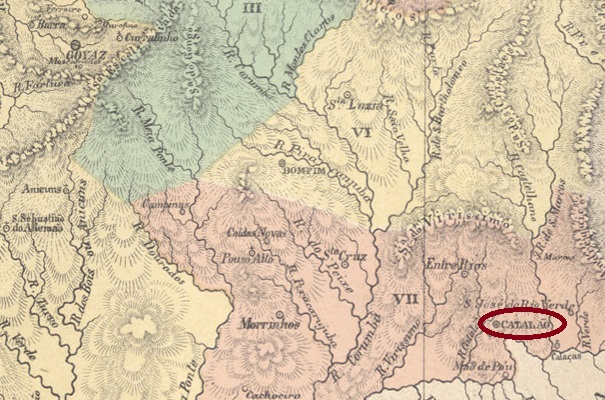
The Vila de N. Sra. Madre de Deus do Catalão was founded in April 1833 and is located on the north bank of the Paranaíba, 400 kilometres south-east of the ancient provincial capital of Goyaz (now Goiás Velho). It was only declared a freguesia in July 1835 and was elevated to a town in August 1859.
Two dates have been found for the founding of the local post office. Nova Monteiro mentions March 1829 in Administrações e Agencias Postaes do Brasil Imperio (Brasil Filatelico/RJ, 1934-5; reprint SPP 1994-1999), while the agency is mentioned in the Directory of Imperial Post Offices (Tabella das Agencias do Correio do Imperio, Rio de Janeiro, 1885) from 1832 on. The oldest postmark to date is CGO-0035a, which can be seen on Bull’s-Eye issues from 1843 and was already shown by Paulo Ayres in Catálogo de Carimbos Brasil-Império (S. Paulo, 1937, 1942) with no. 1268:
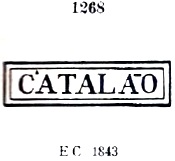
This cancel broke at some point and there was no replacement. Therefore, the stamps were cancelled by hand, as also noted by P. Ayres (op. cit.):

CGO-0035b (fig. R. Koester, in Carimbologia X) was introduced about 1881 and remained in use until at least 1899:

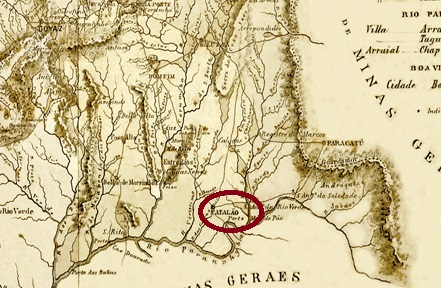
Die Vila de N. Sra. Madre de Deus do Catalão wurde im April 1833 gegründet und liegt am Nordufer des Paranaíba, 400 km südöstlich der damaligen Provinzhauptstadt Goyaz (heute Goiás Velho). Es wurde erst im Juli 1835 zur Freguesia erklärt und im August 1859 zur Stadt erhoben.
Für die Gründung des örtlichen Postamtes wurden zwei Daten gefunden. Nova Monteiro nennt dafür den März 1829 in Administrações e Agencias Postaes do Brasil Imperio (Brasil Filatelico/RJ, 1934-5; Reprint SPP 1994-1999), während die Agentur im Verzeichnis der kaiserlichen Postämter (Tabella das Agencias do Correio do Imperio, Rio de Janeiro, 1885) ab 1832 erwähnt wird. Der bisher älteste Poststempel ist CGO-0035a, der auf Ochsenaugen-Ausgaben von 1843 zu sehen ist und bereits von Paulo Ayres in Catálogo de Carimbos Brasil-Império (S. Paulo, 1937, 1942) mit Nr. 1268 gezeigt wurde:
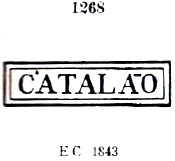
Dieser Stempel ging irgendwann kaputt und es gab keinen Ersatz. Daher wurden die Marken von Hand entwertet, wie auch bei P. Ayres (op. cit.) vermerkt:

Erst ab etwa 1881 wurde CGO-0035b (Abb. R. Koester, in Carimbologia X) eingeführt und bis mindestens 1899 verwendet:


 Carimbologia