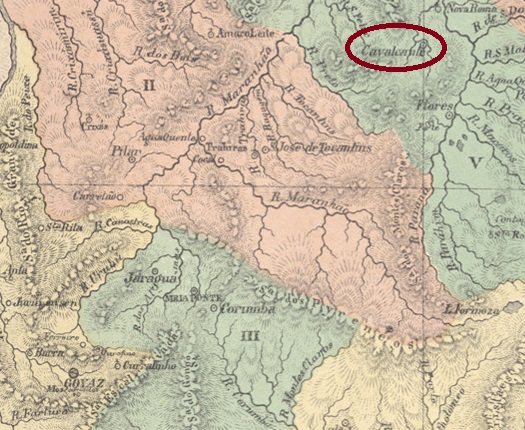
Little is known about this place. The settlement is said to have originated 580 kilometres north-east of the later provincial capital of Goyaz (today Goiás Velho) in 1740, became the Freguesia Sant’Anna de Cavalcante in 1759 and a Vila in November 1831. However, the Brazilian statistics authority IBGE records another appointment as a freguesia in July 1835, so there is still a need for research here.
Two foundation dates were found for the local post office. One is 1832, as can be read in the directory of imperial post offices (Tabella das Agencias do Correio do Imperio, Rio de Janeiro, 1885). Then again in January 1851, as Nova Monteiro writes in Administrações e Agencias Postaes do Brasil Imperio (Brasil Filatelico/RJ, 1934-5; reprint SPP 1994-1999). The only imperial postmark to date is CGO-0040a, which according to the RHM catalogue (no. P-GO-02) was used from around 1832.

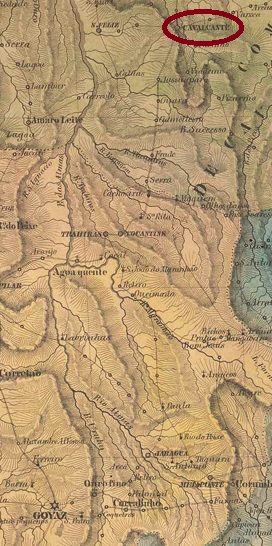
Über diesen Ort ist wenig bekannt. Die Siedlung soll 1740 580 km nordöstlich der späteren Provinzhauptstadt Goyaz (heute Goiás Velho) entstanden sein, wurde bereits 1759 zur Freguesia Sant’Anna de Cavalcante und im November 1831 zur Vila. Die brasilianische Statistikbehörde IBGE verzeichnet jedoch eine weitere Ernennung zur Freguesia im Juli 1835, so dass hier noch Klärungsbedarf besteht.
Für das örtliche Postamt wurden zwei Gründungsdaten gefunden. Einmal 1832, wie im Verzeichnis der kaiserlichen Postämter (Tabella das Agencias do Correio do Imperio, Rio de Janeiro, 1885) zu lesen ist. Dann wieder im Januar 1851, wie Nova Monteiro in Administrações e Agencias Postaes do Brasil Imperio (Brasil Filatelico/RJ, 1934-5; Reprint SPP 1994-1999) schreibt. Der bisher einzige kaiserliche Poststempel ist CGO-0040a, der laut RHM-Katalog (Nr. P-GO-02) ab ca. 1832 verwendet wurde.


 Carimbologia