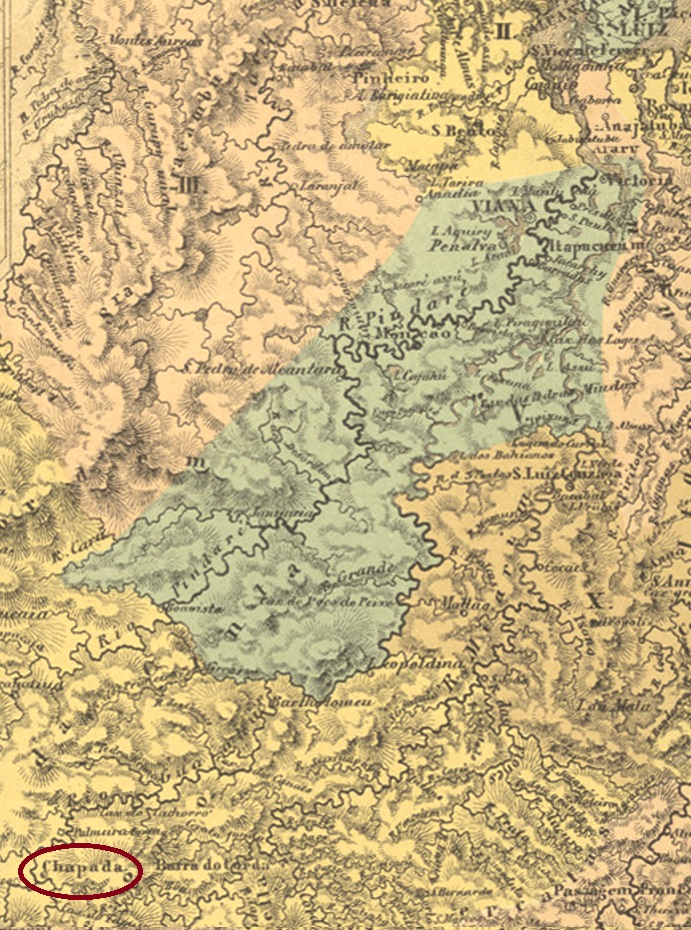
The history of this settlement begins around 1811 with the construction of a harbour at Fazenda Chapada on the west bank of the Grajaú, 560 km south of the later provincial capital S. Luís do Maranhão. As early as 1817, the Arraial was called S. Paulo do Norte and belonged to the Vila de Pastos Bons. In April 1835, it was elevated to Vila do Senhor do Bomfim da Chapada, which became the town of Grajaú in April 1881.
There are three creation dates for the local post office. They are so close together that they can be safely summarised. The first was at the end of March 1856, as Aureo G. Santos writes in Agências de Correio Criadas e Suprimidas 1851, 1855, 1856 e 1857 (Brasil Filatélico 181, Rio de Janeiro, 1977):

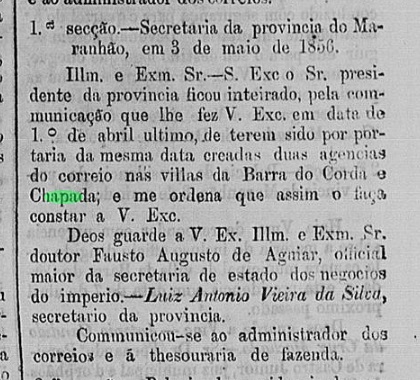
The regional press mentions on the other hand 1 April 1856:
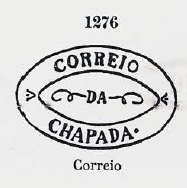
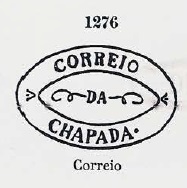
And R. Koester indicates 5 April 1856 in Carimbologia XI. The oldest postmark to date is CMA-0085a with the typical shape for the province of Maranhão, which was already presented by P. Ayres in Catálogo de Carimbos Brasil-Império (S. Paulo, 1937, 1942) with no. 1276:
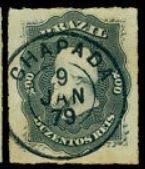
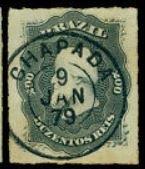
It was followed by the double circle CMA-0085b (illustration from the Internet):
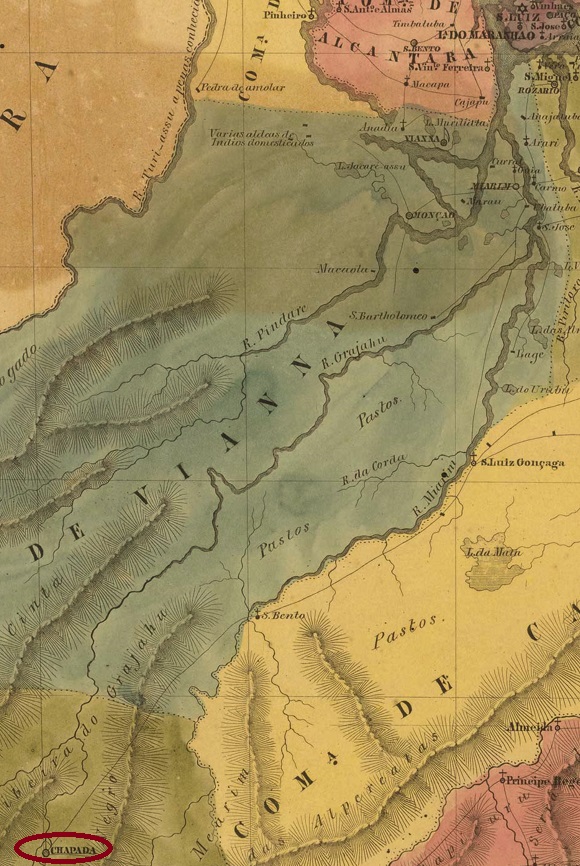
Die Geschichte der Siedlung beginnt um 1811 mit dem Bau eines Hafens der Fazenda Chapada am Westufer des Grajaú, 560 km südlich der späteren Provinzhauptstadt S. Luís do Maranhão. Bereits 1817 hieß der Arraial S. Paulo do Norte und gehörte zur Vila de Pastos Bons. Im April 1835 erfolgte die Erhebung zur Vila do Senhor do Bomfim da Chapada, die seit April 1881 die Stadt Grajaú ist.
Es gibt drei Gründungsdaten für das örtliche Postamt. Sie liegen so nahe beieinander, dass man sie getrost zusammenfassen kann. Zum ersten Mal Ende März 1856, wie Aureo G. Santos in Agências de Correio Criadas e Suprimidas 1851, 1855, 1856 e 1857 (Brasil Filatélico 181, Rio de Janeiro, 1977) schreibt:

Die regionale Presse erwähnt dafür den 1. April 1856:

Und R. Koester gibt in Carimbologia XI den 5. April 1856 an. Der bisher älteste Poststempel ist CMA-0085a mit der für die Provinz Maranhão typischen Form, der bereits von P. Ayres in Catálogo de Carimbos Brasil-Império (S. Paulo, 1937, 1942) mit Nr. 1276 vorgestellt wurde:
Ihm folgte der Doppelkreis CMA-0085b (Abbildung aus dem Internet):

 Carimbologia