
Text update on March 1st, 2026
Other names: Campo de Palmas, Passo Bormann, Passo dos Indios
In its relatively short history, the locality has experienced many turbulent times. At times it belonged to the province of São Paulo, at other times to the province of Paraná, was courted by Argentina, was placed in an autonomous region and yet has been part of the state of Santa Catarina for more than a century.
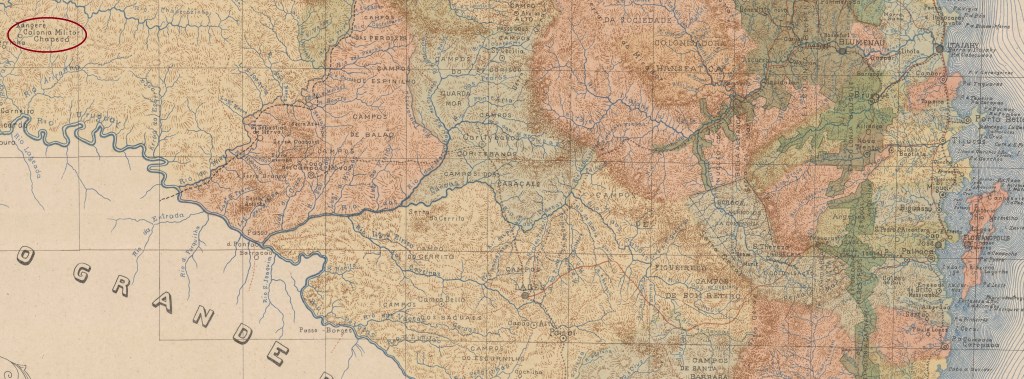
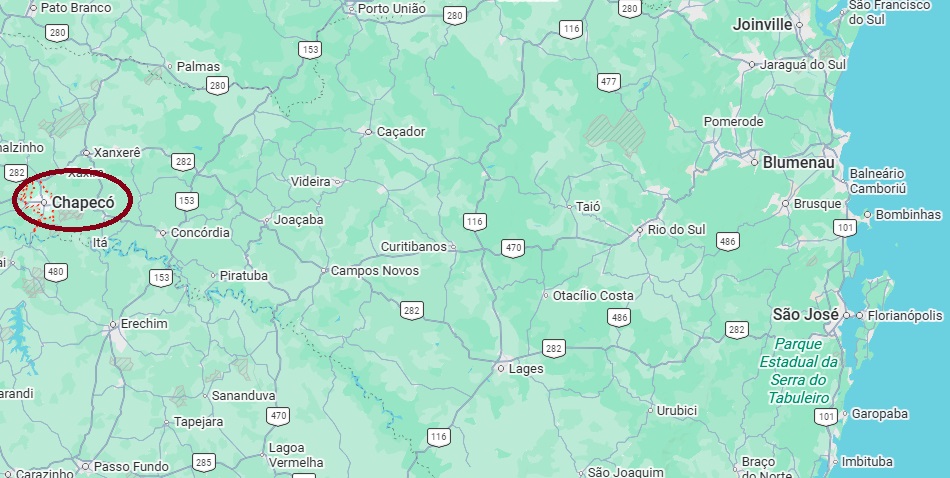
Settlement began around 1839 as Povoação de Campo de Palmas, 560 kilometres west of the future capital Florianópolis, but still part of the province of São Paulo. In August 1853, it became a colony called Vila de Palmas, which then belonged to the province of Paraná. The territory aroused covetousness in Argentina, which is why the Brazilian Empire established a military colony called Xapecó in November 1859. However, this did not begin operations until March 1882, a sign of political détente.
Three name changes followed. The first in August 1917 as Município de Passo Bormann, already in the state of Sta. The lieutenant José Bernardino Bormann (1844-1919), born in Porto Alegre from a German family, was the colony’s first director. In April 1931, it was renamed Município de Passo dos Indios. This name was obviously not well received, because in March 1938 it was renamed for the third time to Chapecó, as it is still known today. Between 1943 and 1946, Chapecó was in the Território do Iguaçu, an autonomous region created for geopolitical reasons.
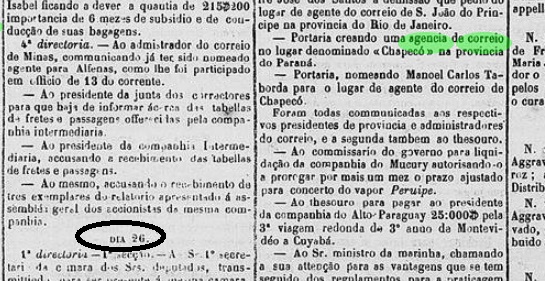
The historical turmoil is reflected in the postal system. So far, three creation dates have been found for the local post office, but no postmarks. First in June 1862, as Nova Monteiro writes in Administrações e Agencias Postaes do Brasil Imperio (Brasil Filatelico/RJ, 1934-5; reprint SPP 1994-1999) and is confirmed by the press in Rio:
Then again in 1864, as R. Koester (Carimbologia XI) notes. And finally in June 1882, as also reported by Koester and the press in Rio:

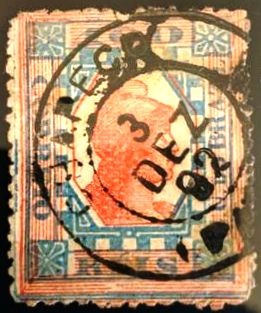
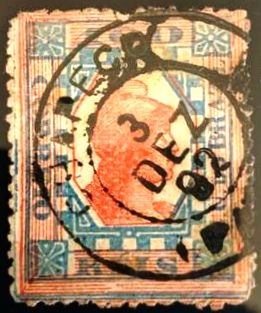
Until now, the only known ‘postmark’ was a handwritten cancellation on a D. Pedro issue from 1866, as mentioned by R. Koester – unfortunately without an illustration. In the meantime, the double circle CPR-0045b (illustration by Alexandre Andrade) has been found:
Texto atualizado em 1º de março de 2026
Outros nomes: Campo de Palmas, Passo Bormann, Passo dos Indios
Em sua história relativamente curta, a localidade passou por muitos momentos de turbulência. Em alguns momentos, pertenceu à província de São Paulo, em outros, à província do Paraná, foi cortejada pela Argentina, estava localizada em uma região autônoma e além disso faz parte do estado de Santa Catarina há mais de um século.
A colonização começou por volta de 1839 como Povoação de Campo de Palmas, 560 quilômetros a oeste da futura capital Florianópolis, mas ainda parte da província de São Paulo. Em agosto de 1853, tornou-se uma colônia chamada Vila de Palmas, que então pertencia à província do Paraná. O território despertou a cobiça da Argentina, razão pela qual o Império brasileiro criou uma colônia militar chamada Xapecó em novembro de 1859. No entanto, ela só começou a funcionar em março de 1882, um sinal de distensão política.
Seguiram-se três mudanças de nome. A primeira, em agosto de 1917, como Município de Passo Bormann, já no estado de Sta. O tenente gaúcho de origem alemã José Bernardino Bormann (1844-1919) foi o primeiro diretor da colônia. Em abril de 1931, passou a se chamar Município de Passo dos Índios. Esse nome obviamente não foi bem recebido, pois em março de 1938 foi renomeado pela terceira vez para Chapecó, como é conhecido até hoje. Entre 1943 e 1946, Chapecó estava localizada no Território do Iguaçu, uma região autônoma criada por razões geopolíticas.
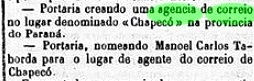
A turbulência histórica se reflete nos seus correios. Foram encontradas três datas de fundação para o correio local, mas sem carimbos postais. A primeira foi em junho de 1862, como escreve Nova Monteiro em Administrações e Agencias Postaes do Brasil Imperio (Brasil Filatelico/RJ, 1934-5; reimpressão SPP 1994-1999) e é confirmada pela imprensa do Rio:
Depois, novamente em 1864, como observa R. Koester (Carimbologia XI). E, finalmente, em junho de 1882, como também relatado por Koester e pela imprensa do Rio:

Até agora, o único “carimbo postal” conhecido era uma oobliteração manuscrita em um selo de D. Pedro de 1866, conforme mencionado por R. Koester — infelizmente sem ilustração. Entretanto, agora foi encontrado o círculo duplo CPR-0045b (ilustração de Alexandre Andrade):
Textaktualisierung am 1. März 2026
Andere Namen: Campo de Palmas, Passo Bormann, Passo dos Indios
In seiner relativ kurzen Geschichte hat der Ort viele bewegte Zeiten erlebt. Sie gehörte mal zur Provinz São Paulo, mal zur Provinz Paraná, wurde von Argentinien umworben, lag in einem autonomen Gebiet und ist doch seit mehr als einem Jahrhundert Teil des Bundesstaates Santa Catarina.
Die Besiedlung begann um 1839 als Povoação de Campo de Palmas, 560 km westlich der späteren Hauptstadt Florianópolis, aber noch zur Provinz São Paulo gehörig. Im August 1853 wurde daraus eine Kolonie mit dem Namen Vila de Palmas, die dann zur Provinz Paraná gehörte. Das Gebiet weckte Begehrlichkeiten in Argentinien, weshalb das bras. Kaiserreich im November 1859 eine Militärkolonie namens Xapecó. Diese nahm jedoch erst im März 1882, als Zeichen der politischen Entspannung, ihren Betrieb auf.
Es folgten drei Namensänderungen. Die erste im August 1917 als Município de Passo Bormann, bereits im Staat Sta. Catarina. Der in Porto Alegre geborene, deutschstämmige Leutnant José Bernardino Bormann (1844-1919) war der erste Direktor der Kolonie. Im April 1931 wurde sie dann in Município de Passo dos Indios umbenannt. Dieser Name kam offensichtlich nicht gut an, denn bereits im März 1938 erfolgte die dritte Umbenennung in die Stadt Chapecó, wie sie heute noch bekannt ist. Zwischen 1943 und 1946 lag Chapecó im Território do Iguaçu, einem aus geopolitischen Gründen geschaffenen autonomen Gebiet.
Die historischen Wirren spiegeln sich im Postwesen wider. Für das örtliche Postamt wurden bisher drei Gründungsdaten, aber keine Poststempel gefunden. Zuerst im Juni 1862, wie Nova Monteiro in Administrações e Agencias Postaes do Brasil Imperio (Brasil Filatelico/RJ, 1934-5; Nachdruck SPP 1994-1999) schreibt und von der Presse in Rio bestätigt wird:
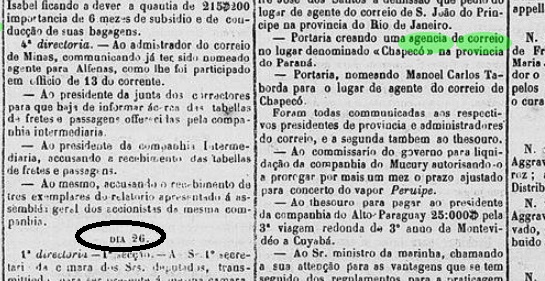
Dann wieder 1864, wie R. Koester (Carimbologia XI) bemerkt. Und zuletzt im Juni 1882, wie ebenfalls von Koester und der Presse in Rio berichtet:

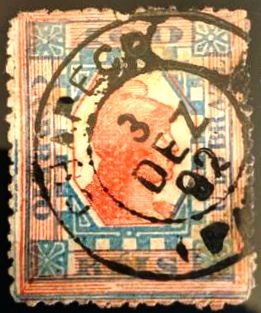
Als bisher einziger „Poststempel“ galt eine handschriftliche Entwertung auf einer D. Pedro-Marke von 1866, wie bei R. Koester – leider ohne Abbildung – erwähnt. Inzwischen wurde der Doppelkreis CPR-0045b (Abb. Alexandre Andrade) gefunden:

 Carimbologia