Updated on January 21, 2024
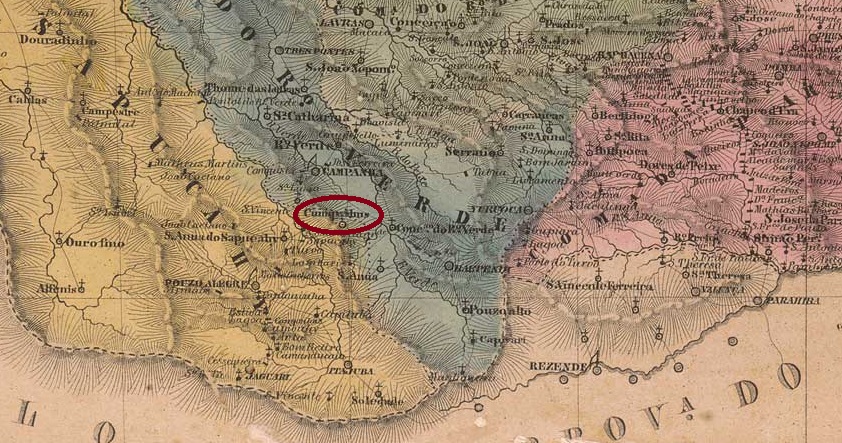
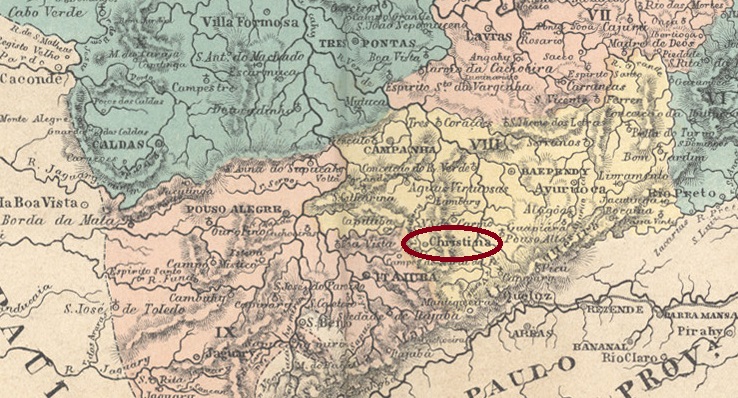
This village was the Curato do Espirito Santo de Cumquibus (sic) from 1824 and belonged to the Freguesia de Carmo do Rio Verde, which in turn belonged to the Vila de Baependy, and was located on the east bank of the Lambari, 370 kilometres southwest of the provincial capital Ouro Preto. In April 1841, it became a freguesia, which was incorporated into the Vila de Boa Vista de Itajubá in September 1848. In June 1850 it was elevated to Villa Christina, in honour of Empress Teresa Cristina, and since July 1872 Cristina (as it is spelled today) has been a town.
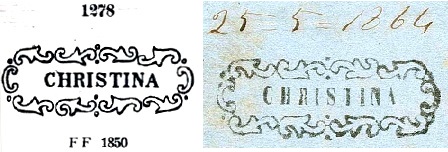
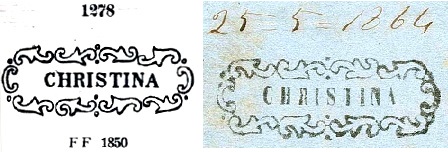
There has been a post office since August 1856, as several sources agree. The first postmark is CMG-0745a, which was used until 1870 and also exists in red. Since the illustration in P. Ayres’ Catálogo de Carimbos Brasil-Império (P.A. 1278, S. Paulo, 1937, 1942) does not exactly reproduce the shape of the letters, here is an additional illustration from the Corinphila auction catalogue:
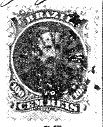
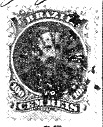
Sometime around 1868 a mute cancel was also used (fig. R. Koester, in Carimbologia XI):
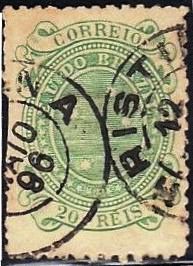
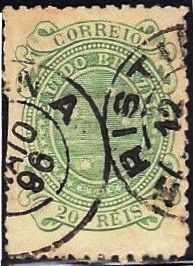
It was not until the 1880s that the double circle CMG-0745b (illustration from the Internet) has arrived:
Textaktualisierung am 21. Januar 2024
Der Ort war ab 1824 Curato do Espirito Santo de Cumquibus (sic) und gehörte zur Freguesia de Carmo do Rio Verde, die wiederum zur Vila de Baependy gehörte, und lag am Ostufer des Lambari, 370 km südwestlich der Provinzhauptstadt Ouro Preto. Im April 1841 wurde es zu einer Freguesia, die im September 1848 in die Vila de Boa Vista de Itajubá eingegliedert wurde. Im Juni 1850 erfolgte die Erhebung zur Villa Christina, zu Ehren der Kaiserin Teresa Cristina, und seit Juli 1872 ist Cristina (wie es heute geschrieben wird) eine Stadt.
Seit August 1856 gibt es ein Postamt, wie mehrere Quellen übereinstimmend berichten. Der erste Poststempel ist CMG-0745a, der bis 1870 verwendet wurde und auch in Rot existiert. Da die Abbildung in P. Ayres‘ Catálogo de Carimbos Brasil-Império (P.A. 1278, S. Paulo, 1937, 1942) die Form der Buchstaben nicht genau wiedergibt, hier zusätzlich eine Abbildung aus dem Auktionskatalog Corinphila:
Irgendwann um 1868
Irgendwann um 1868 wurde auch ein stummer Stempel verwendet (Abb. R. Koester, in Carimbologia XII):
Erst in den 80er Jahren wurde der Doppelkreis CMG-0745b (Abb. aus dem Internet) hinzugefügt:

 Carimbologia