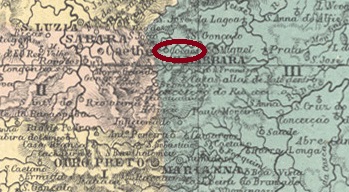
Other names: Macacos, Morro Grande, Barão de Cocais (1943)
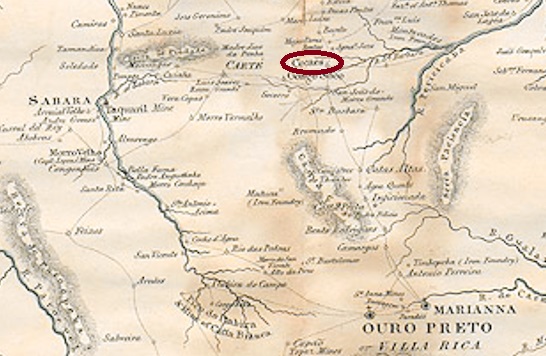
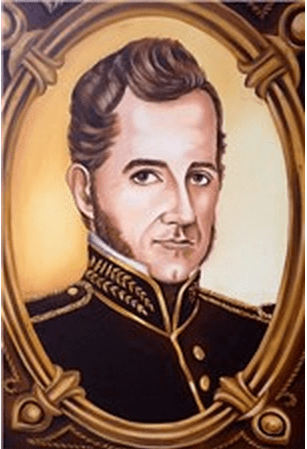
In January 1752, the village is said to have been called Arraial de Macacos (Monkey Village), which belonged to the Freguesia de S. João de Morro Grande and was located on the Rio Santa Barbara, 80 kilometres north of the later provincial capital of Ouro Preto. The name Cocaes (coconut grove) is said to come from a mine in the area. In May 1856, the Freguesia de Sant’Anna de Cocaes was created in the Vila de Sta. Barbara, which has been Município de Barão de Cocais since December 1943. The noble name commemorates José Feliciano Pinto Coelho da Cunha (1792-1869), landowner, military man, politician, entrepreneur and governor of the province of Minas Gerais, who was born here and died as a baron.

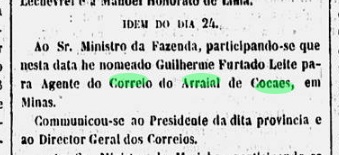
For the local post office, Nova Monteiro in Administrações e Agencias Postaes do Brasil Imperio (Brasil Filatelico/RJ, 1934-5; reprint SPP 1994-1999) gives the date of foundation as January 1848, when a postal agent was appointed:
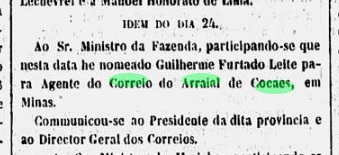
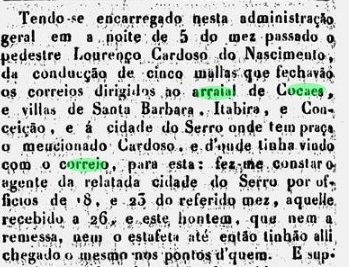
However, this date is in the middle of the second period of operation of the Cocaes post office. It has not yet been possible to determine when the first period of operation began, but it is known that there was regular postal traffic to Cocaes as early as October 1840:
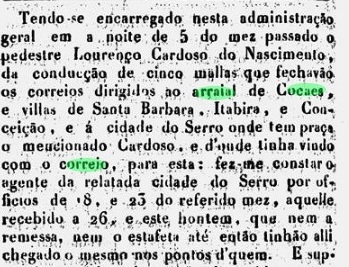
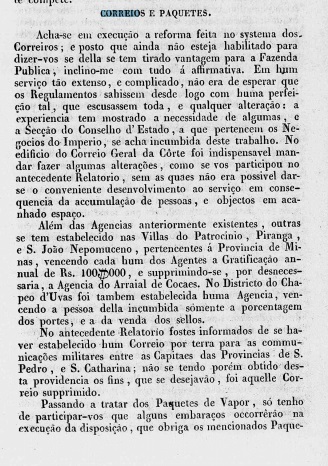
The first period of operation ended around 1843, as can be seen from the report of the Ministry of the Empire for the following year:

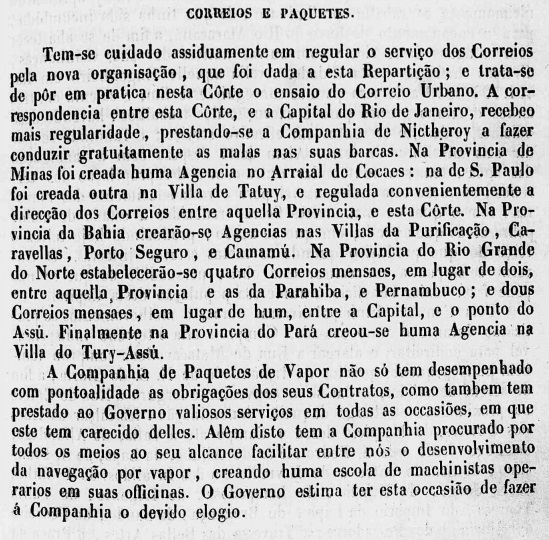
However, the Cocaes post office was soon reopened, as can be seen from the 1845 report:
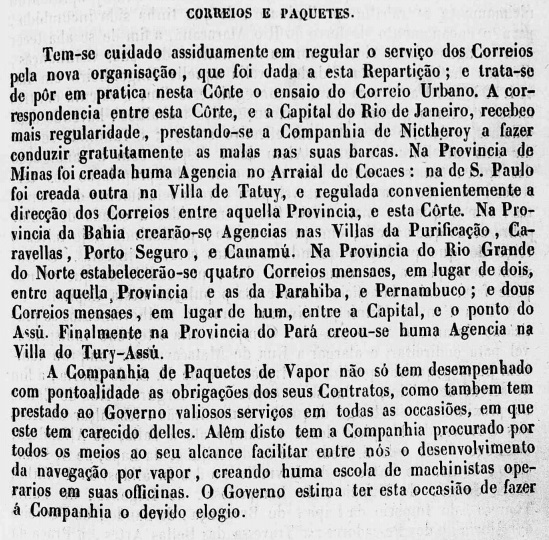
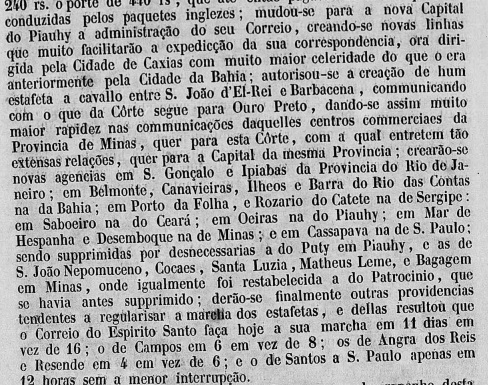
The second period of operation ended around 1851, as is also officially reported:
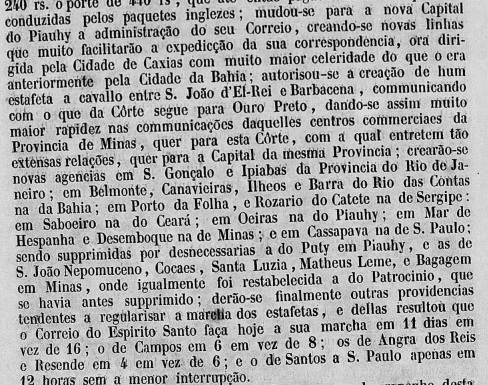
It was not until ten years later, in October 1862, that the third post office was opened in Cocaes, as R. Koester writes in Carimbologia XI and as the directory of imperial post offices (Tabella das Agencias do Correio do Imperio, Rio de Janeiro, 1885) confirms.
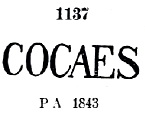
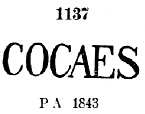
The oldest postmark there to date is CMG-0760a, known through Paulo Ayres (Catálogo de Carimbos Brasil-Império, S. Paulo, 1937, 1942) with no. 1137 from ca. 1843 on, but since it was assigned a pre-philatelic number in the RHM catalogue, it can be assumed that the postmark was also used in the first period of operation.
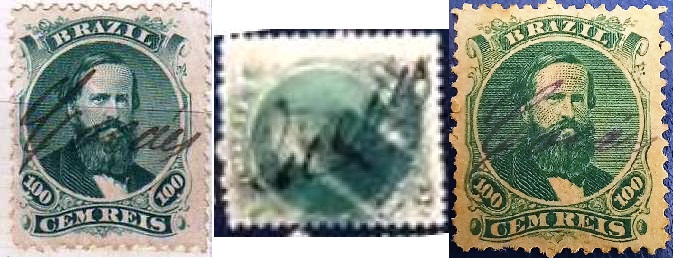
At the beginning of the third operating period, the old postmark must have become obsolete, as cancellations were made by hand from around 1866:
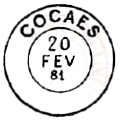
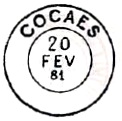
The successor postmark CMG-0760b, which is also illustrated in P. Ayres (op. cit.), was not used until around 1881:
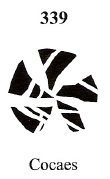
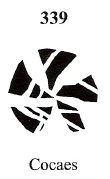
We also know a mute cancellation from Cocaes, which is illustrated both by P. Ayres (no. 29) and by James Dingler and Klerman W. Lopes (Mute Cancellations of the Brazil Empire / Carimbos Mudos do Brasil Império, Brazil Philatelic Association, Rio de Janeiro, 2000), here with no. 339:
Andere Namen: Macacos, Morro Grande, Barão de Cocais (1943)
Im Januar 1752 soll der Ort noch Arraial de Macacos (Affendorf) geheißen haben, das zur Freguesia de S. João de Morro Grande gehörte und am Rio Santa Barbara, 80 km nördlich der späteren Provinzhauptstadt Ouro Preto lag. Der Name Cocaes (Kokoshain) soll von einer Mine in der Gegend stammen. Im Mai 1856 erfolgte die Erhebung zur Freguesia de Sant’Anna de Cocaes in der Vila de Sta. Barbara, die seit Dezember 1943 Município de Barão de Cocais ist. Der Adelsname erinnert an José Feliciano Pinto Coelho da Cunha (1792-1869), Großgrundbesitzer, Militär, Politiker, Unternehmer und Gouverneur der Provinz Minas Gerais, der hier geboren wurde und als Baron starb.
Für das örtliche Postamt gibt Nova Monteiro in Administrações e Agencias Postaes do Brasil Imperio (Brasil Filatelico/RJ, 1934-5; Reprint SPP 1994-1999) als Gründungsdatum den Januar 1848 an, als ein Postagent ernannt wurde:
Dieses Datum liegt jedoch in der Mitte der zweiten Betriebsperiode des Postamts Cocaes. Wann die erste Betriebsperiode begann, konnte bisher nicht festgestellt werden, aber es ist bekannt, dass es bereits im Oktober 1840 einen regelmäßigen Postverkehr nach Cocaes gab:
Die erste Betriebsperiode endete um 1843, wie aus dem Bericht des Reichsministeriums für das folgende Jahr hervorgeht:
Das Postamt von Cocaes wurde jedoch bald wieder eröffnet, wie aus dem Bericht von 1845 hervorgeht:
Die zweite Betriebsperiode endete um 1851, wie ebenfalls offiziell berichtet wird:
Erst zehn Jahre später, im Oktober 1862, fand die dritte Postamteröffnung in Cocaes statt, wie R. Koester in Carimbologia XI schreibt und wie das Verzeichnis der kaiserlichen Postämter (Tabella das Agencias do Correio do Imperio, Rio de Janeiro, 1885) bestätigt.
Der bisher älteste Stempel dort ist CMG-0760a, bekannt durch Paulo Ayres (Catálogo de Carimbos Brasil-Império, S. Paulo, 1937, 1942) mit Nr. 1137 ab ca. 1843. Da ihm jedoch im RHM-Katalog eine Prephila-Nummer zugeordnet wurde, ist davon auszugehen, dass der Stempel auch in der ersten Betriebsperiode verwendet wurde.
Zu Beginn der dritten Betriebsperiode muss der alte Poststempel ausgedient haben, da ab ca. 1866 die Entwertung von Hand erfolgte:

Erst ab etwa 1881 wurde der Nachfolgestempel CMG-0760b verwendet, der auch bei P. Ayres (op. cit.) abgebildet ist:
Wir kennen auch einen stummen Stempel aus Cocaes, der sowohl bei P. Ayres (Nr. 29) als auch bei James Dingler und Klerman W. Lopes (Mute Cancellations of the Brazil Empire / Carimbos Mudos do Brasil Império, Brazil Philatelic Association, Rio de Janeiro, 2000) abgebildet ist, hier mit Nr. 339:

 Carimbologia