
Other names: Corumbá de Goiás (1943)
The Freguesia de N. Sra. da Penha de França de Corumbá was founded in December 1840, belonged to the Vila de Meia Ponte (today Pirenópolis) and was located on the west bank of the Corumbá, 190 km east of the provincial capital Goyaz (today Goiás Velho). The village was elevated to vila twice: in February 1849 and July 1875; in between it was again a Freguesia of Meia Ponte from August 1863. Since July 1902 it has been a town, which has been called Corumbá de Goiás since December 1943, to avoid confusion with the town of the same name in the state of Mato Grosso do Sul.
Two foundation dates were found for the local post office. The first was in August 1853, as Nova Monteiro writes in Administrações e Agencias Postaes do Brasil Imperio (Brasil Filatelico/RJ, 1934-5; reprint SPP 1994-1999) and is confirmed by the press in Rio:
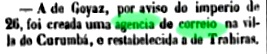
Then again in September 1854, as can also be read in Nova Monteiro (op. cit.) and is also mentioned by R. Koester in Carimbologia XIV. Koester also shows an illustration of the first postmark CGO-0050a:

It was followed by CGO-0050b, known through Paulo Ayres (Catálogo de Carimbos Brasil-Império, S. Paulo, 1937, 1942):

Towards the end of the 19th century, CGO-0050c (fig. Claudio Coelho) has also appeared:


Andere Namen: Corumbá de Goiás (1943)
Die Freguesia de N. Sra. da Penha de França de Corumbá wurde im Dezember 1840 gegründet, gehörte zur Vila de Meia Ponte (heute Pirenópolis) und lag am Westufer des Corumbá, 190 km östlich der Provinzhauptstadt Goyaz (heute Goiás Velho). Der Ort wurde zweimal zur Vila erhoben: im Februar 1849 und im Juli 1875; dazwischen war er ab August 1863 wieder eine Freguesia von Meia Ponte. Seit Juli 1902 ist es eine Stadt, die seit Dezember 1943 Corumbá de Goiás heißt, um Verwechslungen mit der gleichnamigen Stadt im Bundesstaat Mato Grosso do Sul zu vermeiden.
Für das örtliche Postamt wurden zwei Gründungsdaten gefunden. Erstmals im August 1853, wie Nova Monteiro in Administrações e Agencias Postaes do Brasil Imperio (Brasil Filatelico/RJ, 1934-5; Nachdruck SPP 1994-1999) schreibt und von der Presse in Rio bestätigt wird:
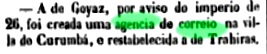
Dann wieder im September 1854, wie auch bei Nova Monteiro (op. cit.) zu lesen ist und auch von R. Koester in Carimbologia XIV erwähnt wird. Koester zeigt auch eine Abbildung des ersten Poststempels CGO-0050a:

Ihm folgte CGO-0050b, bekannt durch Paulo Ayres (Catálogo de Carimbos Brasil-Império, S. Paulo, 1937, 1942):

Ende des 19. Jahrhunderts kam auch CGO-0050c (Abb. Claudio Coelho):


 Carimbologia