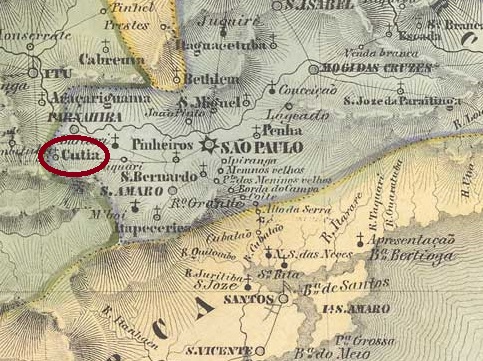
Other names: Acutia
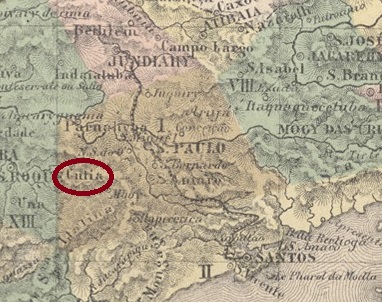
The Freguesia de N. Sra. de Monte Serrat de Cutia (also spelt Cotia) was founded in 1723 and belonged to the Vila de São Paulo, from which it was located 30 kilometres to the west. It became a Vila in April 1856 and a town in December 1906.
Nova Monteiro writes in Administrações e Agencias Postaes do Brasil Imperio (Brasil Filatelico/RJ, 1934-5; reprint SPP 1994-1999) that there had been a post office there since April 1833. This first operation was short-lived, as the directory of imperial post offices (Tabella das Agencias do Correio do Imperio, Rio de Janeiro, 1885) shows a second post office opening in 1844.
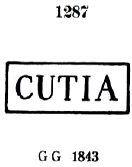
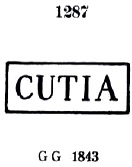
The oldest postmark to date is CSP-0395a, which also exists in brown and was already presented by P. Ayres in the Catálogo de Carimbos Brasil-Império (S. Paulo, 1937, 1942) with no. 1287:
It was followed by CSP-0395b, which also occurs in red and was also registered by P. Ayres, this time with the no. 1282:

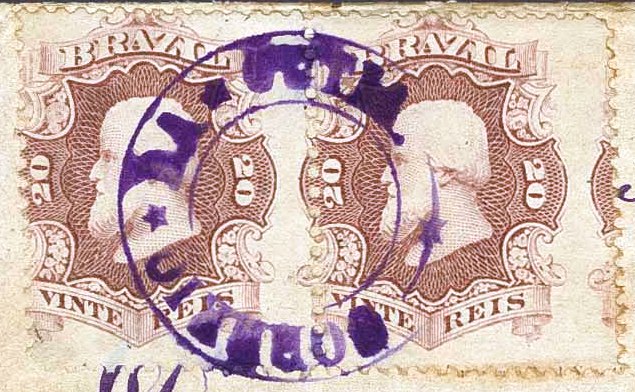
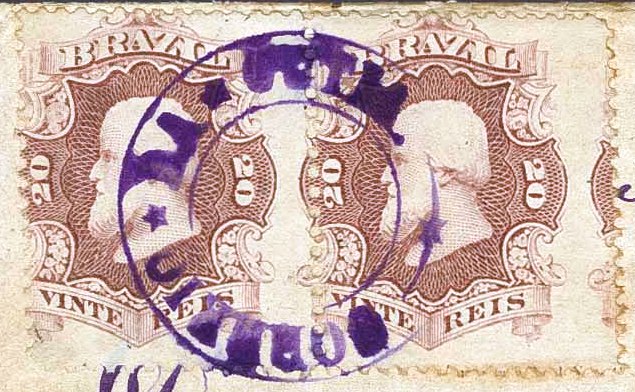
This was followed by circular cancellations, starting with the beautiful violet CSP-0395c (fig. Corinphila Auctions):
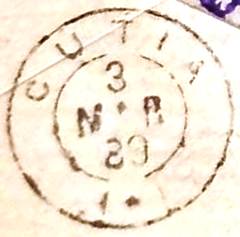
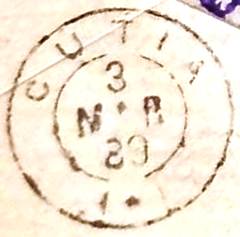
It was followed by CSP-0395d (fig. R. Koester, in Carimbologia XIV):

Parallel to it there was the French type CSP-0395e (coll. Fuad Ferreira Fo.):
Andere Namen: Acutia
Die Freguesia de N. Sra. de Monte Serrat de Cutia (auch Cotia geschrieben) wurde 1723 gegründet und gehörte zur Vila de São Paulo, von der sie 30 km westlich entfernt lag. Der Ort wurde im April 1856 zur Vila und im Dezember 1906 zur Stadt erhoben.
Nova Monteiro schreibt in Administrações e Agencias Postaes do Brasil Imperio (Brasil Filatelico/RJ, 1934-5; Nachdruck SPP 1994-1999), dass es dort seit April 1833 ein Postamt gab. Dieser erste Betrieb war nur von kurzer Dauer, denn aus dem Verzeichnis der kaiserlichen Postämter (Tabella das Agencias do Correio do Imperio, Rio de Janeiro, 1885) geht hervor, dass 1844 eine zweite Postamteröffnung stattfand.
Der bisher älteste Stempel ist CSP-0395a, der auch in Braun existiert und bereits von P. Ayres im Catálogo de Carimbos Brasil-Império (S. Paulo, 1937, 1942) mit Nr. 1287 vorgestellt wurde:
Ihm folgte CSP-0395b, der auch in rot vorkommt und ebenfalls von P. Ayres registriert wurde, diesmal mit der Nr. 1282:

Es folgten Kreisstempel, beginnend mit dem schönen violetten CSP-0395c (Abb. Corinphila Auktionen):
Und gefolgt von CSP-0395d (Abb. R. Koester, in Carimbologia XIV):

Parallel dazu gab es den französischen Typ CSP-0395e (Samml. Fuad Ferreira Fo.):

 Carimbologia