Other names: Degredo, Cuieté, Cuyethi, Cuité, Barra do Cuieté, Cuieté Velho (1953)
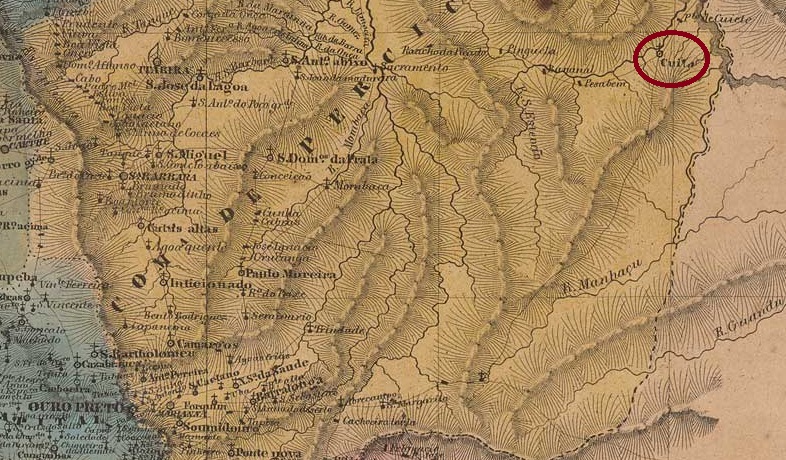
The Freguesia de N. Sra. da Conceição do Cuiethé was founded in 1824 on the south bank of the Cuieté (now Caratinga) in the Vila de Manhuaçu, 350 kilometres north-east of the provincial capital Ouro Preto. The Indian name means “vessel” and the place originated as a prison, hence the original name Degredo (exile).
Cuiethé became a district of Vila de Caratinga in February 1890 and as such went to the Município de Itanhomi in September 1923. There were then two name changes: in December 1938 to Barra do Cuieté (then in the Município de Conselheiro Pena) and five years later to Cuieté Velho.
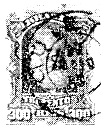
Both R. Koester in Carimbologia XV and Paula Sobrinho in História Postal de Minas Gerais (Belo Horizonte, 1997) agree that there has been a post office there since October 1881. The imperial postmark is CMG-0920a (fig. Koester, op. cit.):

Andere Namen: Degredo, Cuieté, Cuyethi, Cuité, Barra do Cuieté, Cuieté Velho (1953)
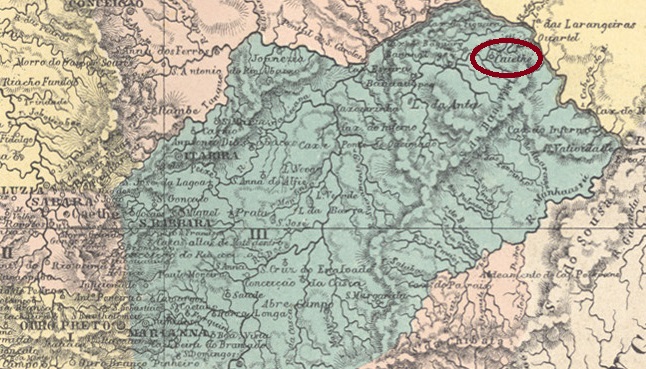
Die Freguesia de N. Sra. da Conceição do Cuiethé wurde 1824 gegründet und lag am Südufer des Cuieté (heute Caratinga-Fluss) im Gebiet der Vila de Manhuaçu, 350 km nordöstlich der Provinzhauptstadt Ouro Preto. Der indianische Name bedeutet “Gefäß” und der Ort entstand als Gefängnis, daher der ursprüngliche Name Degredo (Verbannung).
Cuiethé wurde im Februar 1890 zum Bezirk der Vila de Caratinga und wechselte als solcher im September 1923 zum Município de Itanhomi. Danach gab es zwei Namensänderungen: im Dezember 1938 in Barra do Cuieté (dann im Município de Conselheiro Pena) und fünf Jahre später in Cuieté Velho.
Sowohl R. Koester in Carimbologia XV als auch Paula Sobrinho in História Postal de Minas Gerais (Belo Horizonte, 1997) sind sich einig, dass es dort seit Oktober 1881 ein Postamt gab. Der kaiserliche Poststempel ist CMG-0920a (Abb. Koester, op. cit.):

 Carimbologia