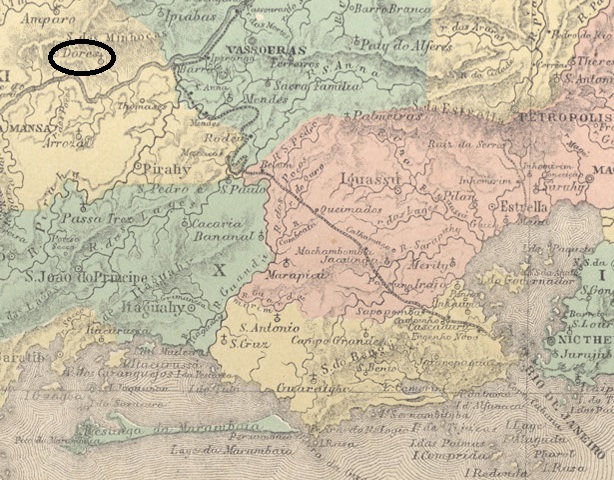
Other names: Dorândia (1943)
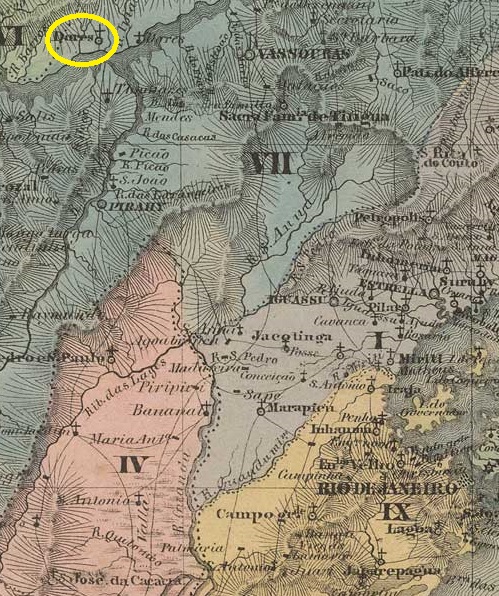
N. Sra. das Dores was the name of a freguesia belonging to the Vila de Piraí near the north bank of the Paraíba do Sul, 140 km north-west of the capital Rio de Janeiro, from March 1844. In February 1890 it was incorporated as a distrito into the Município de Barra do Piraí, which has been called Dorândia since December 1943.
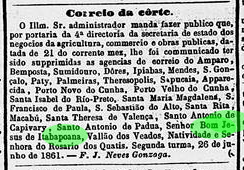
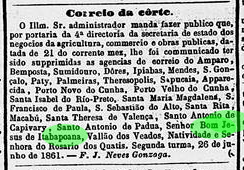
The local post office was founded twice. The first time was in May 1841, as Nova Monteiro writes in Administrações e Agencias Postaes do Brasil Imperio (Brasil Filatelico/RJ, 1934-5; reprint SPP 1994-1999). The agency was closed in June 1861, as reported in the Rio press:
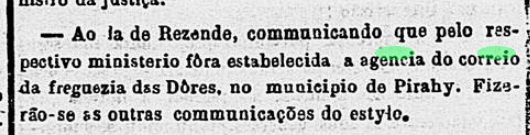
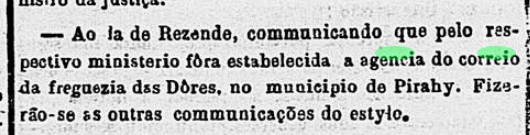
It reopened in November of the same year:
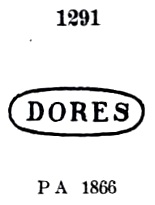
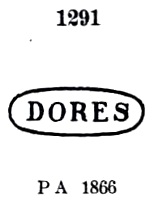
The oldest cancel is DRJ-0450a, it also occurs in dark violet and was already introduced by P. Ayres in the Catálogo de Carimbos Brasil-Império (S. Paulo, 1937, 1942) under no. 1291:
This was followed by DRJ-0460a (fig. R. Koester, Carimbologia XVI), which also occurs in blue and dark violet:

Then came DRJ-0460b, which also occurs in dark violet and is illustrated by P. Ayres (op. cit.):

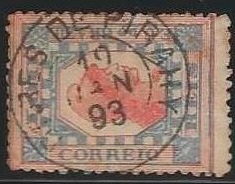
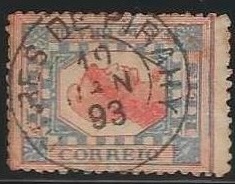
DRJ-0460c (fig. agenciaspostais.com.br) was also used in the early Republic:
P. Ayres also showed a handwritten cancellation which, according to R. Koester, could be assigned to this place.

Andere Namen: Dorândia (1943)
N. Sra. das Dores war ab März 1844 der Name einer zur Vila de Piraí gehörenden Freguesia nah am Nordufer des Paraíba do Sul, 140 km nordwestlich der Hauptstadt Rio de Janeiro. Im Februar 1890 wurde es als Distrito in das Município de Barra do Piraí eingegliedert, das seit Dezember 1943 Dorândia heißt.
Das örtliche Postamt wurde zweimal gegründet. Das erste Mal im Mai 1841, wie Nova Monteiro in Administrações e Agencias Postaes do Brasil Imperio (Brasil Filatelico/RJ, 1934-5; Nachdruck SPP 1994-1999) schreibt. Im Juni 1861 wurde die Agentur geschlossen, wie die Presse in Rio berichtete:
Die Wiedereröffnung erfolgte im November desselben Jahres:
Der älteste Stempel ist DRJ-0450a, er kommt auch in dunkelviolett vor und wurde bereits von P. Ayres im Catálogo de Carimbos Brasil-Império (S. Paulo, 1937, 1942) unter Nr. 1291 vorgestellt:
Es folgte DRJ-0460a (Abb. R. Koester, Carimbologia XVI), die auch in blau und dunkelviolett vorkommt: DRJ-0460a (RK) 1877-1883
Danach kam DRJ-0460b, die auch in dunkelviolett vorkommt und bei P. Ayres (op. cit.) abgebildet ist:

In der frühen Republik wurde auch DRJ-0460c (Abb. agenciaspostais.com.br) verwendet:
P. Ayres zeigte auch eine handschriftliche Entwertung, die nach R. Koester diesem Ort zuzuordnen ist.


 Carimbologia