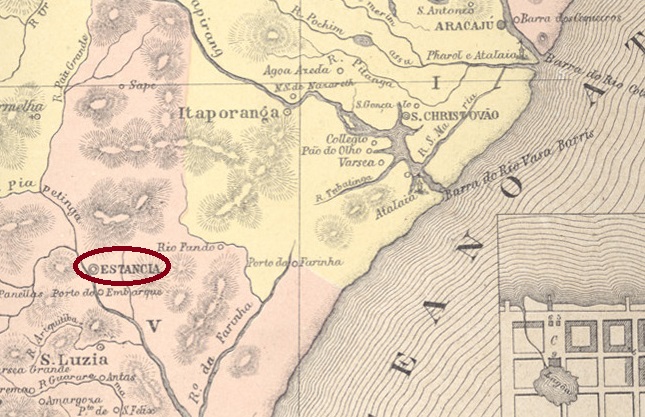
The original settlement called N. Sra. de Guadelupe has been known since April 1757. It belonged to the Vila de Sta. Luzia do Real and was located on the north bank of the Piauí, 80 kilometres southwest of the later provincial capital of Aracaju. In October 1831 it became the Freguesia e Vila Constitucional da Estancia and in May 1848 it was elevated to the status of a town.
Both Nova Monteiro (Administrações e Agencias Postaes do Brasil Imperio, in Brasil Filatelico/RJ, 1934-5; reprint SPP 1994-1999) and R. Koester (Carimbologia XVIII) write that there had been a post office there since December 1844. The directory of imperial post offices (Tabella das Agencias do Correio do Imperio, Rio de Janeiro, 1885) gives here the year 1845, which perhaps indicates that the agency was then set in operation.
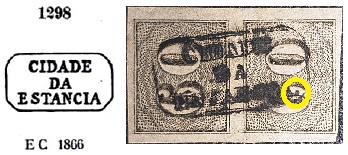
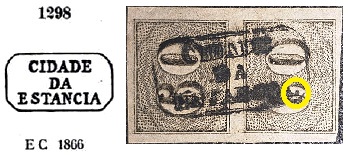
Here we can be relatively certain that the first postmark is missing, as the oldest ESE-0070b to date bears the inscription Cidade (city) and was therefore used in 1848 at the earliest. It bears the no. 1298 in P. Ayres’ Catálogo de Carimbos Brasil-Império (S. Paulo, 1937, 1942), but the dot after ESTANCIA is here missing, as can be seen in the other illustration (image: F. Piccinini):
R. Koester (op. cit.) also shows the French type ESE-0070c:

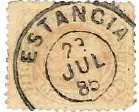
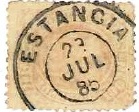
ESE-0070d (image from the Internet) was also used about the same time:
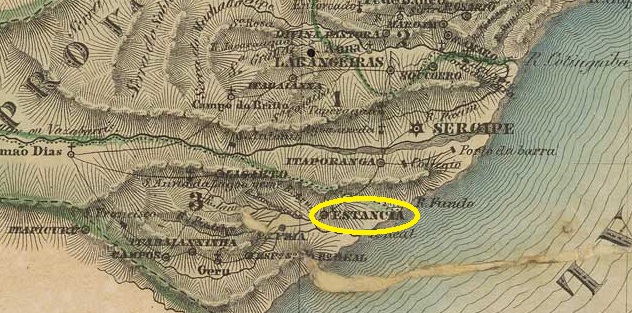
Die ursprüngliche Siedlung N. Sra. de Guadelupe ist seit April 1757 bekannt, sie gehörte zur Vila de Sta. Luzia do Real und lag am Nordufer des Piauí, 80 km südwestlich der späteren Provinzhauptstadt Aracaju. Im Oktober 1831 wurde es zur Freguesia e Vila Constitucional da Estancia und im Mai 1848 zur Stadt erhoben.
Sowohl Nova Monteiro (Administrações e Agencias Postaes do Brasil Imperio, in Brasil Filatelico/RJ, 1934-5; Reprint SPP 1994-1999) als auch R. Koester (Carimbologia XVIII) schreiben, dass es dort seit Dezember 1844 ein Postamt gab. Das Verzeichnis der kaiserlichen Postämter (Tabella das Agencias do Correio do Imperio, Rio de Janeiro, 1885) gibt hier das Jahr 1845 an, was vielleicht auf die Inbetriebnahme der Agentur hinweist.
Hier können wir relativ sicher sein, dass der erste Poststempel fehlt, da der bisher älteste ESE-0070b die Aufschrift Cidade (Stadt) trägt und somit frühestens 1848 verwendet wurde. Er trägt die Nr. 1298 in P. Ayres‘ Catálogo de Carimbos Brasil-Império (S. Paulo, 1937, 1942), aber der Punkt nach ESTANCIA fehlt hier, wie auf der anderen Abbildung zu sehen ist (Foto: F. Piccinini):
R. Koester (op. cit.) zeigt hier auch den französischen Typ ESE-0070c:

Parallel dazu wurde auch ESE-0070d (Bild aus dem Internet) verwendet:

 Carimbologia