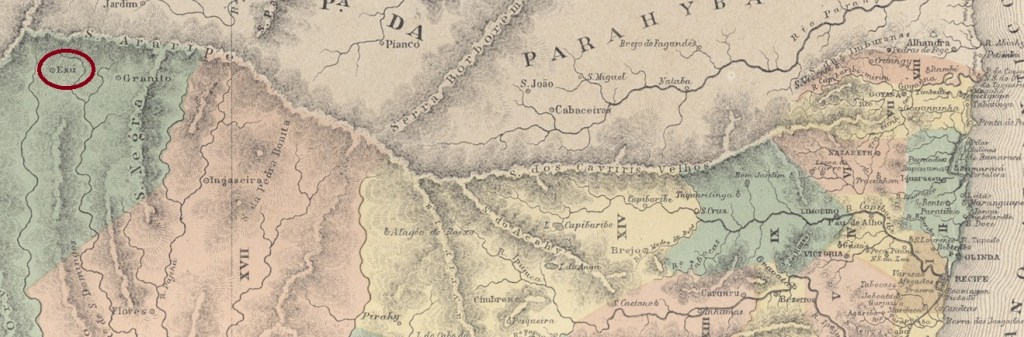
Other names: Novo Exú (1907)
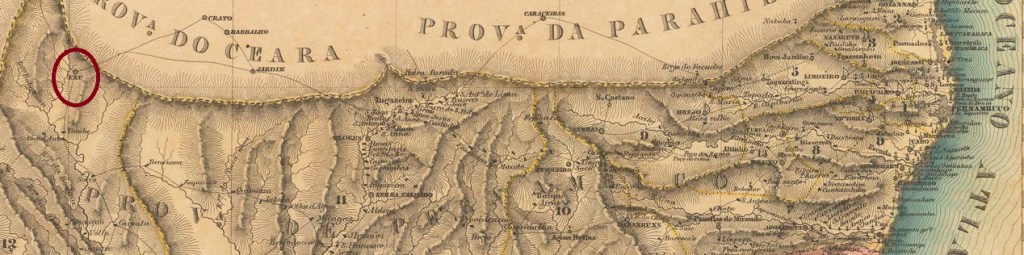
The Freguesia de Bom Jesus dos Aflictos do Exú was founded in 1734 on the south bank of the Riacho da Brígida, 610 kilometres west of the later provincial capital of Recife. The town was subsequently elevated to the status of Vila four times: in March 1846, June 1858, April 1874 and June 1907, then as Município de Novo Exú. In between there were three downgrades: in June 1849 and April 1863 as a freguesia of the Vila de Ouricuri and the Vila de Granito respectively and in April 1895 as a district in the Município de Granito. Novo Exú was declared a town in July 1909 and the old place name Exú returned in December 1938. The African-sounding name is of indigenous origin, in memory of the Ançu Indian tribe of the region, although some researchers claim that it derives from the bee species Inxu.
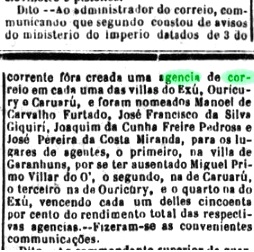
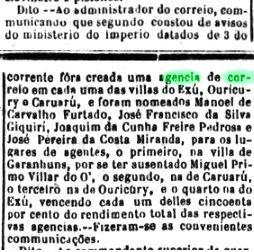
The local post office was opened at least twice, the first time in June 1850, as reported in the regional press:
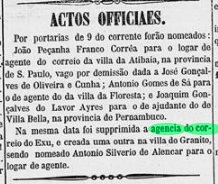
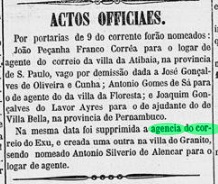
It was closed in April 1865, as reported by the Rio press:
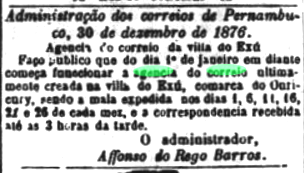
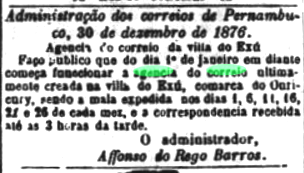
It reopened at the end of 1876:
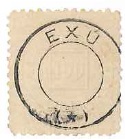
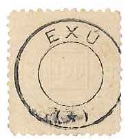
The first Exu postmark is unknown, as the oldest postmark to date, the French type EPE-0245b (image from the Internet), dates from the second period of operation of the post office:
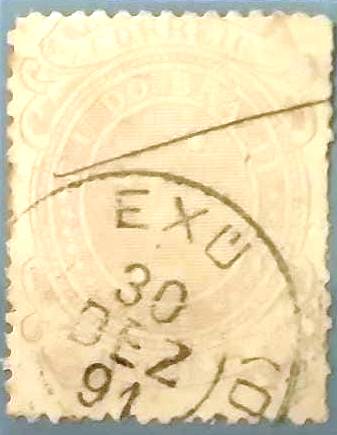
Its successor EPE-0245c (illustration by Felipe Piccinini) dates from the early Republic:

Andere Namen: Novo Exú (1907)
1734 wurde die Freguesia de Bom Jesus dos Aflictos do Exú am Südufer des Riacho da Brígida, 610 km westlich der späteren Provinzhauptstadt Recife, gegründet. Danach wurde der Ort viermal zur Vila erhoben: im März 1846, im Juni 1858, im April 1874 und im Juni 1907, zuletzt als Município de Novo Exú. Dazwischen lagen drei Rückstufungen: im Juni 1849 und im April 1863 als Freguesia der Vila de Ouricuri bzw. der Vila de Granito und im April 1895 als Distrikt im Município de Granito. Im Juli 1909 wurde Novo Exú zur Stadt erklärt, der alte Ortsname Exú kehrte im Dezember 1938 zurück. Der afrikanisch klingende Name ist indigenen Ursprungs, in Erinnerung an den Ançu-Indianerstamm der Region, obwohl einige Forscher behaupten, dass er von der Bienenart Inxu abstammt.
Das örtliche Postamt wurde mindestens zweimal eröffnet, das erste Mal im Juni 1850, wie die regionale Presse berichtete:
Im April 1865 wurde es geschlossen, wie die Presse von Rio berichtet:
Die Wiedereröffnung erfolgte Ende 1876:
Der erste Poststempel Exus ist unbekannt, da der bisher älteste Stempel, der französische Typ EPE-0245b (Abb. aus dem Internet), aus der zweiten Betriebsperiode des Postamts stammt:
Sein Nachfolger EPE-0245c (Abb. Felipe Piccinini) stammt bereits aus der frühen Republik:

 Carimbologia