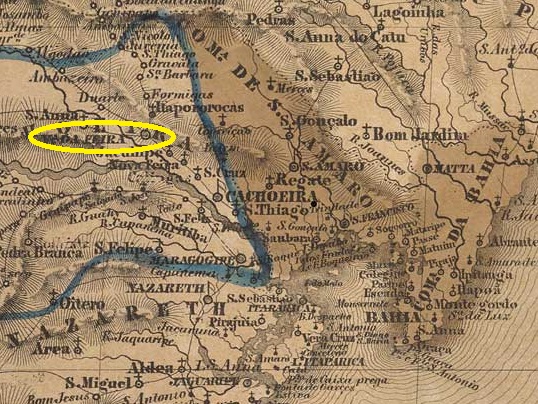
Today’s city of Feira de Santana, with over 600,000 inhabitants, was originally the Fazenda Sant’Anna dos Olhos d’Água in the Vila de Cachoeira area, 115 km north-west of the capital Salvador da Bahia. It became a Freguesia in 1696, a Vila in November 1832 and the Cidade Commercial da Feira de Sant’Anna in June 1873.
Two creation dates have been recorded for the local post office. Once in March 1836, as Nova Monteiro wrote in Administrações e Agencias Postaes do Brasil Imperio (Brasil Filatelico/RJ, 1934-5; reprint SPP 1994-1999). Then again in March 1846, according to R. Koester’s Carimbologia XIX. Seen in this light, only a few 19th century postmarks are known for this important city.
First and foremost is the pre-philatelic FBA-0365a, which was given the no. P-BA-07 in the RHM catalogue:

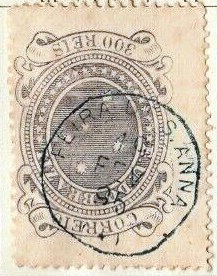
This was followed by a long period without known cancellations until FBA-0365b (fig. R. Koester, op. cit.) appeared:
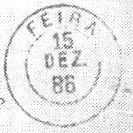
Towards the end of the Empire, the French type FBA-0365c (ill. from the Internet) was added:
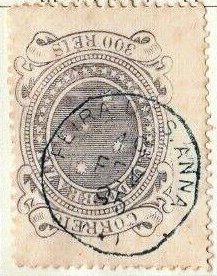
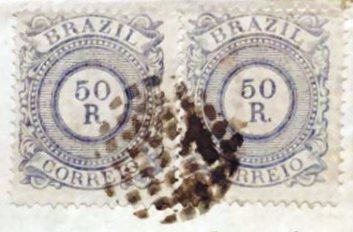
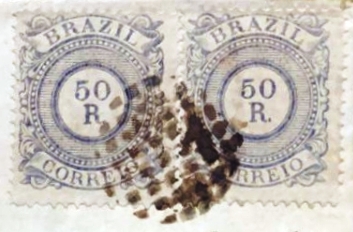
At least we still know of a mute cancel (illustration by Roberto Assef Jr.) from 1888:
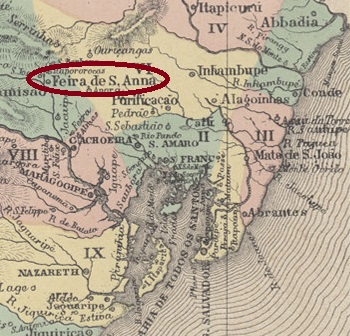
Die heutige Stadt Feira de Santana mit über 600.000 Einwohnern war ursprünglich die Fazenda Sant’Anna dos Olhos d’Água im Gebiet der Vila de Cachoeira, 115 km nordwestlich der Hauptstadt Salvador da Bahia. 1696 wurde sie zur Freguesia, im November 1832 zur Vila und im Juni 1873 zur Cidade Commercial da Feira de Sant’Anna.
Für das örtliche Postamt sind zwei Gründungsdaten überliefert. Einmal im März 1836, wie Nova Monteiro in Administrações e Agencias Postaes do Brasil Imperio (Brasil Filatelico/RJ, 1934-5; Nachdruck SPP 1994-1999) schrieb. Dann noch einmal im März 1846, nach R. Koesters Carimbologia XIX. So gesehen sind nur wenige Poststempel aus dem 19. Jahrhundert für diese bedeutende Stadt bekannt.
An erster Stelle ist der vorphilatelistische FBA-0365a zu nennen, der im RHM-Katalog die Nr. P-BA-07 erhielt:

Es folgte eine lange Zeit ohne bekannte Stempel, bis FBA-0365b (Abb. R. Koester, op. cit.) erschien:
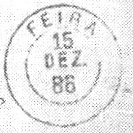
Gegen Ende des Kaiserreichs kam der französische Typ FBA-0365c (Abb. aus dem Internet) hinzu:
Immerhin kennen wir noch einen stummen Stempel (Abb. Roberto Assef Jr.) von 1888:

 Carimbologia