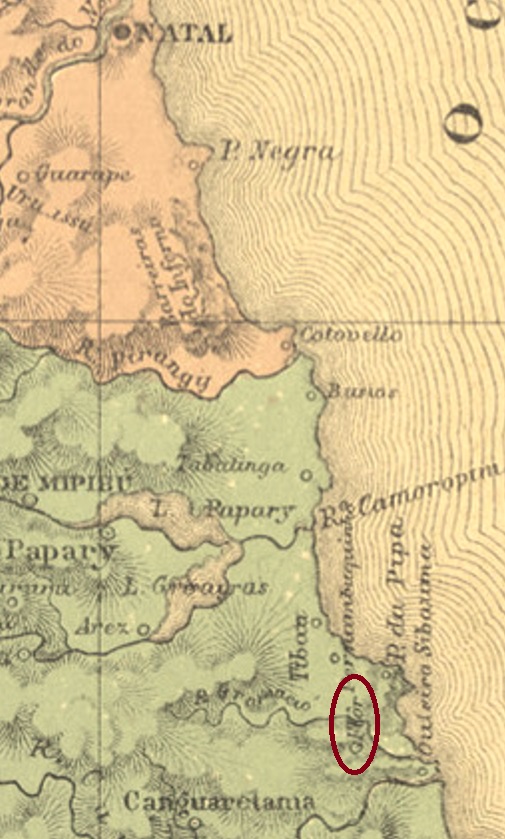
Other names: Gramació
See also Villa Flor (VRN-0240)
This village was originally an Indian settlement called Gramació, situated on the north bank of the Curimataú River, more than 80 km south of the future provincial capital Natal. In May 1755, the village rose to the status of a vila, but three years later it was moved to the neighbouring village of Canguaretama. In November 1892, Villa Flor became a district of Canguaretama and only regained political independence as a município in December 1963.
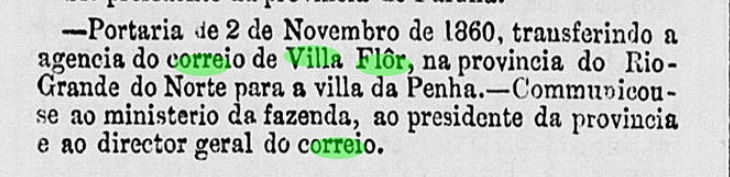
As Nova Monteiro writes in Administrações e Agencias Postaes do Brasil Imperio (Brasil Filatelico/RJ, 1934-5; Reprint SPP 1994-1999), there was a post office there as early as April 1818. With the move to Penha de Canguaretama (1858), the postal agency also moved there two years later, according to the capital’s official press:
Unfortunately, no 19th century postmark from this locality has been seen so far.
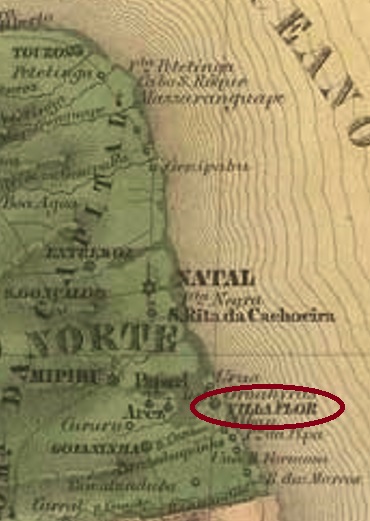
Andere Namen: Gramació, Flor
Siehe auch Villa Flor (VRN-0240)
Diese Ortschaft war ursprünglich eine Indianersiedlung namens Gramació, die am Nordufer des Flusses Curimataú lag, über 80 km südlich der künftigen Provinzhauptstadt Natal entfernt. Im Mai 1755 stieg der Ort zur Vila auf, die aber drei Jahre später zum Nachbarort Canguaretama verlegt wurde. Im November 1892 wurde Villa Flor ein Distrikt von Canguaretama und erhielt erst im Dezember 1963 die politische Selbständigkeit als Município wieder.
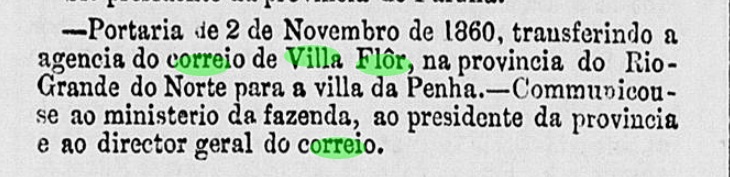
Wie Nova Monteiro in Administrações e Agencias Postaes do Brasil Imperio (Brasil Filatelico/RJ, 1934-5; Reprint SPP 1994-1999) schreibt, gab es dort ein Postamt bereits ab April 1818. Mit dem Umzug nach Penha de Canguaretama (1858) zog die Postagentur zwei Jahre später auch dorthin, wie die Amtspresse der Hauptstadt berichtet:
Leider wurde bisher kein Poststempel des 19. Jahrhunderts aus dieser Ortschaft gesehen.

 Carimbologia