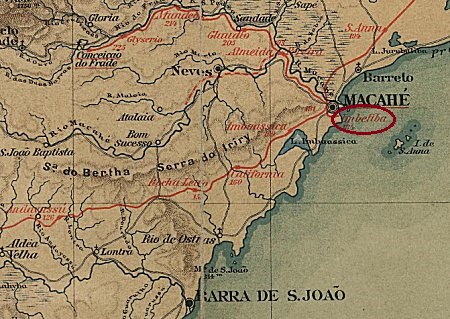
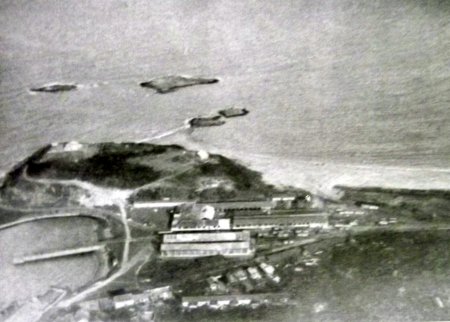
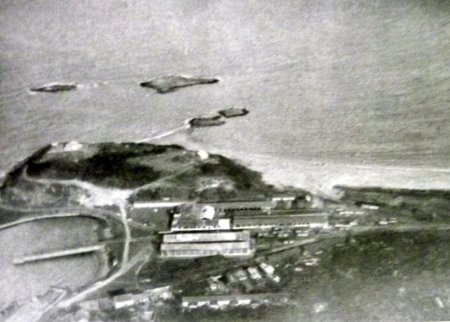
Imbetiba station was opened in June 1873 by the railway company E.F. Macaé e Campos, Imbetiba branch, and was located almost on the beach in the Município Macaé, 190 km north-east of the capital Rio de Janeiro. The railway line went to E.F. Leopoldina around 1890 and belonged to Rede Ferroviária Federal S.A. from 1975 until its closure in 1996 (estacoesferroviarias.com.br). Today, the tracks have disappeared, the entire harbour facility belongs to the oil giant Petrobras and it is not known what has become of the former railway station.
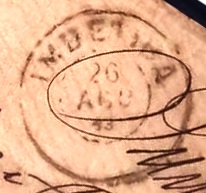
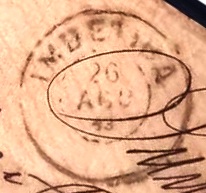
As Paulo Novaes writes on agenciaspostais.com, there had been a post office in the station since August 1875, which was closed for the first time in July 1897. The oldest postmark to date is IRJ-1775a (Image: Fuad Ferreira Fo.) 1882-1885
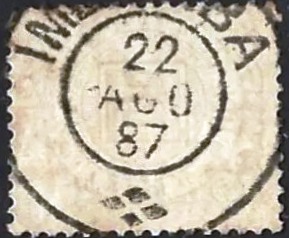
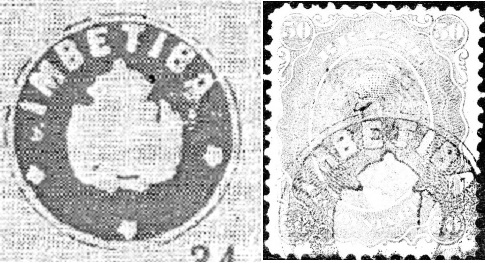
Two very similar postmarks followed: IRJ-1775b (Image: R. Koester, in Carimbologia XXII) and IRJ-1775c (Image: Felipe Piccinini):

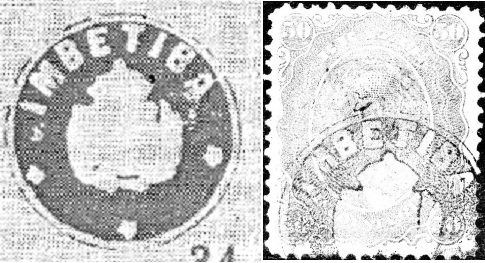
R. Koester showed in Carimbologia XXII two postmarks with the imperial seal, IRJ-1775d (Image: R. Koester – Felipe Piccinini) and IRJ-1775e (R. Koester):

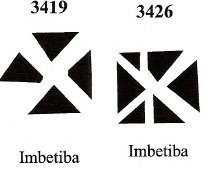
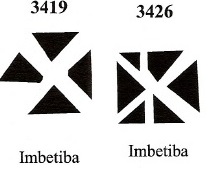
James Dingler and Klerman W. Lopes have listed two mute cancellations of Imbetiba in Mute Cancellations of the Brazil Empire / Carimbos Mudos do Brasil Império (Brazil Philatelic Association, Rio de Janeiro, 2000):

Der Bahnhof Imbetiba wurde im Juni 1873 von der Eisenbahngesellschaft E.F. Macaé e Campos, Imbetiba- Zweig eröffnet und lag fast am Strand im Município Macaé, 190 km nordöstlich der Hauptstadt Rio de Janeiro. Die Bahnlinie ging um 1890 an die E.F. Leopoldina und gehörte von 1975 bis zu ihrer Stilllegung 1996 der Rede Ferroviária Federal S.A. (estacoesferroviarias.com.br). Heute sind die Gleise verschwunden, die gesamte Hafenanlage gehört dem Ölgiganten Petrobras und es ist nicht bekannt, was aus dem ehemaligen Bahnhof geworden ist.
Wie Paulo Novaes auf agenciaspostais.com schreibt, gab es im Bahnhof seit August 1875 ein Postamt, das im Juli 1897 zum ersten Mal geschlossen wurde. Der bislang älteste Poststempel ist IRJ-1775a (Abb. Fuad Ferreira Fo.):
Es folgten zwei sehr ähnliche Stempel: IRJ-1775b (Abb. Koester in Carimbologia XXII) und IRJ-1775c (Abb. F. Piccinini):

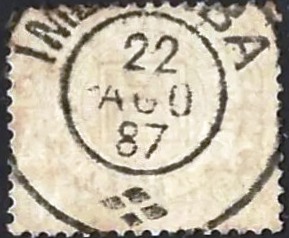
R. Koester zeigte in Carimbologia XXII zwei Poststempel mit dem kaiserlichen Siegel, IRJ-1775d (Abb. Koester – F. Piccinini) und IRJ-1775e (Abb. Koester):

James Dingler und Klerman W. Lopes haben in Mute Cancellations of the Brazil Empire / Carimbos Mudos do Brasil Império (Brazil Philatelic Association, Rio de Janeiro, 2000) zwei stumme Abstempelungen von Imbetiba aufgeführt:

 Carimbologia