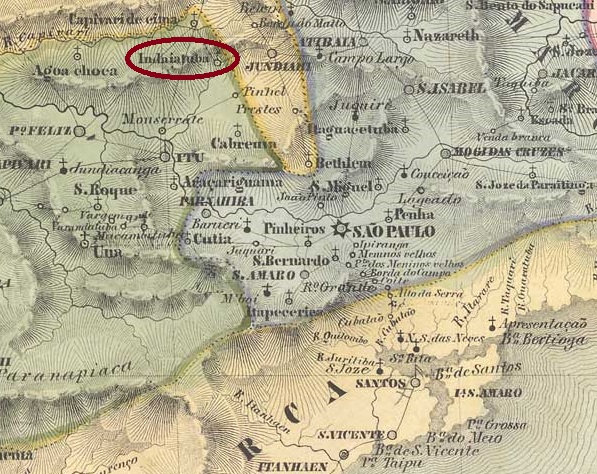
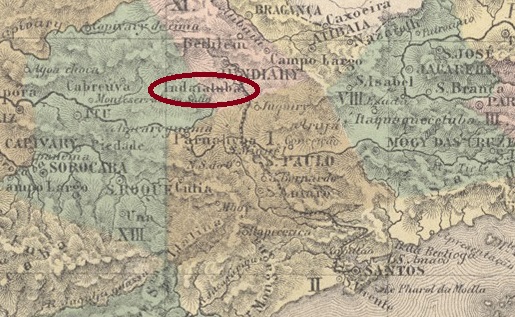
The Freguesia de N. Sra da Candelária de Indaiatuba (also spelt Indayatuba) was founded in December 1830, belonged to the Vila de Itu and was located on the east bank of the Córrego Barnabé, 100 km north-west of the provincial capital of São Paulo. It became a vila in March 1859 and a town in December 1906. The Indian name Indaiatuba means many palm trees.
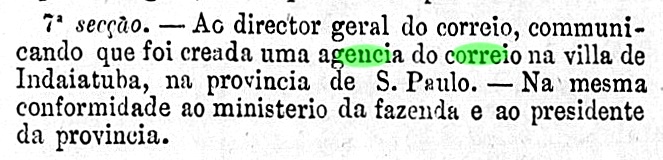
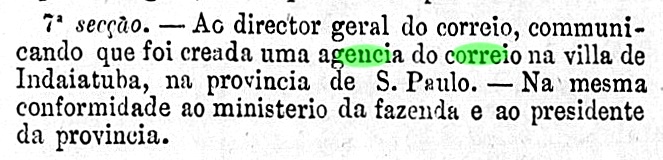
Nova Monteiro writes in Administrações e Agencias Postaes do Brasil Imperio (Brasil Filatelico/RJ, 1934-5; reprint SPP 1994-1999) that there had been a post office there since July 1860. This is confirmed by the bulletin of the imperial ministry:
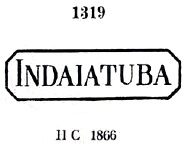
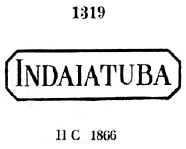
The first postmark is ISP-0590a, which was given the number 1319 by P. Ayres in the Catálogo de Carimbos Brasil-Império (S. Paulo, 1937, 1942):
Then came the double circle ISP-0590b (fig. R. Koester, in Carimbologia XXII):

Towards the end of the century, the French type ISP-0590c also arrived (ill. from the Internet):

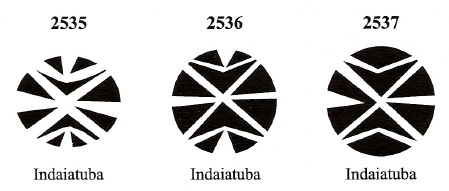
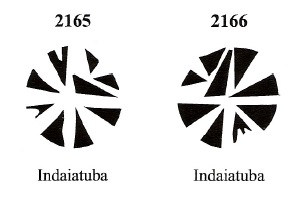
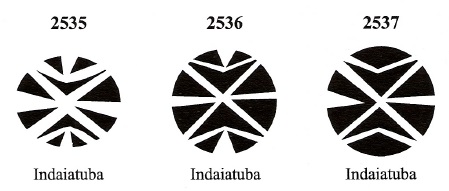
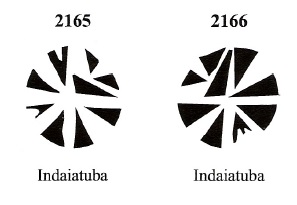
James Dingler and Klerman W. Lopes have listed at least 5 mute cancels from Indaiatuba in Mute Cancellations of the Brazil Empire / Carimbos Mudos do Brasil Império (Brazil Philatelic Association, Rio de Janeiro, 2000):
Die Freguesia de N. Sra da Candelária de Indaiatuba (auch Indayatuba geschrieben) wurde im Dezember 1830 gegründet, gehörte zur Vila de Itu und lag am Ostufer des Córrego Barnabé, 100 km nordwestlich der Provinzhauptstadt São Paulo. Es wurde im März 1859 zur Vila und im Dezember 1906 zur Stadt erhoben. Der indianische Name Indaiatuba bedeutet viele Palmen.
Nova Monteiro schreibt in Administrações e Agencias Postaes do Brasil Imperio (Brasil Filatelico/RJ, 1934-5; Nachdruck SPP 1994-1999), dass es dort seit Juli 1860 ein Postamt gab. Dies wird durch das Bulletin des kaiserlichen Ministeriums bestätigt:
Der erste Poststempel ist ISP-0590a, der von P. Ayres die Nummer 1319 im Catálogo de Carimbos Brasil-Império (S. Paulo, 1937, 1942) erhielt:
Danach kam der Doppelkreis ISP-0590b (Abb. R. Koester, in Carimbologia XXII):

Gegen Ende des Jahrhunderts kam auch der französische Typ ISP-0590c (Abb. aus dem Internet):

James Dingler und Klerman W. Lopes haben mindestens 5 stumme Stempel aus Indaiatuba in Mute Cancellations of the Brazil Empire / Carimbos Mudos do Brasil Império (Brazil Philatelic Association, Rio de Janeiro, 2000) aufgeführt:

 Carimbologia