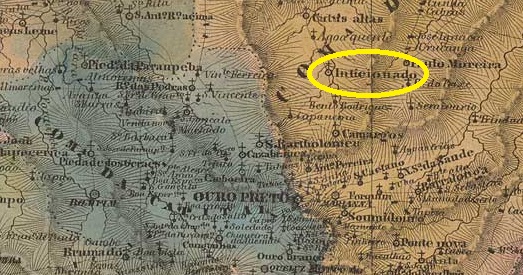
Other names: Infeccionado, Santa Rita Durão (1895)
The old settlement on the west bank of the Piracicaba River was already a parish (paróquia) called N. Sra. de Nazareth do Inficionado in February 1718 and belonged to Vila de Mariana, 60 kilometres north of the later provincial capital Ouro Preto. The place name, which sounds strange even to Brazilian ears, is said to designate an ore variety that appeared contaminated (‘infected’). In 1836, Inficionado became a freguesia, which has been the district of Santa Rita Durão since June 1895.
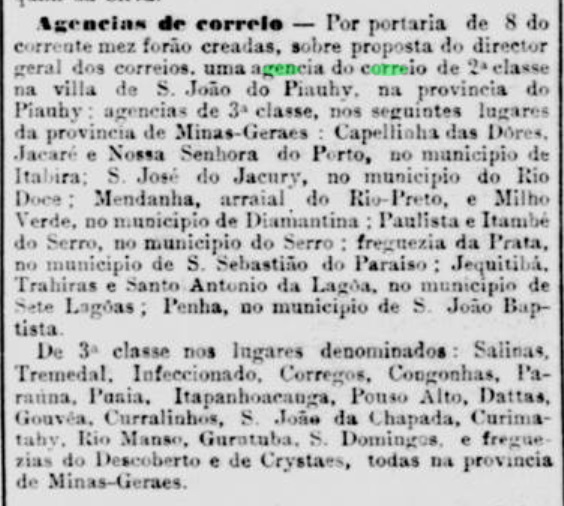
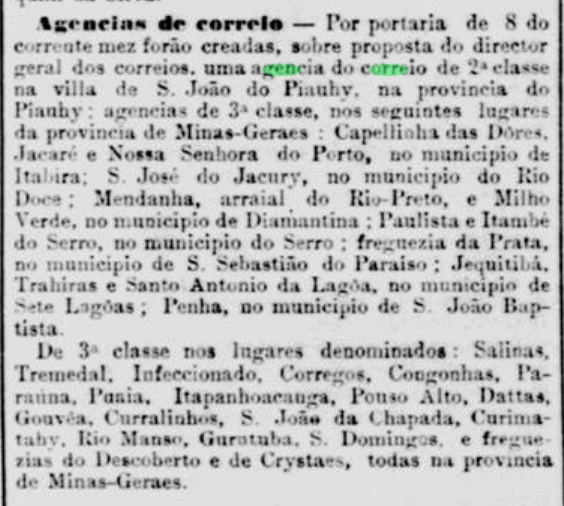
Both Paula Sobrinho (História Postal de Minas Gerais, Belo Horizonte, 1997) and R. Koester (Carimbologia XXII) write that there has been a post office there since November 1881. This is confirmed by the press in Rio:
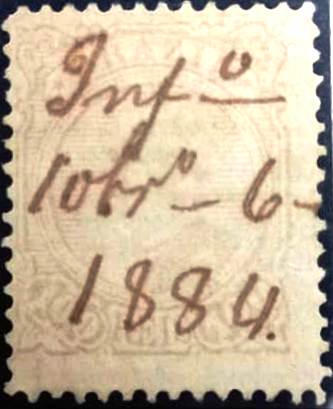
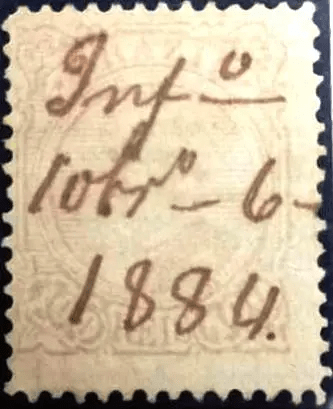
Here, too, the postmark does not appear to have arrived in time, as there is a handwritten cancellation at the beginning (collect. Fuad Ferreira Fo.):
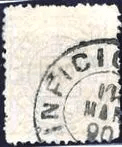
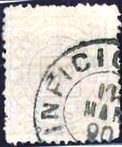
IMG-1335a is known from 1885 (image from the Internet):
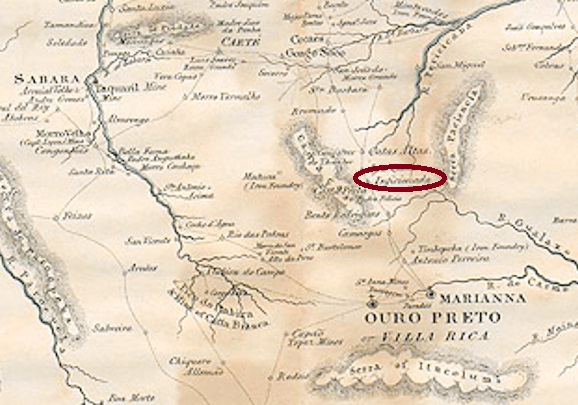
Andere Namen: Infeccionado, Santa Rita Durão (1895)
Die alte Siedlung am Westufer des Piracicaba-Flusses war bereits im Februar 1718 eine Pfarrei (Paróquia) namens N. Sra. de Nazareth do Inficionado und gehörte zu Vila de Mariana, 60 km nördlich der späteren Provinzhauptstadt Ouro Preto. Der selbst für brasilianische Ohren merkwürdig klingende Ortsname soll eine Erzvarietät bezeichnen, die verunreinigt („infiziert“) erschien. 1836 wurde Inficionado eine Freguesia, die seit Juni 1895 der Bezirk von Santa Rita Durão ist.
Sowohl Paula Sobrinho (História Postal de Minas Gerais, Belo Horizonte, 1997) als auch R. Koester (Carimbologia XXII) schreiben, dass es dort seit November 1881 ein Postamt gab. Dies wird von der Presse in Rio bestätigt:
Auch hier scheint der Poststempel nicht rechtzeitig angekommen zu sein, denn am Anfang steht eine handschriftliche Entwertung (Samml. Fuad Ferreira Fo.):
Ab 1885 ist IMG-1335a bekannt (Abbildung aus dem Internet):

 Carimbologia