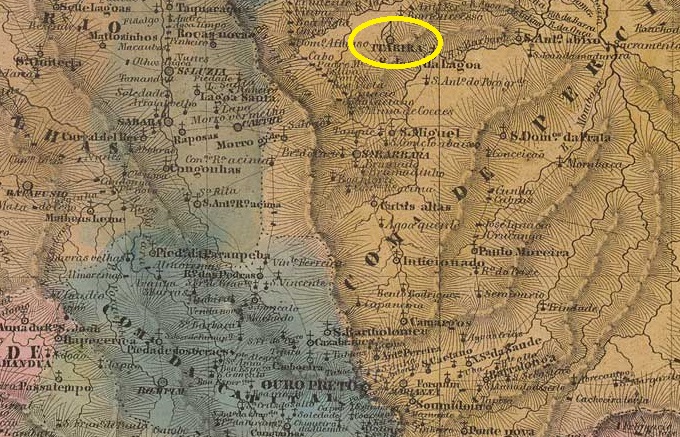
Other names: Itabira de Matto Dentro, Getúlio Vargas (1943-1947)
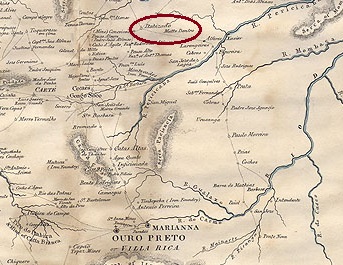
The Freguesia de N. Sra. do Rosário de Itabira, which had existed since January 1827, belonged to the Vila de Caeté and was located on the north bank of the Rio do Peixe, 150 kilometres north of the provincial capital Ouro Preto. It was elevated to a vila in June 1833 and to a town in October 1848. In December 1943, the município was renamed in honour of the dictator Getúlio Vargas, but the old place name returned in March 1947. The word Itabira comes from the Tupi-Guarani and means shiny stone. It refers to the iron ore that brought prosperity to the municipality for a long time.
The Catálogo Enciclopédico RHM (S. Paulo, 1999) states that there has been a post office since December 1848. However, as the regional press reports on postal traffic to and from Itabira in August 1831 at the earliest, an earlier date of the establishment of the local post office in March 1829 is probably more accurate. This date is supported by R. Koester (Carimbologia XXIII), Paula Sobrinho (História Postal de Minas Gerais, Belo Horizonte, 1997) and Nova Monteiro (Administrações e Agencias Postaes do Brasil Imperio, in Brasil Filatelico/RJ, 1934-5; reprint SPP 1994-1999).
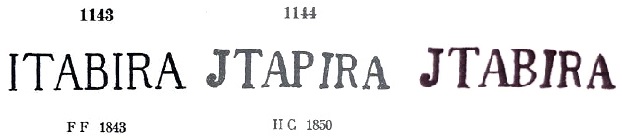
Two illustrations of the oldest postmark IMG-1345a can be found in P. Ayres’ Catálogo de Carimbos Brasil-Império (S. Paulo, 1937, 1942). However, the correct illustration is a mixture of both, as Henrique B. Ferreira shows in Catálogo ilustrado dos carimbos sobre os olhos-de-boi (4a. ed., Porto Alegre, 2017):
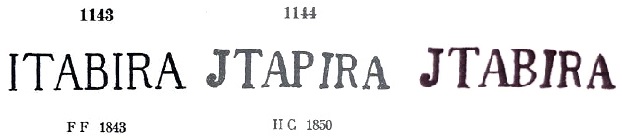
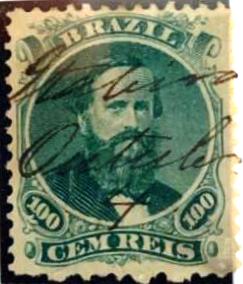
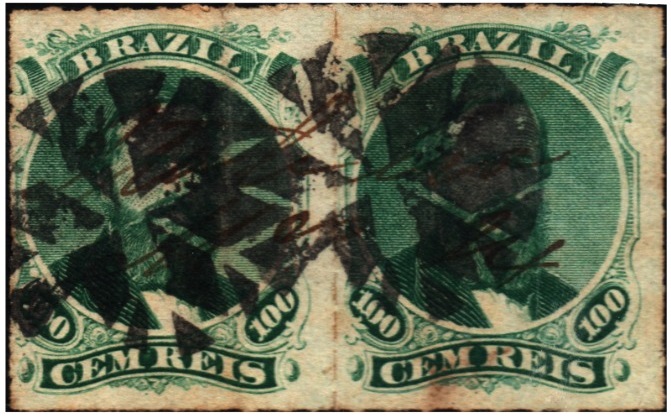
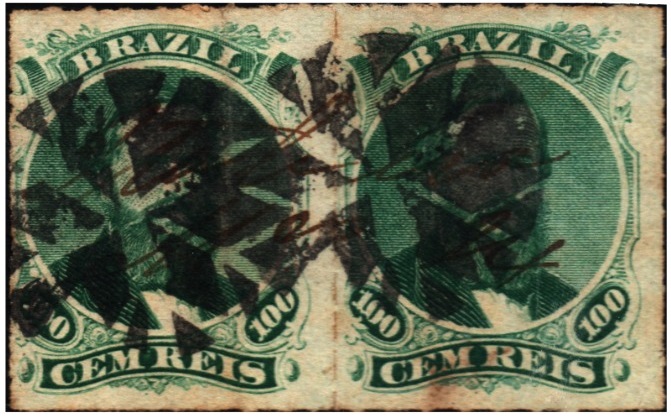
Sometime in the 1860s, this cancel stamp broke and a replacement was not obtained in time. The stamps in Itabira were therefore cancelled by hand for at least 10 years. An illustration of this can also be found in P. Ayres (op. cit.), here together with an example from the Paulo Corchaki collection:
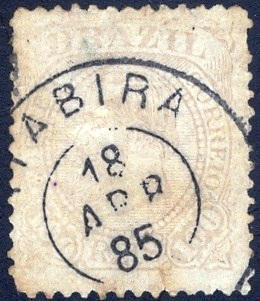
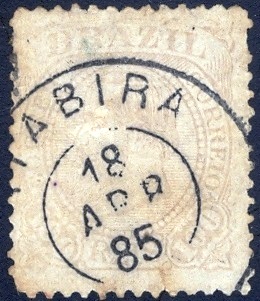
Only in the last decade of the Empire was the following circle cancellation IMG-1345b (Márcio Protzner collection) used:
The following mute cancellation (Carlos A. C. Balata Collection) probably also originates from Itabira:
Andere Namen: Itabira de Matto Dentro, Getúlio Vargas (1943-1947)
Die seit Januar 1827 bestehende Freguesia de N. Sra. do Rosário de Itabira gehörte zur Vila de Caeté und lag am Nordufer des Rio do Peixe, 150 km nördlich der Provinzhauptstadt Ouro Preto. Die Erhebung zur Vila erfolgte im Juni 1833, die zur Stadt im Oktober 1848. Im Dezember 1943 wurde der Município zu Ehren des Diktators Getúlio Vargas umbenannt, aber im März 1947 kehrte der alte Ortsname zurück. Das Wort Itabira stammt aus dem Tupi-Guarani und bedeutet glänzender Stein. Es bezieht sich auf das Eisenerz, das der Gemeinde lange Zeit zu Wohlstand verhalf.
Im Catálogo Enciclopédico RHM (S. Paulo, 1999) ist zu lesen, dass es seit Dezember 1848 ein Postamt gab. Da jedoch in der regionalen Presse schon ab August 1831 über Postverkehr von und nach Itabira berichtet wird, dürfte das frühere Datum der Gründung des örtlichen Postamtes im März 1829 zutreffender sein. Dieses Datum wird von R. Koester (Carimbologia XXIII), Paula Sobrinho (História Postal de Minas Gerais, Belo Horizonte, 1997) und Nova Monteiro (Administrações e Agencias Postaes do Brasil Imperio, in Brasil Filatelico/RJ, 1934-5; Nachdruck SPP 1994-1999) vertreten.
Vom ältesten Poststempel IMG-1345a sind zwei Abbildungen in P. Ayres‘ Catálogo de Carimbos Brasil-Império (S. Paulo, 1937, 1942) zu finden. Die korrekte Abbildung dürfte jedoch eine Mischung aus beiden sein, wie Henrique B. Ferreira in Catálogo ilustrado dos carimbos sobre os olhos-de-boi (4a. ed., Porto Alegre, 2017) zeigt:
Irgendwann in den 1860er Jahren ging dieser Stempel kaputt, und es wurde nicht rechtzeitig Ersatz beschafft. Daher wurden die Marken in Itabira mindestens 10 Jahre lang von Hand gestempelt. Eine Abbildung davon findet sich auch bei P. Ayres (op. cit.), hier zusammen mit einem Beispiel aus der Sammlung Paulo Corchaki:

Erst im letzten Jahrzehnt des Kaiserreichs wurde der folgende Kreisstempel IMG-1345b (Sammlung Márcio Protzner) verwendet:
Aus Itabira stammt vermutlich auch die folgende stumme Abstempelung (Samml. Carlos A. C. Balata):

 Carimbologia