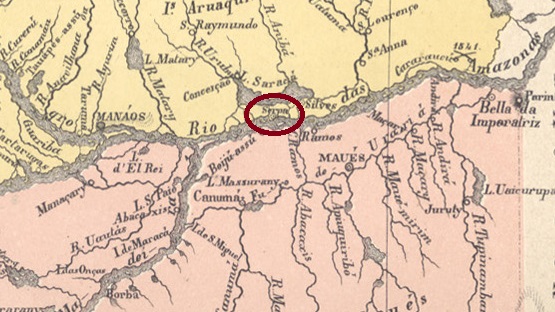
See also Serpa (SAM-0115)
Nossa Senhora do Rosário de Serpa was the name of the villa that is said to have existed as early as 1759 on the north bank of the Amazon River, about 270 km east of the later provincial capital of Manaus. In 1833, the village was demoted to a district of Manaus, but in December 1857, it was again granted villa status. Since April 1874, the locality has been a town called Itacoatiara. The word from the Tupi language means painted stone.
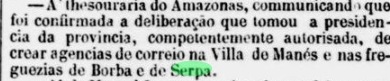
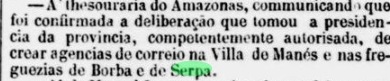
Two opening years were found for the local post office. Nova Monteiro (Administrações e Agencias Postaes do Brasil Imperio, in Brasil Filatelico/RJ, 1934-5; Reprint SPP 1994-1999) writes September 1852 for it, while the Imperial Mail Register (Tabella das Agencias do Correio do Imperio, Rio de Janeiro, 1885) lists this agency from 1855 on. The second date is confirmed by the Rio de Janeiro press:
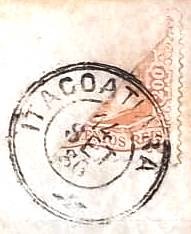
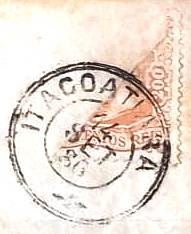
The only postmark from the imperial period to date is IAM-0050a (Coll. Fuad Ferreira Fo.):
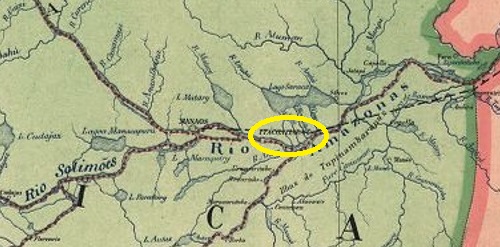
Siehe auch Serpa (SAM-0115)
Nossa Senhora do Rosário de Serpa hieß die Villa, die bereits 1759 am Nordufer des Amazonas existiert haben soll, ca. 270 km östlich der späteren Provinzhauptstadt Manaus entfernt. Im Jahr 1833 wurde dann die Ortschaft zum Distrikt von Manaus degradiert, erhielt aber im Dezember 1857 erneut den Villa-Status. Seit April 1874 ist der Ort eine Stadt namens Itacoatiara. Das Wort aus der Tupi-Sprache bedeutet bemalter Stein.
Zwei Eröffnungsjahre wurden fürs örtliche Postamt gefunden. Nova Monteiro (Administrações e Agencias Postaes do Brasil Imperio, in Brasil Filatelico/RJ, 1934-5; Reprint SPP 1994-1999) schreibt dafür den September 1852, während das Verzeichnis der kaiserlichen Postämter (Tabella das Agencias do Correio do Imperio, Rio de Janeiro, 1885) diese Agentur ab 1855 auflistet. Das zweite Datum wird durch die Presse aus Rio de Janeiro bestätigt:
Der bisher einzige Poststempel der Kaiserzeit ist IAM-0050a (Samml. Fuad Ferreira Fo.):
Für Stempel mit Serpa siehe SAM-0115.

 Carimbologia