Other names: Boa Vista, Capella Nova
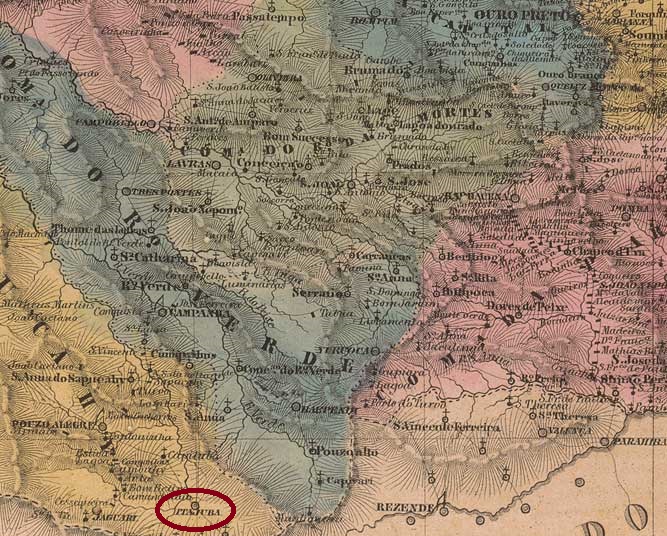
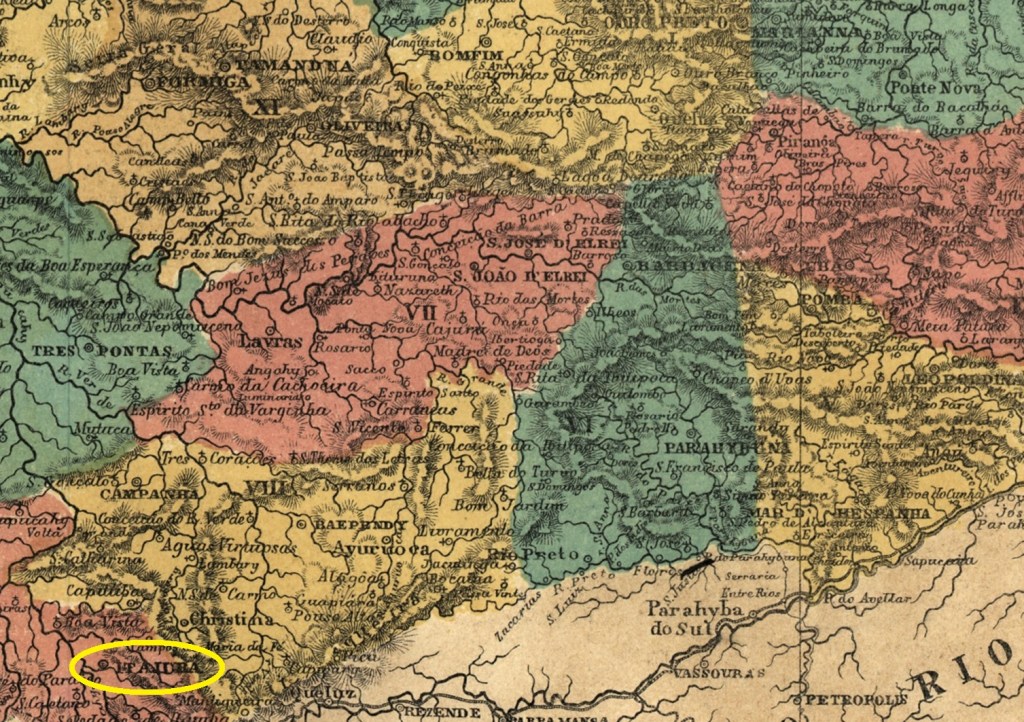
The settlement of Boa Vista do Itajubá was founded in March 1819. It belonged to the Freguesia de Descoberto (today the município de Delfim Moreira) in the Vila de Campanha area and was located on the north bank of the Sapucaí, 420 kilometres southwest of the later provincial capital Ouro Preto. In July 1832 it became the Freguesia de N. Sra. da Conceição da Boa Vista do Itajubá, in September 1848 it was elevated to a Vila and in October 1862 to a town. The name, which comes from the Tupi-guarani, can mean both yellow stone (ita + juba) and waterfall on the river of stones (ita + jybá).
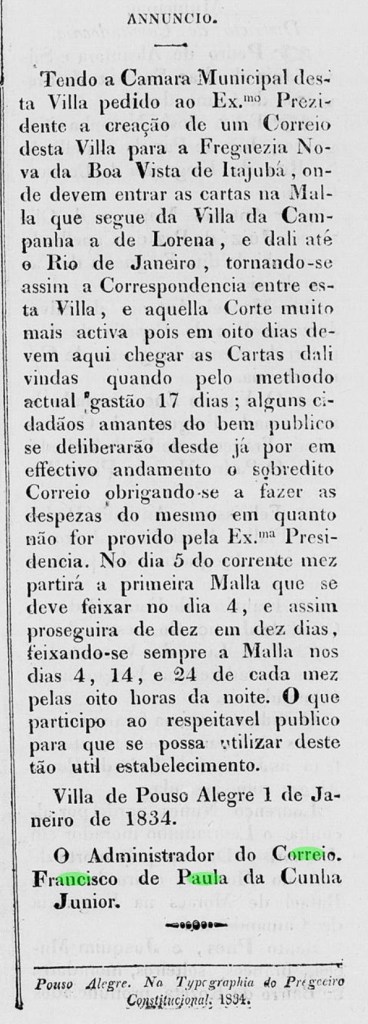
Two creation dates have been found for the local post office. The first was around January 1834, according to the regional press:
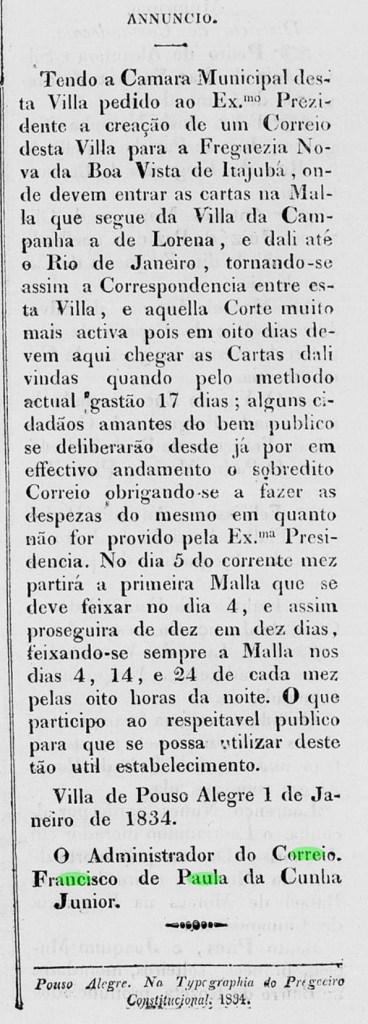
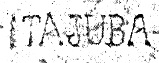
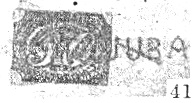
Then again in October 1856, as Nova Monteiro writes in Administrações e Agencias Postaes do Brasil Imperio (Brasil Filatelico/RJ, 1934-5; reprint SPP 1994-1999). The two oldest postmarks, IMG-1355a (fig. R. Koester in Carimbologia XXIII) and IMG-1355b (dto.), date from the agency’s first period of operation:
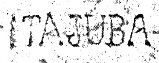
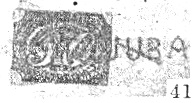
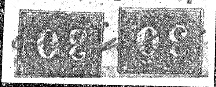
Around the time of the reopening, the stamps were initially cancelled by hand, as Koester (op. cit.) shows:
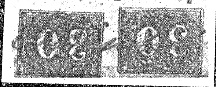
It was not until the 1870s that the circular cancellation IMG-1355c (fig. P. Ayres in Catálogo de Carimbos Brasil-Império, S. Paulo, 1937, 1942) was used:
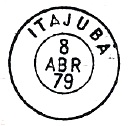
At this time Itajubá was already a town, as the following cancel IMG-1355d (fig. P. Ayres, op. cit.) proudly points out:

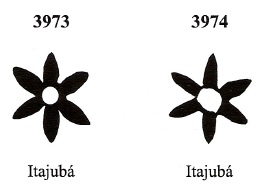
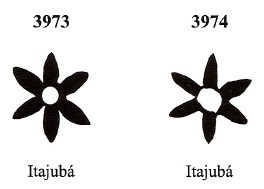
James Dingler and Klerman W. Lopes have listed two mute cancellations from Itajubá in Mute Cancellations of the Brazil Empire / Carimbos Mudos do Brasil Império (Brazil Philatelic Association, Rio de Janeiro, 2000):
Andere Namen: Boa Vista, Capella Nova
Die Siedlung Boa Vista do Itajubá entstand im März 1819. Sie gehörte zur Freguesia de Descoberto (heute der Município de Delfim Moreira), im Gebiet der Vila de Campanha und lag am Nordufer des Sapucaí, 420 km südwestlich der späteren Provinzhauptstadt Ouro Preto. Im Juli 1832 wurde es zur Freguesia de N. Sra. da Conceição da Boa Vista do Itajubá, im September 1848 zur Vila und im Oktober 1862 zur Stadt erhoben. Der aus dem Tupi-guarani stammende Name kann sowohl gelber Stein (ita + juba) als auch Wasserfall am Fluss der Steine (ita + jybá) bedeuten.
Für das örtliche Postamt wurden zwei Gründungsdaten gefunden. Die erste um Januar 1834, wie aus der regionalen Presse hervorgeht:
Dann wieder im Oktober 1856, wie Nova Monteiro in Administrações e Agencias Postaes do Brasil Imperio (Brasil Filatelico/RJ, 1934-5; Nachdruck SPP 1994-1999) schreibt. Die beiden ältesten Stempel, IMG-1355a (Abb. R. Koester in Carimbologia XXIII) und IMG-1355b (dto.), stammen wohl aus der ersten Betriebsperiode der Agentur:
Um die Zeit der Wiedereröffnung wurden die Marken zunächst von Hand entwertet, wie Koester (op. cit.) zeigt:
Erst in den 1870er Jahren wurde der Rundstempel IMG-1355c (Abb. P. Ayres in Catálogo de Carimbos Brasil-Império, S. Paulo, 1937, 1942) verwendet:
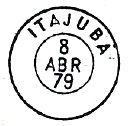
Zu diesem Zeitpunkt war Itajubá bereits eine Stadt, worauf der folgende Stempel IMG-1355d (Abb. P. Ayres, op. cit.) stolz hinweist:

James Dingler und Klerman W. Lopes haben in Mute Cancellations of the Brazil Empire / Carimbos Mudos do Brasil Império (Brazil Philatelic Association, Rio de Janeiro, 2000) zwei stumme Abstempelungen aus Itajubá aufgelistet:

 Carimbologia