Other names: Est. Nhangapi (1943)
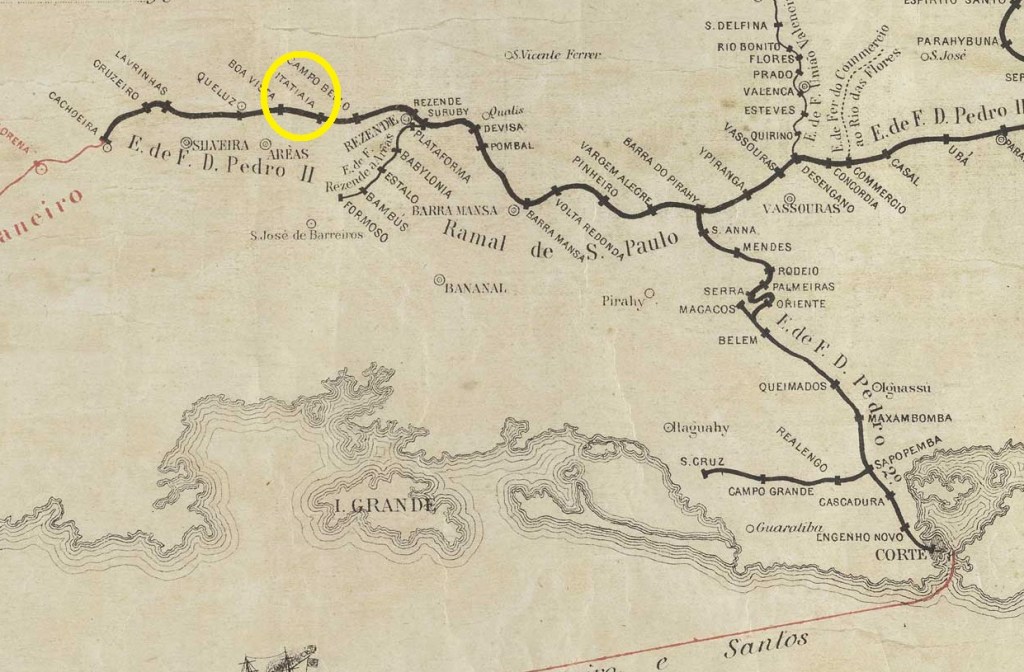
Itaiaia station (also spelt Itatyaia or Itatiaya) was opened in January 1874 by the E.F. D. Pedro II railway company (S. Paulo line) in the Município de Resende, 200 km north-west of the capital Rio de Janeiro. The word from the Tupi-guarani means rock with spikes. The line was transferred to E.F. Central do Brasil in 1889 and belonged to Rede Ferroviária Federal S.A. from 1975 until its closure in 1996 (estacoesferroviarias.com.br). The tracks are still there today, but the station building is no longer there.
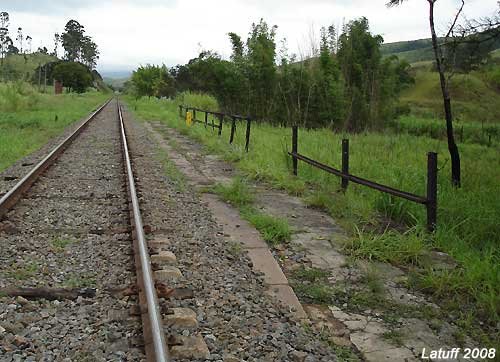
The area around the railway station has belonged to the Distrito de Itatiaia since December 1943, when the station was renamed Nhangapi (Devil’s Path, in tupi-guarani); Itatiaia has been an independent município since July 1988.
There had been a post office at the railway station since January 1874, as reported in the Rio press:

The first postmark is IRJ-1785a, which was given the no. 1145 in P. Ayres’ Catálogo de Carimbos Brasil-Império (S. Paulo, 1937, 1942), here also on an example from the Marcio Duarte collection:

This was followed by IRJ-1785b, which also exists in blue and was given the no. 1330 by P. Ayres, here with a corrected version from agenciaspostais.com.br:

Then came the rare IRJ-1785c (fig. R. Koester, in Carimbologia XXIV):

Shortly afterwards, IRJ-1785d (fig. Koester) was also used, which also occurs in blue:

Towards the end of the Empire, IRJ-1785e also appeared (fig. agenciaspostais.com.br):

The philatelist Carlos A. Balata also showed a hand-written cancellation from Itatiaia:

Andere Namen: Est. Nhangapi (1943)
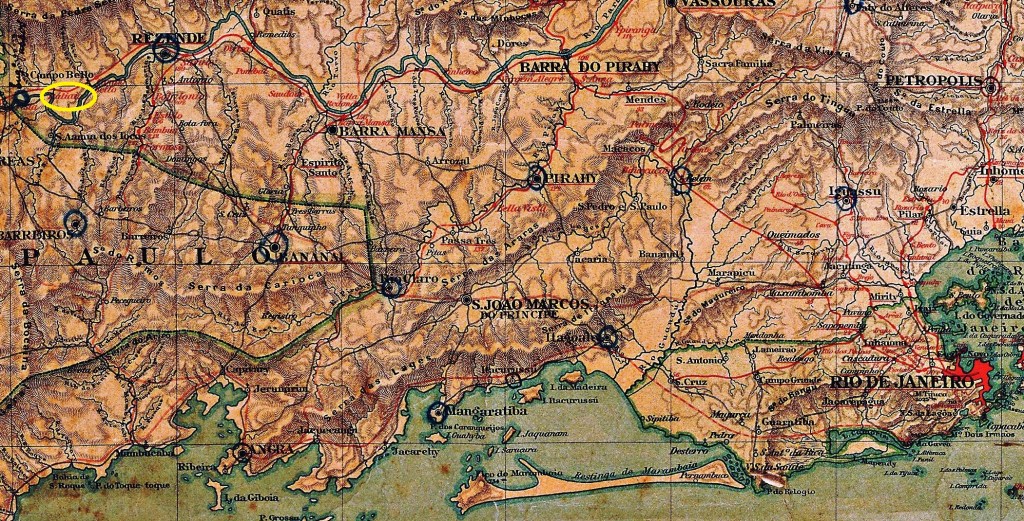
Der Bahnhof Itaiaia (auch Itatyaia oder Itatiaya geschrieben) wurde im Januar 1874 von der Eisenbahngesellschaft E.F. D. Pedro II (S. Paulo-Linie) eröffnet und lag im Município de Resende, 200 km nordwestlich der Hauptstadt Rio de Janeiro. Das Wort aus dem Tupi-guarani bedeutet Felsen mit Spitzen. Die Strecke ging 1889 an die E.F. Central do Brasil über und gehörte von 1975 bis zu ihrer Stilllegung 1996 der Rede Ferroviária Federal S.A. (estacoesferroviarias.com.br). Heute sind die Gleise noch vorhanden, das Bahnhofsgebäude jedoch nicht mehr.
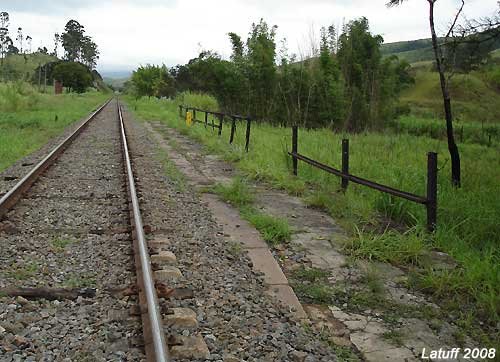
Das Gebiet um den Bahnhof gehört seit Dezember 1943 zum Distrito de Itatiaia, als der Bahnhof in Nhangapi (Teufelsweg, in tupi-guarani) umbenannt wurde, seit Juli 1988 ist Itatiaia ein eigenständiges Município.
Seit Januar 1874 gibt es ein Postamt am Bahnhof, wie die Presse von Rio berichtet:

Der erste Poststempel ist IRJ-1785a, der in P. Ayres‘ Catálogo de Carimbos Brasil-Império (S. Paulo, 1937, 1942) die Nr. 1145 erhielt, hier auch auf einem Beispiel aus der Sammlung Marcio Duarte:

Es folgte IRJ-1785b, der auch in Blau existiert und von P. Ayres die Nr. 1330 erhielt, hier mit einer korrigierten Version aus agenciaspostais.com.br:

Danach kam der seltene IRJ-1785c (Abb. R. Koester, in Carimbologia XXIV):

Kurz darauf wurde auch IRJ-1785d (Abb. Koester) verwendet, der auch in Blau vorkommt:

Gegen Ende des Kaiserreichs erschien auch IRJ-1785e (Abb. agenciaspostais.com.br):

Der Philatelist Carlos A. Balata zeigte auch eine handschriftliche Entwertung aus Itatiaia:


 Carimbologia