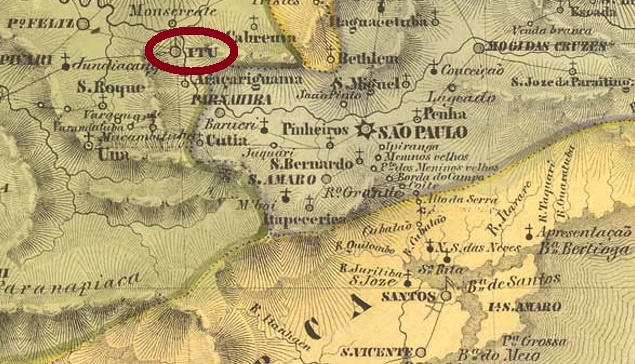
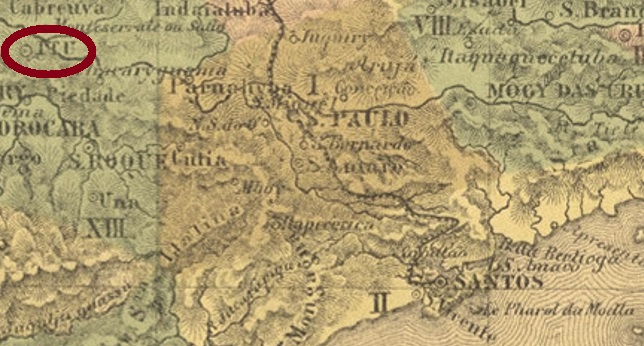
This village, old by Brazilian standards, was the chapel of N. Sra. da Candelária from February 1610 and was located on the south bank of the Tietê, barely 100 km west of the later provincial capital of São Paulo. Ytu became a freguesia in 1653, a vila in April 1657 and a town in February 1842.
Two years of origin for the local post office have been found. First in October 1824, as Nova Monteiro writes in Administrações e Agencias Postaes do Brasil Imperio (Brasil Filatelico/RJ, 1934-5; Reprint SPP 1994-1999). Then in 1844, according to the Directory of Imperial Post Offices (Tabella das Agencias do Correio do Imperio, Rio de Janeiro, 1885).
The first two postmarks have been definitively used in the pre-philatelic period. YSP-1615a was in use at least between 1825 and 1829 and was already made known by the RHM catalogue:

Parallel to this – more precisely between 1825 and at least 1850 – YSP-1615b was in use, which can not only be seen in the RHM, but was also recorded with no. 1542 in the Catálogo de Carimbos Brasil-Império (S. Paulo, 1937, 1942) by Paulo Ayres:

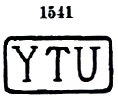
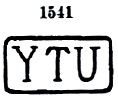
Then there came YSP-1615c, used between about 1843 and at least 1877. This postmark also exists in red; it can be seen in the Paulo Ayres (op. cit.) with no. 1541:
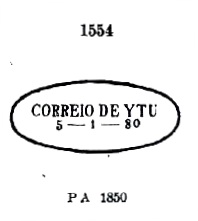
Its successor YSP-1615d came into use from about 1850 – also in red – and is also listed in Paulo Ayres, this time under no. 1635:

YSP-1615e was also in use about the same time and can also be seen in P. Ayres. Later cancels present a dot after YTU:
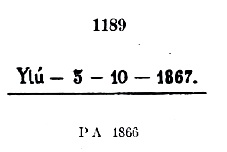
Also YSP-1615f, which also occurs in blue between 1866 and 1881, with P. Ayres no. 1189. However, the dot at the end may sometimes be missing:
All the following postmarks have ITU written with I. ISP-0660a was in circulation from about 1866 and was given No. 1331 by P. Ayres:

ISP-0660b apparently occurred in blue, was in use from ca. 1866 to ca. 1877 and has no. 1332 by P. Ayres:

Five more postmarks followed as double circles until the end of the 19th century. The French type ISP-0660c (Coll. José L. Fevereiro) has the inscription ITÚ above and the asterisk between brackets below. Dates in the centre go from 1868 to 1879. ISP-0660d (Coll. Mário Celso Orsi Jr.) also exists in violet and blue, with internal dates from 1881 to 1887. Here the accent on the U is barely visible, if at all. ISP-0660e (Coll. Mário Celso Orsi Jr.) is also found in violet, has ITU written in wide letters at the top and a five-pointed star without brackets at the bottom, with inner dates from 1886 to 1890. In ISP-0660f (image from the internet) we have a Correio Ambulante cancel, with (C.A.) below. Dates from 1885 to 1887. Finally, ISP-0660g (image by Luís C. Fritzen) is a second French type, but this time the letters of ITU are narrower. A specimen from 1897 was found.
Mário Celso Orsi Jr. also presents a handwritten cancellation from Itu:

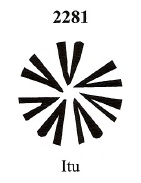
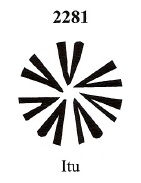
Then we have three mute cancellations from there. The first of these has already been presented by J. Dingler and K. W. Lopes in Mute Cancellations of the Brazil Empire / Carimbos Mudos do Brasil Império (Brazil Philatelic Association, Rio de Janeiro, 2000) under no. 2281:
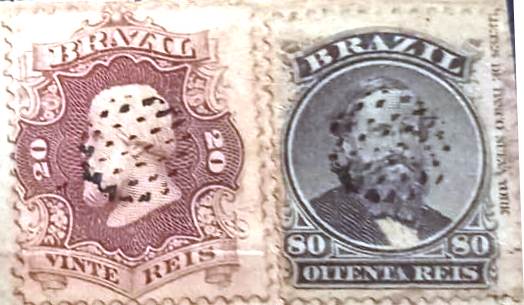
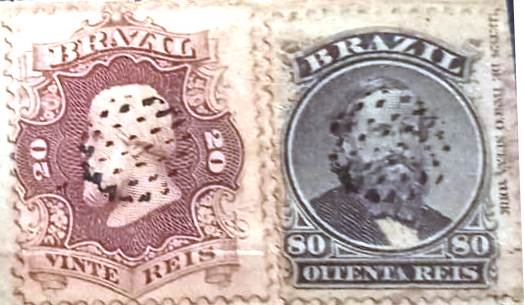
The second mute cancel comes from the Fuad Ferreira Fo. collection:
Lastly, another mute cancellation, as announced by Mário Celso Orsi Jr:

Diese für brasilianische Verhältnisse alte Ortschaft war ab Februar 1610 die Kapelle von N. Sra. da Candelária und lag am Südufer des Tietê, knapp 100 km westlich der späteren Provinzhauptstadt São Paul. Ytu wurde 1653 zur Freguesia, im April 1657 zur Vila und im Februar 1842 zur Stadt.
Zwei Entstehungsjahre fürs örtliche Postamt wurden gefunden. Erstmals im Oktober 1824, wie Nova Monteiro in Administrações e Agencias Postaes do Brasil Imperio (Brasil Filatelico/RJ, 1934-5; Reprint SPP 1994-1999) schreibt. Dann 1844, laut Verzeichnis der kaiserlichen Postämter (Tabella das Agencias do Correio do Imperio, Rio de Janeiro, 1885).
Die ersten beiden Poststempel sind nachweislich in der Vorphila-Zeit verwendet worden. YSP-1615a war zumindest zwischen 1825 und 1829 in Gebrauch und wurde bereits durch den RHM-Katalog bekannt gemacht:

Parallel dazu – genauer zwischen 1825 bis zumindest 1850 – wurde YSP-1615b verwendet, der nicht nur im RHM zu sehen ist, sondern auch mit Nr. 1542 im Catálogo de Carimbos Brasil-Império von Paulo Ayres registriert wurde:

Danach kam YSP-1615c, verwendet zwischen ca. 1843 und mindestens 1877. Diesen Poststempel gibt es auch in Rot, er ist im Paulo Ayres (op. cit.) mit Nr. 1541 zu sehen:
Sein Nachfolger YSP-1615d kam ab ca. 1850 in Gebrauch – auch in Rot – und ist ebenfalls in Paulo Ayres aufgelistet, diesmal unter Nr. 1635:

Auch YSP-1615e wurde etwa zur gleichen Zeit verwendet und ist auch im P. Ayres zu sehen, wobei später ein Punkt nach YTU erscheinen kann:
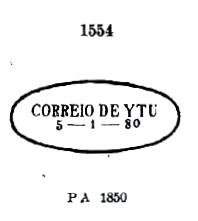
Ebenfalls YSP-1615f, der auch in Blau zwischen 1866 und 1881 vorkommt, mit P. Ayres Nr. 1189. Allerdings kann der Punkt am Ende manchmal fehlen:
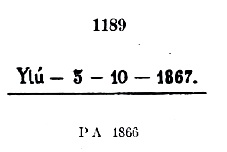
Alle folgenden Poststempel haben ITU mit I geschrieben. ISP-0660a war ab ca. 1866 im Umlauf und bekam von P. Ayres die Nr. 1331:

ISP-0660b kommt angeblich in Blau vor, wurde von ca. 1866 bis ca. 1877 verwendet und hat Nr. 1332 bei P. Ayres:

Es folgten noch fünf Poststempel als Doppelkreise bis Ende des 19. Jahrhunderts. Der französische Typus ISP-0660c (Samml. José L. Fevereiro) hat oben die Inschrift ITÚ und unten des Sternchen zwischen Klammern. Daten in der Mitte von 1868 bis 1879. ISP-0660d (Samml. Mário Celso Orsi Jr.) gibt es auch in Violett und Blau, mit inneren Daten von 1881 bis 1887. Hier ist der Akzent auf dem U kaum oder nicht zu sehen. ISP-0660e (Samml. Mário Celso Orsi Jr.) kommt auch in Violett vor, hat oben ITU mit breiten Buchstaben geschrieben und unten einen fünfzackigen Stern ohne Klammer, dazu innere Daten von 1886 bis 1890. In ISP-0660f (Bild aus dem Internet) haben wir einen Stempel von Correio Ambulante, mit (C.A.) darunter. Datiert von 1885 bis 1887. Schließlich kommt mit ISP-0660g (Abb. Luís C. Fritzen) ein zweiter französischer Typ dazu, wobei die Buchstaben von ITU diesmal schmäler sind. Ein Exemplar aus 1897.
Mário Celso Orsi Jr. kennt auch eine handschriftliche Entwertung aus Itu:

Dann haben wir noch drei stumme Abstempelungen von dort. Die erste davon wurde bereits durch J. Dingler und K. W. Lopes in Mute Cancellations of the Brazil Empire / Carimbos Mudos do Brasil Império (Brazil Philatelic Association, Rio de Janeiro, 2000) unter Nr. 2281 vorgestellt:
Die zweite stumme Abstempelung kommt aus der Sammlung Fuad Ferreira Fo.:
Zuletzt eine stumme Abstempelung, wie Mário Celso Orsi Jr. bekannt gab:


 Carimbologia