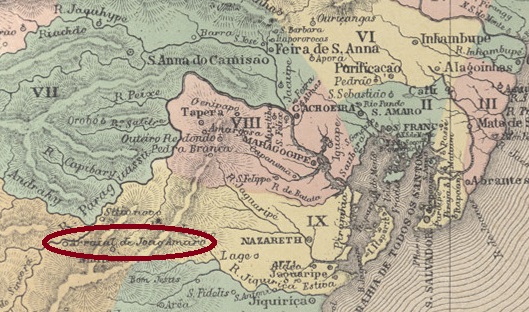
From May 1862 João Amaro was a district of the Vila de Tapera on the east bank of the Paraguaçu, 300 kilometres west of the provincial capital Salvador da Bahia. In May 1881, the village became the Freguesia de Sto. Antonio do João Amaro, but moved to the Município de Jibóia as a distrito in August 1892. Further changes in the respective municípios followed: in August 1899 to Monte Cruzeiro, in July 1921 again to Tapera, in July 1928 to Santa Terezinha and since August 1958 João Amaro has been a distrito in the Município de Iaçu. João Amaro Maciel Parente was a pioneer (sertanista) who explored the area at the end of the 17th century.
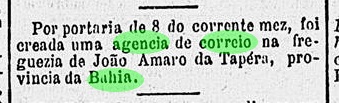
As reported in the Rio press, it was decided in August 1884 to set up a post office there:
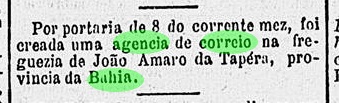
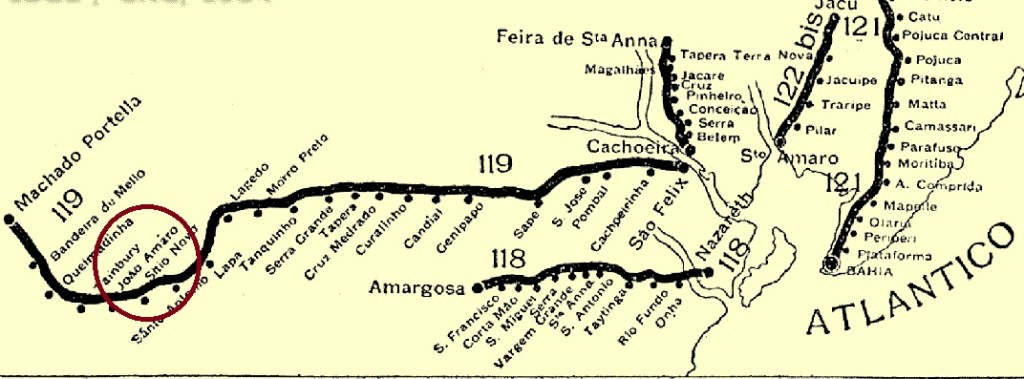
The establishment of the post office is presumably connected with the opening of a railway station of the E.F. Central da Bahia railway company (southern line) in October 1883, even if this is not officially mentioned.
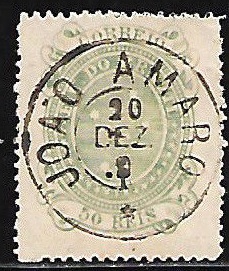
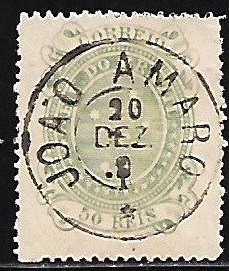
The oldest postmark to date is JBA-0435a (image from the Internet):
Seit Mai 1862 war João Amaro ein Distrito der Vila de Tapera am Ostufer des Paraguaçu, 300 km westlich der Provinzhauptstadt Salvador da Bahia. Im Mai 1881 wurde der Ort zur Freguesia de Sto. Antonio do João Amaro, wechselte aber im August 1892 als Distrito zum Município de Jibóia. Weitere Wechsel in den zuständigen Municípios folgten: im August 1899 zu Monte Cruzeiro, im Juli 1921 wieder zu Tapera, im Juli 1928 zu Santa Terezinha und seit August 1958 ist João Amaro ein Distrito im Município de Iaçu. João Amaro Maciel Parente war ein Pionier (Sertanista), der das Gebiet Ende des 17. Jahrhunderts erforschte.
Wie die Presse in Rio berichtete, wurde im August 1884 beschlossen, dort ein Postamt einzurichten:
Vermutlich hängt die Gründung des Postamtes mit der Eröffnung eines Bahnhofs der Eisenbahngesellschaft E.F. Central da Bahia (Südlinie) im Oktober 1883 zusammen, auch wenn dies nicht offiziell erwähnt wird.
Der bisher älteste Poststempel ist JBA-0435a (Abb. aus dem Internet):

 Carimbologia