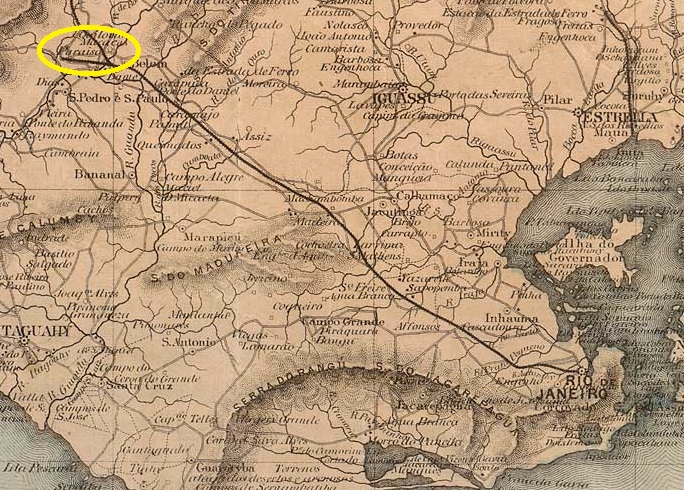
Other names: Tairetá, Paracamby (1903)
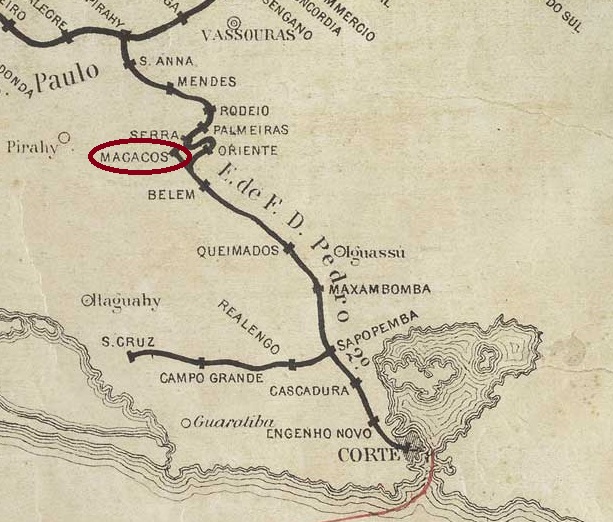
The Macacos (Monkeys) railway station was opened in August 1861 by the E. F. D. Pedro II railway company (Macacos branch) on the east bank of the Macacos stream, now called Ribeirão das Lajes, in the Município de Vassouras, 85 km north-west of the capital Rio de Janeiro. The railway line changed to the E. F. Central do Brasil in 1889, Rede Ferroviária Federal S. A. in 1975 and has been operated by the Supervia consortium since 1997. The branch was probably built for the Fazenda dos Macacos, where the Brasil Industrial textile factory was later located, which despite its name was owned by the British (estacoesferroviarias.com.br).

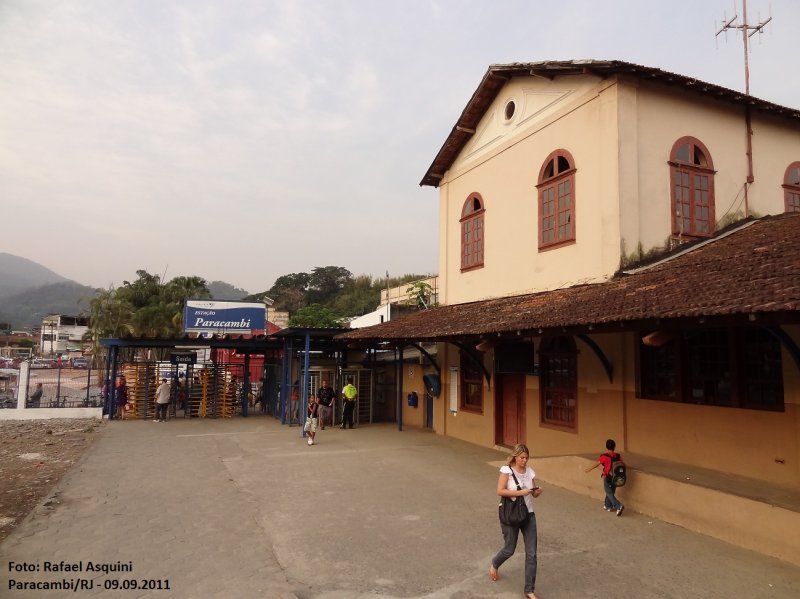
As the name ‘Macacos’ was not very popular, the town and railway station changed their names several times in the following years. In June 1892, Macacos became part of the district of Belém, in August 1903 the station was called Paracamby, in September 1906 Macacos became a district, which later changed its name four times: In September 1909 it was called Belém, in November 1919 Paracamby again, in December 1938 Tairetá and finally in August 1960 Paracambi again, now as an independent Município.
As noted in the minutes of the imperial ministry, the creation of a local post office was decided in October 1861.
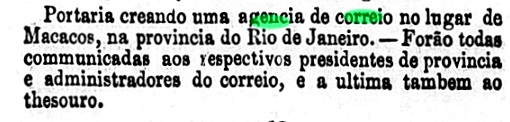
Paulo Novaes writes on agenciaspostais.com.br that the agency was renamed Paracamby in November 1903.
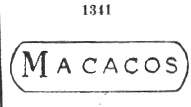
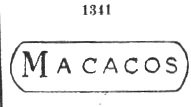
Paulo Ayres shows in Catálogo de Carimbos Brasil-Império (São Paulo, 1937, 1942) a postmark with the number 1341, which unfortunately has not yet been confirmed anywhere.
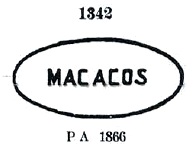
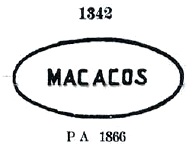
The following postmark no. 1342 shown by him, however, could be confirmed beyond doubt:
This was followed by the simple double circle MRJ-1800b (fig. R. Koester, in Carimbologia XXVII):

Then came MRJ-1800c (ill. Luiz C. Fritzen):

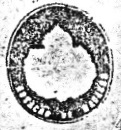
Koester (op. cit.) also showed the postmark with the imperial seal MRJ-1800d:
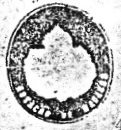
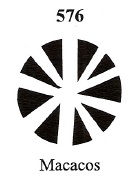
From Macacos station also comes the mute cancellation BPA 576, as noted by James Dingler and Klerman W. Lopes in Mute Cancellations of the Brazil Empire / Carimbos Mudos do Brasil Império (Brazil Philatelic Association, Rio de Janeiro, 2000):

Andere Namen: Tairetá, Paracamby (1903)
Der Bahnhof Macacos (Affen) wurde im August 1861 von der Eisenbahngesellschaft E. F. D. Pedro II. (Macacos-Zweig) am Ostufer des Macacos-Bachs, der heute Ribeirão das Lajes heißt, im Município de Vassouras, 85 km nordwestlich der Hauptstadt Rio de Janeiro, eröffnet. Die Bahnlinie wechselte 1889 zur E. F. Central do Brasil, 1975 zur Rede Ferroviária Federal S. A. und wird seit 1997 vom Supervia-Konsortium betrieben. Vermutlich wurde die Abzweigung für die Fazenda dos Macacos gebaut, auf der sich später die Textilfabrik Brasil Industrial befand, die trotz ihres Namens im englischen Besitz war (estacoesferroviarias.com.br).
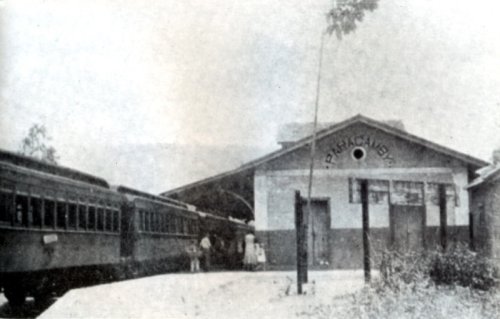
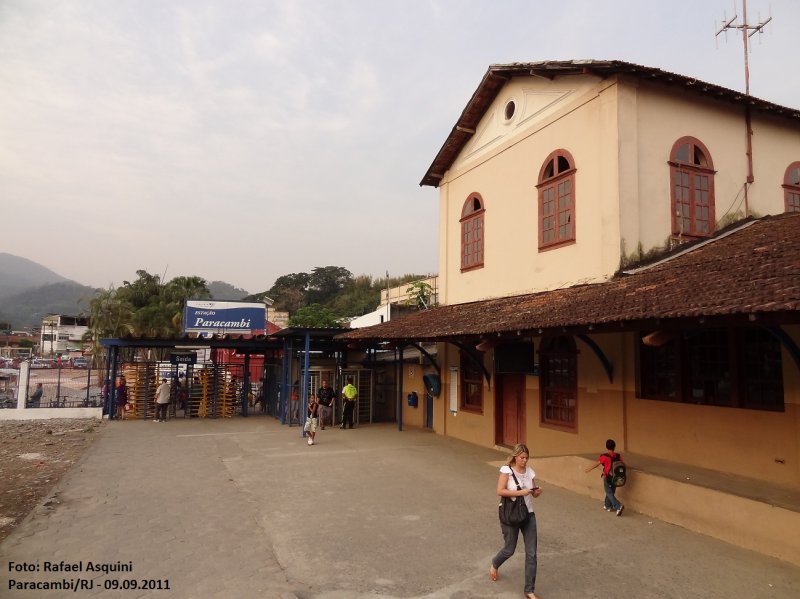
Da der Name „Macacos” wenig Zuspruch fand, wechselten Ort und Bahnhof in der folgenden Zeit mehrmals ihre Bezeichnung. Im Juni 1892 wurde Macacos Teil des Distrikts Belém, im August 1903 hieß der Bahnhof Paracamby, im September 1906 wurde Macacos zum Distrikt, der später seinen Namen viermal änderte: Im September 1909 hieß er Belém, im November 1919 wieder Paracamby, im Dezember 1938 Tairetá und schließlich im August 1960 erneut Paracambi, nun als eigenständiger Município.
Wie im Protokoll des kaiserlichen Ministeriums vermerkt, wurde im Oktober 1861 die Einrichtung eines Bahnhofspostamts beschlossen.
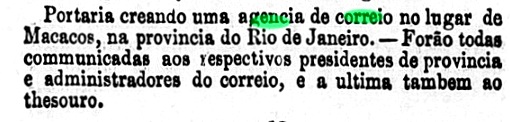
Paulo Novaes schreibt auf agenciaspostais.com.br, dass die Agentur im November 1903 in Paracamby umbenannt wurde.
Paulo Ayres zeigt in Catálogo de Carimbos Brasil-Império (São Paulo, 1937, 1942) einen Poststempel mit der Nummer 1341, der bisher leider nirgends bestätigt werden konnte.
Der folgende von ihm gezeigte Poststempel Nr. 1342 konnte hingegen zweifelsfrei bestätigt werden:
Es folgte der schlichte Doppelkreis MRJ-1800b (Abb. R. Koester, in Carimbologia XXVII):

Danach kam MRJ-1800c (Abb. Luiz C. Fritzen):
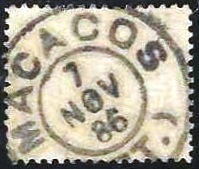
Koester (op. cit.) zeigte auch den Poststempel mit dem kaiserlichen Siegel MRJ-1800d:
Vom Bahnhof Macacos kommt auch der stumme Stempel BPA 576, wie von James Dingler und Klerman W. Lopes in Mute Cancellations of the Brazil Empire / Carimbos Mudos do Brasil Império (Brazil Philatelic Association, Rio de Janeiro, 2000) vermerkt:

 Carimbologia