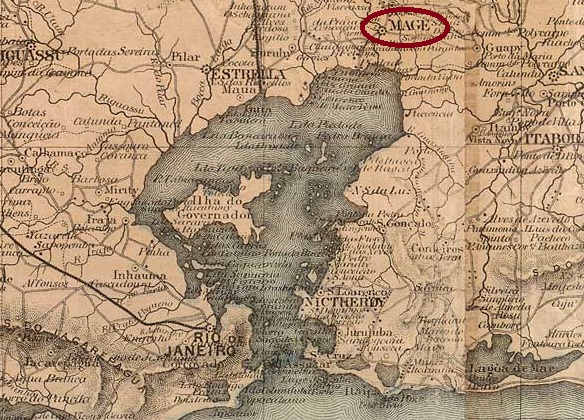
The settlement of Magepe existed since 1565 on the eastern bank of the Magé River, 60 kilometres north of the future capital Rio de Janeiro. In January 1696, it became the parish of Nossa Senhora da Piedade de Magé, which became a small town in June 1789 and a city in October 1857.
Nova Monteiro writes in ‘Administrações e Agencias Postaes do Brasil Imperio’ (Brasil Filatelico/RJ, 1934-5; reprinted by SPP 1994-1999) that there had been a post office there since December 1829. The oldest postmark is MRJ-0700a (illustration in the RHM catalogue):

This was followed by MRJ-0700b, which was given the number 1348 by Paulo Ayres in Catálogo de Carimbos Brasil-Império (S. Paulo, 1937, 1942):

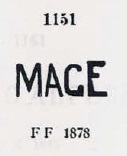
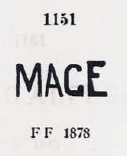
P. Ayres also showed the following cancel, MRJ-0700c, this time with number 1151:
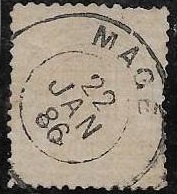
Then came the double circle MRJ-0700d (Fig. agenciaspostais.com.br):
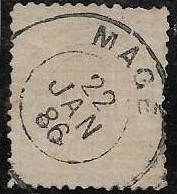
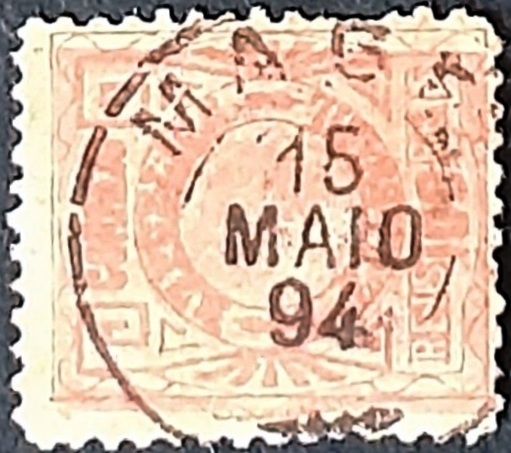
At the end of the Empire, MRJ-0700e (Fig. Luiz C. Fritzen) also appeared, which also exists in blue:

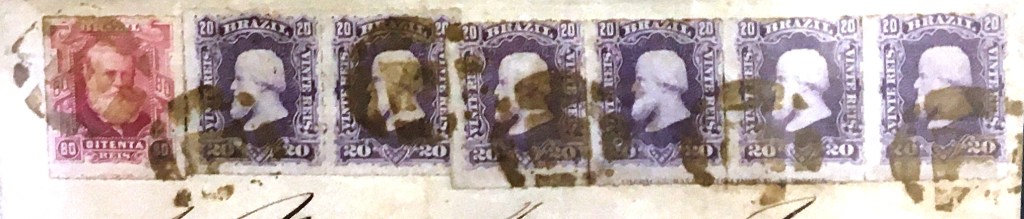
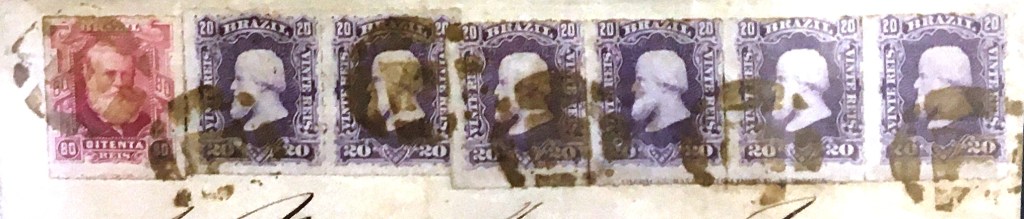
The collection of Jacques R. Benchimol also presents a mute postmark that was used in 1882:
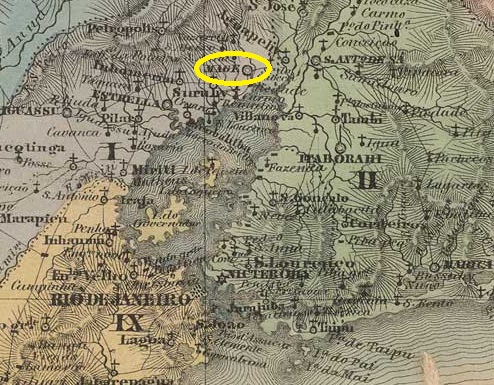
Die Siedlung Magepe bestand seit 1565 am Ostufer des Magé, 60 Kilometer nördlich der späteren Hauptstadt Rio de Janeiro. Im Januar 1696 wurde sie zur Freguesia de Nossa Senhora da Piedade de Magé, die im Juni 1789 zur Vila und diese im Oktober 1857 zur Stadt wurde.
Nova Monteiro schreibt in ‘Administrações e Agencias Postaes do Brasil Imperio’ (Brasil Filatelico/RJ, 1934-5; reprint SPP 1994-1999), dass es dort seit Dezember 1829 ein Postamt gab. Der älteste Poststempel ist MRJ-0700a (Abb. RHM-Katalog):

Es folgte MRJ-0700b , der von Paulo Ayres im Catálogo de Carimbos Brasil-Império (S. Paulo, 1937, 1942) die Nr. 1348 erhielt:

P. Ayres zeigte ebenfalls den Folgestempel MRJ-0700c, diesmal mit Nr. 1151:
Danach kam der Doppelkreis MRJ-0700d (Abb. agenciaspostais.com.br):
Gegen Ende des Kaiserreichs erschien auch MRJ-0700e (Abb. Luiz C. Fritzen), der auch in Blau vorkommt:
Aus der Sammlung von Jacques R. Benchimol stammt auch ein stummer Poststempel, der 1882 verwendet wurde:

 Carimbologia