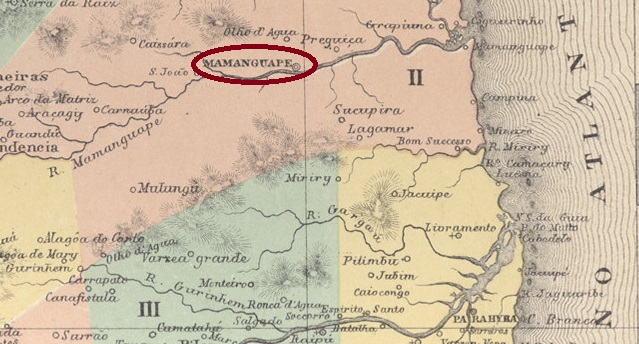
This settlement was an Indian village conquered in the 16th century on the north bank of the Mamanguape River, 50 kilometres northwest of what would later become the provincial capital of Parahyba do Norte (now João Pessoa). It probably became the Freguesia de S. Pedro e S. Paulo de Mamanguape in the early 19th century, which became a vila in January 1839 and a city in October 1855. The indigenous name from the Potiguar language means ‘at the drinking water source’.
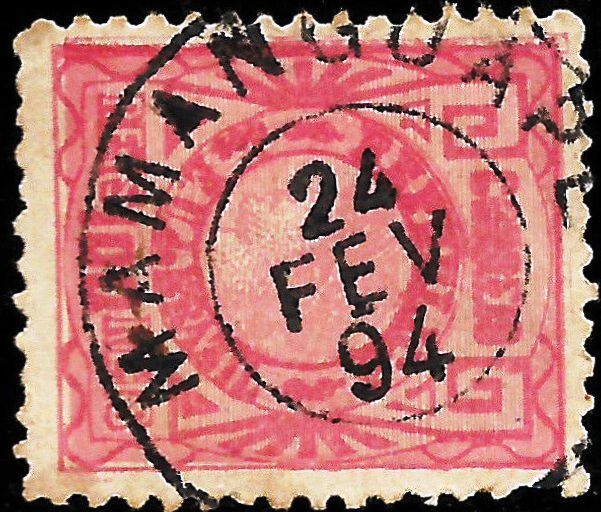
Nova Monteiro writes in Administrações e Agencias Postaes do Brasil Imperio (Brasil Filatelico/RJ, 1934-5; reprinted by SPP 1994-1999) that there had been a post office there since May 1829. The only postmark from the 19th century to date is MPB-0150b (image from the Internet):
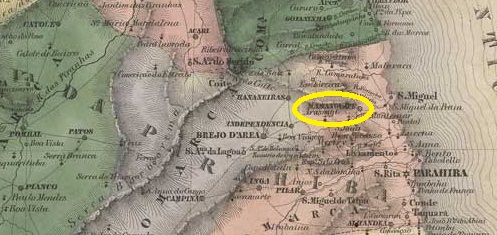
Diese Ortschaft war ein im 16. Jahrhundert erobertes Indianerdorf am Nordufer des Mamanguape, 50 Kilometer nordwestlich der späteren Provinzhauptstadt Parahyba do Norte (heute João Pessoa). Vermutlich wurde sie im frühen 19. Jahrhundert zur Freguesia de S. Pedro e S. Paulo de Mamanguape, die im Januar 1839 zur Vila und seit Oktober 1855 zur Stadt wurde. Der indigene Name aus der Potiguar-Sprache bedeutet „an der Trinkwasserstelle”.
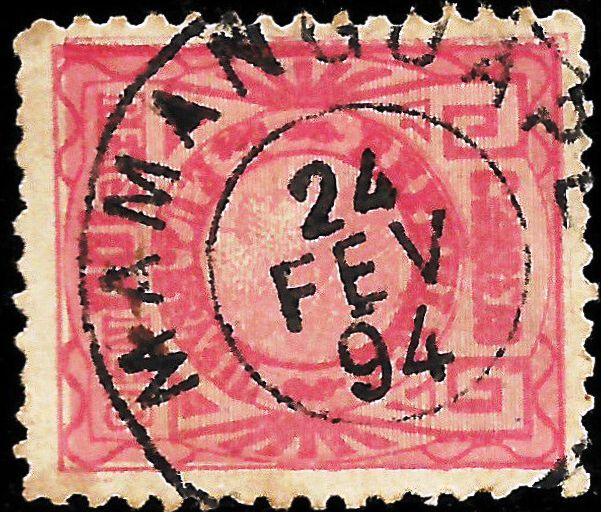
Nova Monteiro schreibt in Administrações e Agencias Postaes do Brasil Imperio (Brasil Filatelico/RJ, 1934-5; Reprint SPP 1994-1999), dass es dort seit Mai 1829 ein Postamt gab. Der bisher einzige Poststempel im 19. Jahrhundert ist MPB-0150b (Abb. aus dem Internet):

 Carimbologia