Other names: Nova Mazagão, Marzagão, Regeneração, Mazagão Velho (1915)
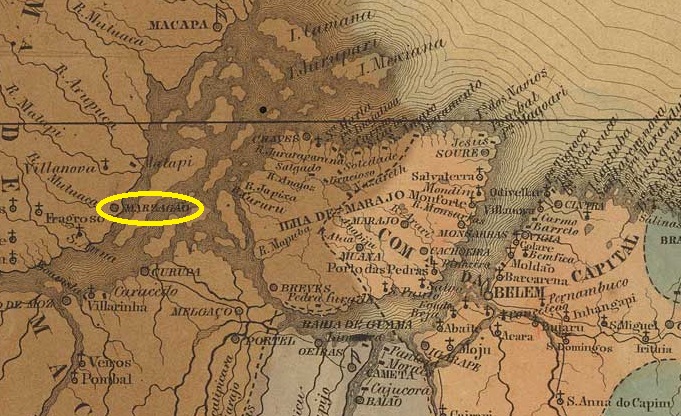
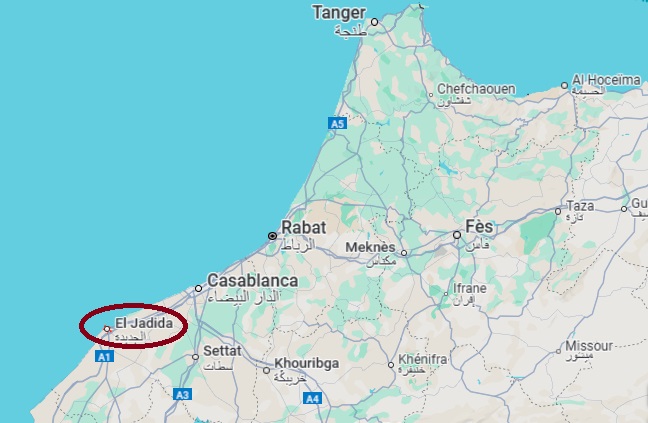
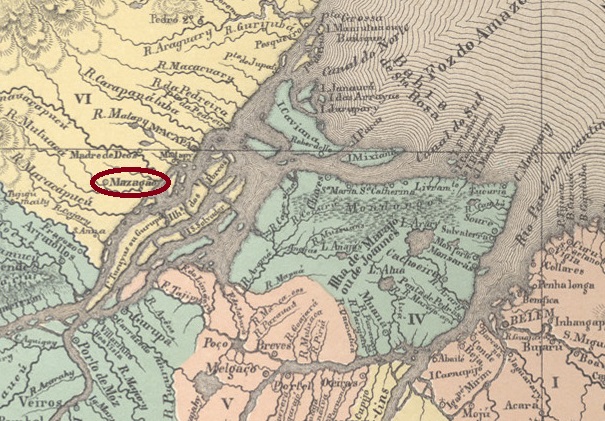
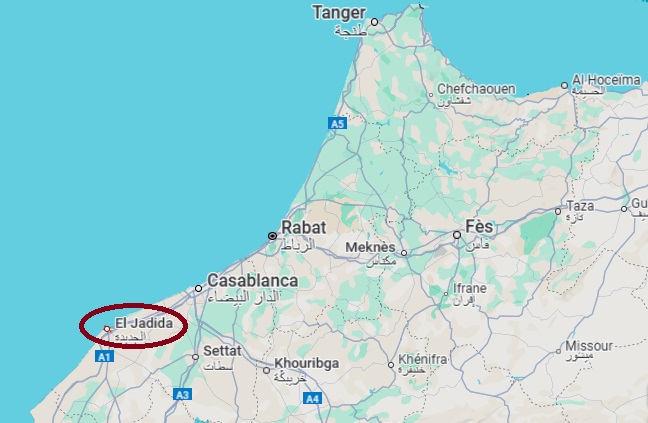
The history of this rather inconspicuous town in northern Brazil now spans four continents and three centuries. It began in 1770 with the founding of Vila de Nossa Senhora da Conceição de Nova Mazagão at the mouth of the Mutucá River (now Mazagão), just under 600 navigated kilometres northwest of the provincial capital Belém do Pará. This vila was intended to provide a new home for Portuguese immigrants from the original Mazagão in the Mauritania region on the north-western coast of Africa. The African Mazagão is now the Moroccan city of El Jadida.
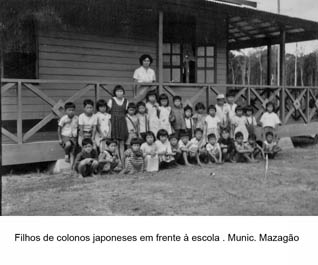
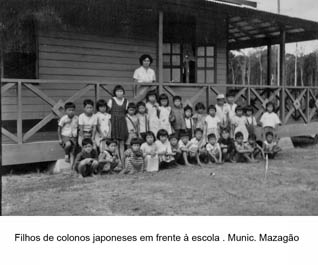
The young village developed into a melting pot of Portuguese, Indians, Jews, Arabs and black slaves on the edge of the Amazon delta. Economic development did not keep pace: Mazagão was downgraded to Freguesia de Regeneração in 1833 and subordinated to the Município de Macapá. In April 1841, it became a vila again and in April 1888 a town. In October 1915, it was downgraded once more, this time to a district called Mazagão Velho in the municipality of Mazaganópolis (formerly Vila Nova do Anauerapucu). As such, the locality was subordinated to Macapá again in November 1930, then back to Mazaganópolis as Mazagão Velho in March 1933, which from then on became the new Municipality of Mazagão. In September 1943, Amapá separated from the state of Pará and became a federal territory. In 1988, it finally became a federal state. From around 1950, Japanese immigrants also began to arrive there.
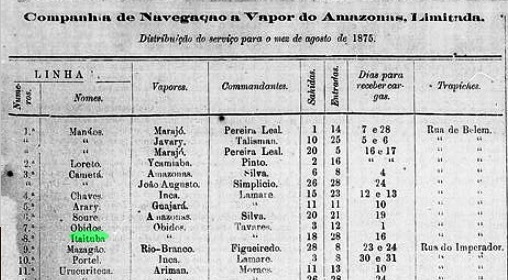
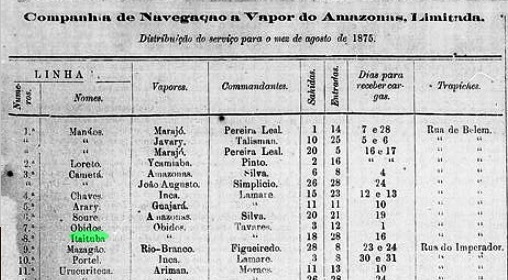
It is not known exactly when the local post office was opened. However, since there was already a regular shipping connection to the capital Belém do Pará in 1875, the conditions for postal traffic were met at that time.
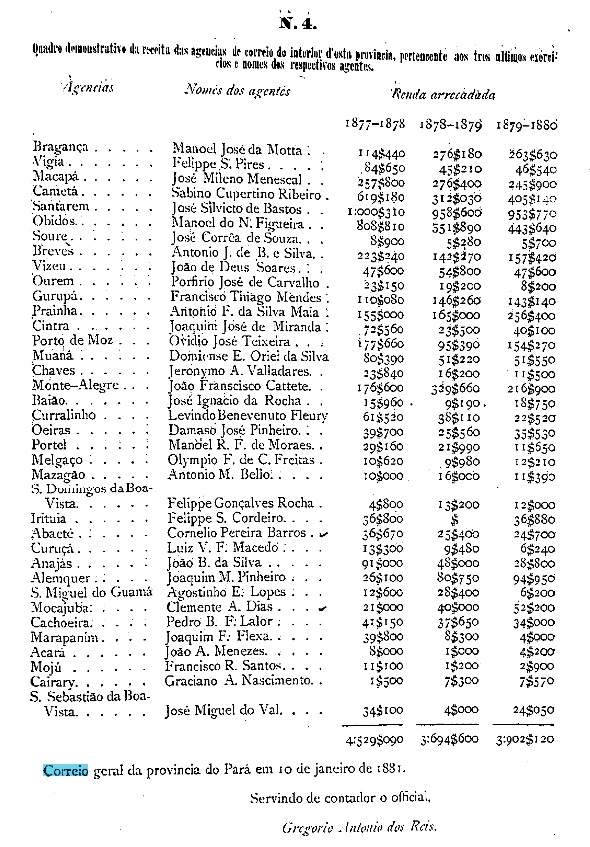
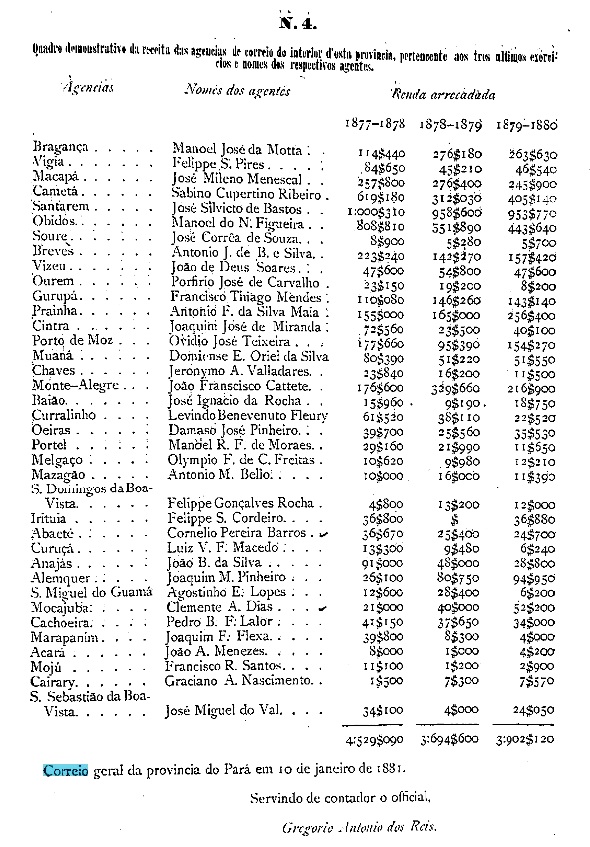
The Mazagão post office was certainly in operation in 1877, as can be seen from the provincial president’s report of February 1881.
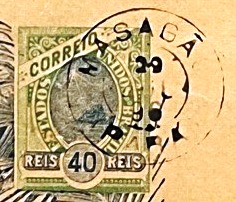
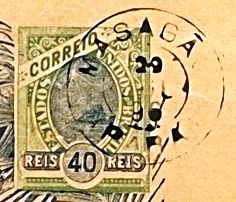
The only postmark from the 19th century to date is MPA-0155b (Fig. Felipe Piccinini):
Andere Namen: Nova Mazagão, Marzagão, Regeneração, Mazagão Velho (1915)
Die Geschichte dieser eher unscheinbaren Ortschaft im Norden Brasiliens umfasst inzwischen vier Kontinente und drei Jahrhunderte. Sie begann im Jahr 1770 mit der Gründung der Vila de Nossa Senhora da Conceição de Nova Mazagão an der Mündung des Flusses Mutucá (heute Mazagão), knapp 600 schiffbare Kilometer nordwestlich der Provinzhauptstadt Belém do Pará entfernt. Diese Vila sollte den portugiesischen Einwanderern aus dem ursprünglichen Mazagão im Gebiet Mauretanien an der Nordwestküste Afrikas eine neue Heimat bieten. Das afrikanische Mazagão ist heute die marokkanische Stadt El Jadida.
Die junge Vila entwickelte sich zu einem Schmelztiegel von Portugiesen, Indianern, Juden, Arabern und schwarzen Sklaven am Rande des Amazonasdeltas. Die wirtschaftliche Entwicklung hielt da nicht mit: Mazagão wurde 1833 als Freguesia de Regeneração herabgestuft und dem Município de Macapá untergeordnet. Im April 1841 wurde sie erneut zur Vila und im April 1888 zur Stadt. Im Oktober 1915 wurde sie dann erneut herabgestuft, diesmal zu einem Distrikt namens Mazagão Velho im Municipio Mazaganópolis (ehemals Vila Nova do Anauerapucu). Als solcher wechselte der Ort im November 1930 abermals zu Macapá, dann im März 1933 als Mazagão Velho zurück zu Mazaganópolis, der von nun an der neue Município de Mazagão wurde. Im September 1943 löste sich Amapá vom Bundesstaat Pará und wurde zu einem Bundesgebiet. 1988 wurde es schließlich zu einem Bundesstaat. Ab ca. 1950 kamen auch japanische Einwanderer dorthin.
Wann genau das örtliche Postamt eröffnet wurde, ist nicht bekannt. Da jedoch bereits 1875 eine reguläre Schiffsverbindung zur Hauptstadt Belém do Pará bestand, waren zu diesem Zeitpunkt die Voraussetzungen für den Postverkehr erfüllt.
Sicherlich war das Postamt Mazagão im Jahr 1877 in Betrieb, wie aus dem Bericht des Provinzpräsidenten vom Februar 1881 hervorgeht.
Der bisher einzige Poststempel im 19. Jahrhundert ist MPA-0155b (Abb. Felipe Piccinini):

 Carimbologia