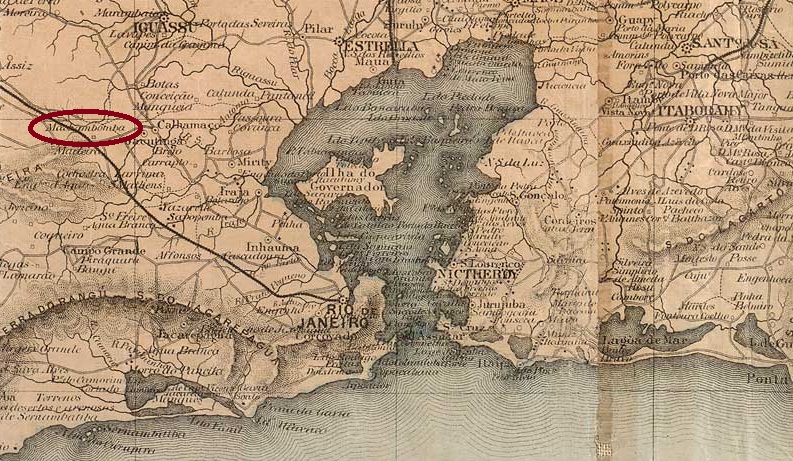
Other names: Nova Iguassu (1916)
In Brazil, a mechanical device for loading and unloading ships on steep banks is called a ‘Maxambomba’. Since the word is also used in Angola and Mozambique to refer to buses and slow vehicles, it can be assumed that it was already in use by the Portuguese during colonial times. In fact, it is often claimed that ‘Maxambomba’ comes from the English ‘machine pump’. Se non è vero, è ben trovato.
The Maxambomba railway station was opened in March 1858 by the E.F. D. Pedro II railway company (Main Line). It was in the município de Iguassu, 40 km northwest of the capital Rio de Janeiro. The railway line changed to E.F. Central do Brasil in 1889 and to Rede Ferroviária Federal S.A. in 1975; since 1997, it has been operated by the Supervias consortium (estacoesferroviarias.com.br).

The town became the seat of the Município de Iguassú in May 1891 and has been part of the Município de Nova Iguassú since November 1916.
According to Nova Monteiro, there has been a post office there since August 1865. He writes about this in Administrações e Agencias Postaes do Brasil Imperio (Brasil Filatelico/RJ, 1934–1935; reprinted by SPP 1994–1999). Paulo Novaes states on agenciaspostais.com.br that the agency was renamed Nova Iguassú in November 1916.
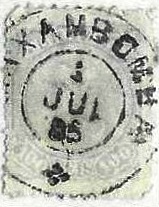
The oldest postmark here to date is MRJ-1815a, which was given the number 1359 by P. Ayres in Catálogo de Carimbos Brasil-Império (S. Paulo, 1937, 1942):

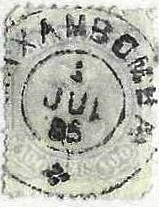
This was followed by the double circle MRJ-1815b (illustration from the Internet):
Philatelist Constatino Papazoglu also showed a mute cancellation from this railway station post office:

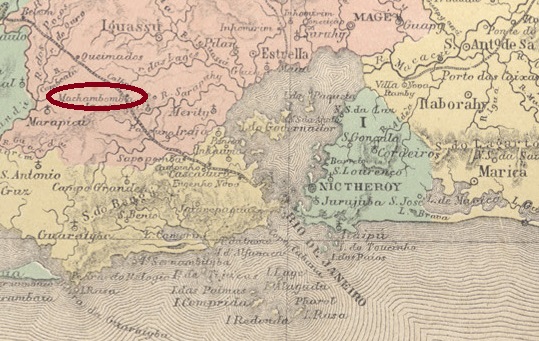
Andere Namen: Nova Iguassu (1916)
In Brasilien bezeichnet man eine mechanische Vorrichtung zum Be- und Entladen von Schiffen an steilen Ufern als „Maxambomba”. Da das Wort auch in Angola und Mosambik verwendet wird, um Busse und langsame Fahrzeuge zu bezeichnen, kann man davon ausgehen, dass es bereits in Kolonialzeiten von den Portugiesen gebraucht wurde. Tatsächlich wird oft behauptet, „Maxambomba” komme vom englischen „Machine Pump”. Se non è vero, è ben trovato.
Der Bahnhof Maxambomba wurde im März 1858 durch die Eisenbahngesellschaft E.F. D. Pedro II (Hauptlinie) eröffnet. Er lag im Município de Iguassu, 40 km nordwestlich der Hauptstadt Rio de Janeiro. Die Bahnlinie wechselte 1889 zur E.F. Central do Brasil und 1975 zur Rede Ferroviária Federal S.A.; seit 1997 wird sie vom Supervias-Konsortium betrieben (estacoesferroviarias.com.br).
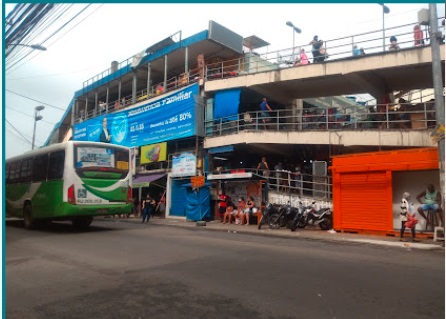
Der Ort wurde im Mai 1891 Hauptsitz des Município de Iguassú und liegt seit November 1916 im Município de Nova Iguassú.
Laut Nova Monteiro gab es dort seit August 1865 ein Postamt. Er schreibt darüber in Administrações e Agencias Postaes do Brasil Imperio (Brasil Filatelico/RJ, 1934–1935; Nachdruck SPP 1994–1999). Paulo Novaes gibt auf agenciaspostais.com.br an, dass die Agentur im November 1916 in Nova Iguassú umbenannt wurde.
Der bisher älteste Poststempel hier ist MRJ-1815a, der von P. Ayres in Catálogo de Carimbos Brasil-Império (S. Paulo, 1937, 1942) die Nr. 1359 erhielt:

Es folgte der Doppelkreis MRJ-1815b (Abb. aus dem Internet):
Der Philatelist Constatino Papazoglu zeigte auch eine stumme Entwertung aus diesem Bahnhofspostamt:


 Carimbologia