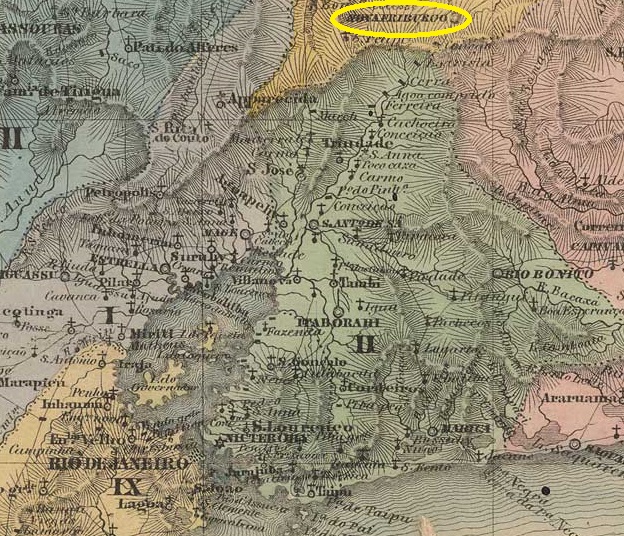
Other names: Morro Queimado
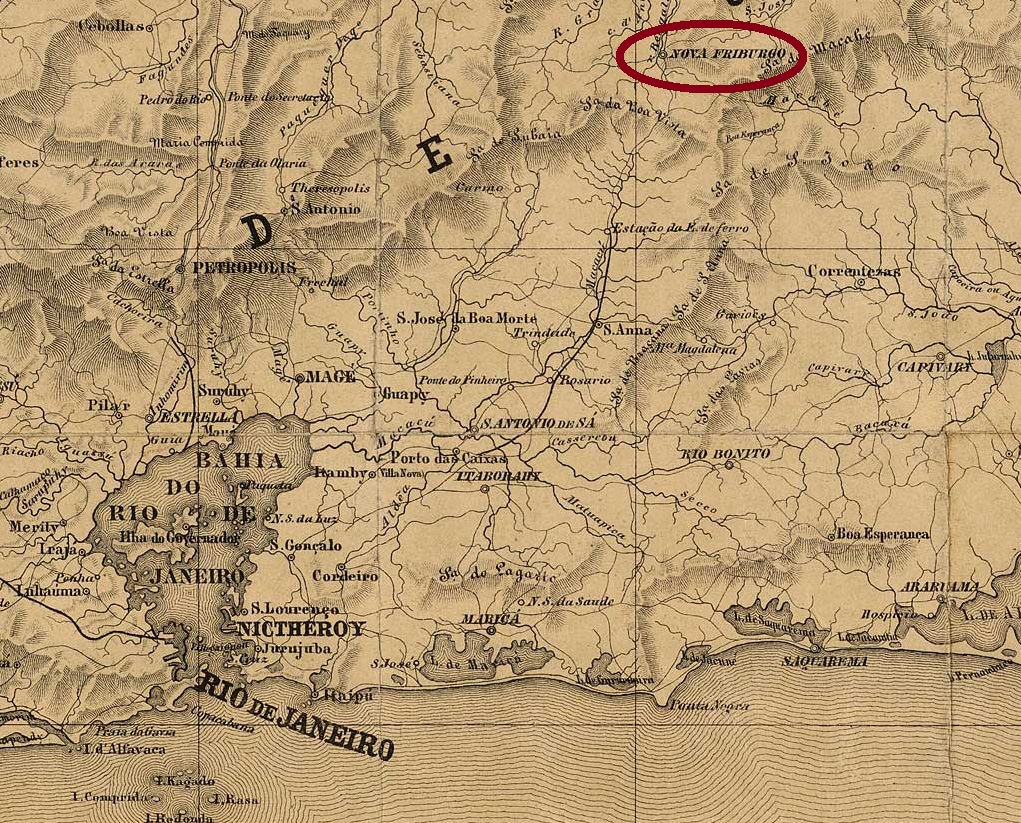
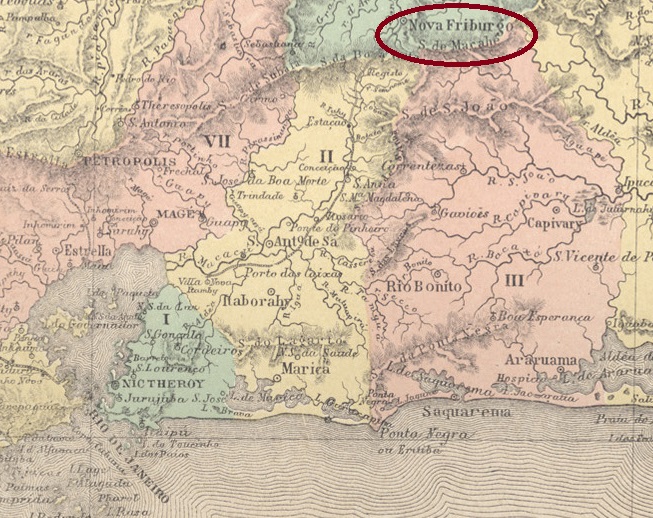
The settlement was originally called Morro Queimado (Burnt Mountain) and was located 140 kilometres northeast of the capital Rio de Janeiro. It still belonged to Vila de Cantagalo. In 1819, at the end of the colonial era, it became a colony to receive immigrants from the Swiss canton of Fribourg. In January 1820, it became a Vila and the following year, the Freguesia de São João Baptista de Nova Friburgo. Nova Friburgo has been a city since January 1890.
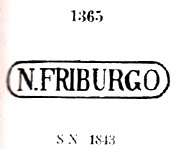
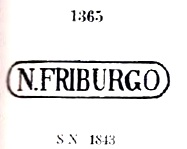
As Nova Monteiro writes in Administrações e Agencias Postaes do Brasil Imperio (Brasil Filatelico/RJ, 1934–1935; reprinted by SPP 1994–1999), there has been a post office there since January 1820. The oldest postmark to date is NRJ-0735a. This was given the number 1365 by Paulo Ayres (Catálogo de Carimbos Brasil-Império, São Paulo, 1937, 1942) and also appears in red and orange.

This was followed by the French type NRJ-0735b, also listed in P. Ayres (op. cit.).
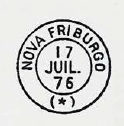
Then came NRJ-0735c. It also exists in blue and is also recorded in P. Ayres:
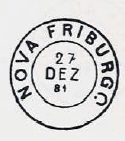
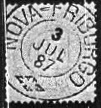
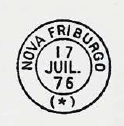
At the end of the Empire, two postmarks with double circles and similar ornaments at the bottom also appeared, starting with NRJ-0735d (illustration by R. Koester in Carimbologia XXVII).
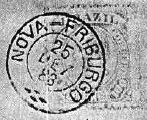
The image of the other postmark NRJ-0735e (which is also available in blue) also comes from Koester.
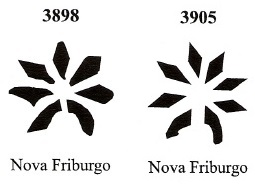
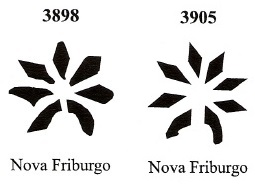
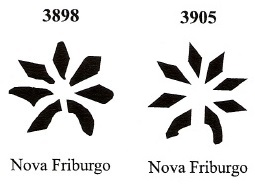
James Dingler and Klerman W. Lopes also presented two mute postmarks from Nova Friburgo in Mute Cancellations of the Brazil Empire / Carimbos Mudos do Brasil Império (Brazil Philatelic Association, Rio de Janeiro, 2000):
Outros nomes: Morro Queimado
O povoado se chamava originalmente Morro Queimado e ficava a 140 quilômetros a nordeste da capital Rio de Janeiro. Ainda pertencia à Vila de Cantagalo. Em 1819, no final do período colonial, tornou-se uma colônia destinada a receber imigrantes do cantão suíço de Friburgo. Em janeiro de 1820, tornou-se vila e, no ano seguinte, freguesia de São João Baptista de Nova Friburgo. Desde janeiro de 1890, Nova Friburgo é uma cidade.
Como escreve Nova Monteiro em Administrações e Agências Postais do Brasil Império (Brasil Filatélico/RJ, 1934-1935; reimpressão SPP 1994-1999), havia uma agência dos correios lá desde janeiro de 1820. O carimbo postal mais antigo até agora é o NRJ-0735a. Este recebeu o número 1365 em Paulo Ayres (Catálogo de Carimbos Brasil-Império, São Paulo, 1937, 1942) e também existe nas cores vermelho e laranja.
Seguiu-se o tipo francês NRJ-0735b, também listado em P. Ayres (op. cit.).
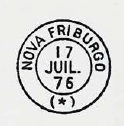
Depois veio o NRJ-0735c. Ele também existe em azul e está registrado em P. Ayres:
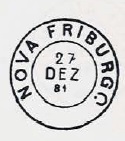
No final do Império, surgiram mais dois carimbos postais circulares, agora com ornamentos semelhantes na parte inferior, começando com o NRJ-0735d (ilustração em R. Koester em Carimbologia XXVII).
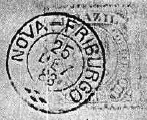
A imagem do outro carimbo NRJ-0735e (que também existe em azul) também é de Koester.
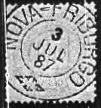
James Dingler e Klerman W. Lopes também apresentaram dois carimbos postais mudos de Nova Friburgo em Mute Cancellations of the Brazil Empire / Carimbos Mudos do Brasil Império (Clube Filatélico do Brasil, Rio de Janeiro, 2000):
Andere Namen: Morro Queimado
Die Siedlung hieß ursprünglich Morro Queimado (Verbrannter Berg) und lag 140 Kilometer nordöstlich der Hauptstadt Rio de Janeiro. Sie gehörte noch zur Vila de Cantagalo. 1819, am Ende der Kolonialzeit, wurde sie zu einer Kolonie, die Einwanderer aus dem schweizerischen Kanton Freiburg empfangen sollte. Im Januar 1820 wurde sie zur Vila und im folgenden Jahr zur Freguesia de São João Baptista de Nova Friburgo. Seit Januar 1890 ist Nova Friburgo eine Stadt.
Wie Nova Monteiro in Administrações e Agencias Postaes do Brasil Imperio (Brasil Filatelico/RJ, 1934–1935; Nachdruck SPP 1994–1999) schreibt, gab es dort seit Januar 1820 ein Postamt. Der bisher älteste Poststempel ist NRJ-0735a. Dieser erhielt bei Paulo Ayres (Catálogo de Carimbos Brasil-Império, São Paulo, 1937, 1942) die Nr. 1365 und kommt auch in den Farben Rot und Orange vor.
Es folgte der französische Typ NRJ-0735b, ebenfalls in P. Ayres (op. cit.) aufgeführt.
Danach kam NRJ-0735c. Es gibt ihn auch in Blau und er ist ebenfalls in P. Ayres erfasst:
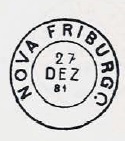
Am Ende des Kaiserreichs erschienen auch zwei Poststempel im Doppelkreis mit ähnlichen Ornamenten unten, beginnend mit NRJ-0735d (Abbildung bei R. Koester in Carimbologia XXVII).
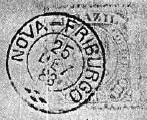
Auch das Bild des anderen Stempels NRJ-0735e (den es auch in Blau gibt) stammt von Koester.
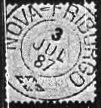
James Dingler und Klerman W. Lopes haben auch zwei stumme Poststempel aus Nova Friburgo in Mute Cancellations of the Brazil Empire / Carimbos Mudos do Brasil Império (Brazil Philatelic Association, Rio de Janeiro, 2000) vorgestellt:

 Carimbologia